


What happens if a lithium battery is not charged for a long time
What Happens If a Lithium Battery Is Not Charged for a Long Time? Full Guide for Home Energy Storage

Table of Contents
If you own a residential energy storage system, you may have asked: what happens if a lithium battery is not charged for a long time? This question is critical for every family using solar batteries, especially a high-performance LiFePO4 Battery or Wall-Mounted Lithium Ion Battery designed for stable Output Power for Home Use.
As a professional lithium-ion and sodium-ion battery factory based in Dongguan, China, with 10 years of R&D and manufacturing experience, we have helped thousands of global families install safe and long‑lasting home energy storage solutions. Today we launch our new 51.2V 100Ah‑5kWh wall-mounted energy storage battery, featuring Grade A LiFePO4 cells, over 8000 cycle life, intelligent BMS, and multiple safety protections. In this article, we explain in detail what happens if a lithium battery is not charged for a long time, share two real cases from American families, and teach you how to maintain your battery correctly.
What Happens If a Lithium Battery Is Not Charged for a Long Time? The Hidden Dangers

Many users think that if a battery is not in use, it can be placed anywhere and will not be damaged. In fact, all lithium batteries, including the stable LiFePO4 Battery, have a natural self-discharge rate. If left uncharged for weeks or months, a series of irreversible problems will occur.
1. Deep Discharge & Permanent Capacity Loss
When a battery is not charged for a long time, voltage continues to drop due to self-discharge and system standby power consumption. Once it falls below the safe cutoff voltage, the battery enters deep discharge. At this point, internal chemical structure is damaged, and capacity loss is permanent. Even if recharged later, it can never return to original performance.
For our 51.2V 100Ah 5kWh Wall-Mounted Lithium Ion Battery, the cutoff voltage is 40V. Long‑term non‑charging will drag voltage below this threshold, directly reducing Output Power for Home Use and shortening service life.
2. BMS Protection Lockout & Unable to Charge
Modern home energy storage batteries, including our new LiFePO4 Battery, are equipped with intelligent BMS (Battery Management System). When voltage is too low, BMS automatically locks the charging circuit to prevent safety hazards. Once locked, regular chargers cannot recognize or activate the battery, and it must be repaired or replaced by professionals.
3. Increased Internal Resistance & Poor Performance
Long‑term non‑charging causes electrolyte deterioration and thickened SEI film inside the battery. Internal resistance rises sharply, leading to slower charging, faster discharging, lower peak power, and unstable Output Power for Home Use. The battery heats up more easily during operation, further accelerating aging.
4. Safety Risks: Internal Short Circuit & Leakage
In severe cases, long‑term deep discharge causes lithium precipitation inside the battery, forming needle‑like lithium dendrites. These dendrites may pierce the diaphragm, causing internal short circuit, heat, bulging, or even liquid leakage. Although LiFePO4 Battery has higher thermal stability, it still cannot avoid damage from long‑term non‑charging.
5. Shortened Service Life & Early Scrap
Our Wall-Mounted Lithium Ion Battery is designed with a 10‑year service life and more than 8000 cycles at 80% DOD. Long‑term non‑charging can reduce life by 30%–60%, making a battery that should last 10 years fail in just 2–3 years.
Real Cases: What Happens If a Lithium Battery Is Not Charged for a Long Time (US Households)

To help you understand the actual impact, we share two real cases from American families who used home energy storage batteries.
Case 1: Texas Family – 6 Months Unattended Battery Scrap
A family in Texas, USA, installed a home energy storage system and traveled abroad for half a year. They did not set a maintenance charge or ask someone to manage the battery. When they returned, the LiFePO4 Battery was completely dead and could not be charged.
Test results showed:
- Battery voltage dropped to 36V, far below the 40V safe cutoff
- BMS was permanently locked
- Capacity loss exceeded 45%
- Output Power for Home Use decreased by more than half
The family had to replace the entire battery pack, costing over $1,200. The maintenance team told them: if they had charged the battery to 50%–60% before leaving and recharged every 2–3 months, this loss could have been completely avoided.
Case 2: California Family – Seasonal Use Leads to Performance Decline
A family in California, USA, uses a solar energy storage system only in summer. In autumn and winter, they turn off the system and leave the Wall-Mounted Lithium Ion Battery unused for 4–5 months without charging.
When they restarted the system the next summer, they found:
- Charging speed was 50% slower than before
- Actual discharge capacity decreased by about 28%
- Output Power for Home Use could not support high-power appliances
- Battery temperature was abnormally high during operation
After testing, the battery had not reached complete scrap, but internal resistance increased significantly, and cycle life was shortened. They spent nearly $400 on professional repair and balancing, but performance never fully recovered.
These two cases clearly answer: what happens if a lithium battery is not charged for a long time—it brings direct economic loss and reduces the reliability of home energy supply.
Our New Product: 51.2V 100Ah‑5kWh Wall-Mounted Lithium Ion Battery

As a 10‑year experienced battery manufacturer in Dongguan, China, we have launched a new Wall-Mounted Lithium Ion Battery dedicated to home energy storage:
- Energy: 5120Wh (5.12kWh)
- Cell type: Grade A LiFePO4 Battery
- Cycle life: ≥8000 cycles (80% DOD)
- Design life: 10 years
- Size: 636×395×187mm, wall‑mounted compact design
- Communication: RS485/CAN/232, support BT & Wi-Fi
- Certifications: UN38.3, CE, MSDS, ISO, ROHS
- Protection: over‑charge, over‑discharge, over‑current, over‑heat, short‑circuit, voltage balance
This battery provides stable and reliable Output Power for Home Use, supports global delivery, and accepts OEM & ODM services. It is an ideal choice for American home solar energy storage systems.
How to Maintain LiFePO4 Battery to Avoid Damage from Long‑Term Non‑Charging
To prevent the problems mentioned above, follow these simple maintenance rules for your LiFePO4 Battery and Wall-Mounted Lithium Ion Battery:
-
Store at 50%–60% chargeBefore long‑term storage, charge the battery to 50%–60%. This is the most stable state for lithium batteries, with the lowest self-discharge rate.
-
Recharge every 2–3 monthsEven if not in use, recharge to 50%–60% every 2–3 months to prevent voltage from dropping too low.
-
Store in a suitable environmentKeep the battery in a dry, ventilated environment at −20°C to 60°C, humidity 10%–85%. Avoid high temperature, direct sunlight, and damp conditions.
-
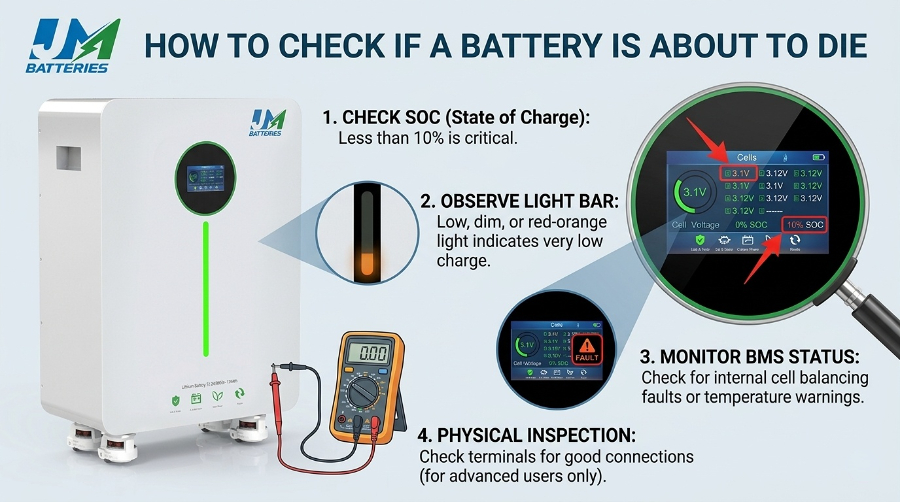
Use intelligent BMS for real-time monitoringOur new battery supports intelligent monitoring. Use Bluetooth or Wi-Fi to check voltage, capacity, and temperature at any time to avoid over‑discharge.
-
Do not completely drain the battery before storageAvoid leaving the battery at 0%–20% for long periods. This is the most harmful state for LiFePO4 Battery.
Conclusion
To answer clearly: what happens if a lithium battery is not charged for a long time—it causes deep discharge, permanent capacity loss, BMS lockout, increased internal resistance, safety risks, and shortened service life. For families using Wall-Mounted Lithium Ion Battery and LiFePO4 Battery for Output Power for Home Use, proper maintenance is crucial to protect your investment and ensure stable power supply.
As a professional battery factory in Dongguan, China, with 10 years of experience, we are committed to providing safe, efficient, and long‑lasting home energy storage solutions. Our new 51.2V 100Ah‑5kWh LiFePO4 Battery will bring more reliable energy support to your family.
If you want to know more about home energy storage battery maintenance or product parameters, please feel free to contact us.
Recommended Product

Contact us for pricing and technical support:
//www.jmenergytech.com/What Is A Lifepo4 Battery
How To Put The Battery