


How Long Does a 15kWh Battery Last?
How Long Does a 15kWh Battery Last? Complete Runtime Guide for US Homes

The deployment of residential energy storage systems has undergone a rapid paradigm shift, evolving from a niche component of off-grid living into a foundational element of modern grid-interactive and backup power architectures. Within this rapidly expanding landscape, the 15-kilowatt-hour (kWh) lithium-ion battery has emerged as a dominant standard block for residential storage topologies. This specific capacity tier represents an optimal intersection of energy density, physical footprint, modular scalability, and economic value. A 15kWh reserve provides sufficient storage to navigate peak time-of-use (TOU) rates, enables significant self-consumption of generated solar power, and offers substantial autonomy during localized grid failures. However, the operational runtime of a 15kWh battery is not a static variable; it is a highly dynamic output governed by depth of discharge limits, inverter conversion efficiencies, load profiles, ambient thermal conditions, and long-term electrochemical degradation.
Determining exactly how many hours a 15kWh battery will last requires an exhaustive examination of the systemic variables that bridge the gap between theoretical chemical energy and usable alternating current (AC) electricity. By evaluating the interactions between household load topologies, the electrochemical realities of Lithium Iron Phosphate (LiFePO4) architecture, and the precise specifications of tier-1 market offerings, this report provides a definitive and exhaustive assessment of how long a 15kWh battery will sustain power under highly diverse real-world conditions.
15kWh Battery Runtime Calculation: Usable Capacity Fundamentals
To calculate the runtime of a 15kWh battery, it is necessary to first distinguish between nominal nameplate capacity and actual usable energy. A battery rated at 15kWh theoretically holds 15,000 watt-hours of direct current (DC) energy. However, extracting this energy to power standard household appliances involves multiple stages of systemic loss, chemical resistance, and engineered safety buffers.
Depth of Discharge (DoD) Limits for 15kWh Batteries
Lithium-ion chemistries, particularly the widely adopted Lithium Iron Phosphate (LiFePO4 or LFP), are highly resilient to deep cycling compared to legacy lead-acid systems, which typically limit discharge to 50%. Nevertheless, frequently discharging a lithium battery to an absolute zero percent state of charge (SOC) accelerates the physical strain on electrode layers during ion movement and promotes the breakdown of active materials within the cells4. To maximize the operational lifespan and guarantee thousands of cycles, manufacturers universally implement a Depth of Discharge (DoD) limit via the integrated Battery Management System (BMS).
While LFP chemistry is theoretically tolerant to 100% DoD in extreme scenarios, the industry standard restricts regular daily cycling to an 80% to 95% DoD4. This software-enforced cap retains a 5% to 20% capacity buffer, averting severe low-voltage states that could permanently damage internal cell architecture and void long-term warranties4. Consequently, a 15kWh nominal battery typically yields an initial DC usable capacity of 12.0 kWh (at 80% DoD) to 14.25 kWh (at 95% DoD)8. Setting discharge caps at 80% is widely considered the optimal standard, as retaining a 20% buffer eases pressure on electrode layers and extends the functional years of the unit well beyond standard expectations4.
Inverter Efficiency & Parasitic Loads Impact
Because household appliances require alternating current (AC) power, the stored DC energy must pass through an inverter. The inversion process is governed by semiconductor switching losses, transformer losses, and thermal dissipation, meaning no inverter operates at 100% efficiency. High-quality hybrid inverters paired with modern LFP batteries typically exhibit round-trip efficiencies (RTE) ranging from 90% to 98%. For every 1,000 watts of DC power pulled from the battery cells, only 900 to 950 watts of AC power is actually delivered to the electrical panel.
Furthermore, the BMS itself, alongside external communication modules (such as RS485 or CAN bus interfaces) and active thermal management components, acts as a continuous parasitic load that marginally drains the battery over time For example, modern batteries equipped with internal heating elements to survive freezing temperatures can draw up to 224 watts just to maintain optimal internal cell temperatures.
15kWh Battery Runtime Formula & Baseline Yields
The effective runtime of a battery under a specific electrical load can be modeled using a deterministic formula that accounts for nominal capacity, safety limits, and systemic inefficiencies. By multiplying the total nominal capacity by the DoD percentage and the inverter efficiency percentage, analysts can derive the true usable AC energy.
Applying this calculation across varying system configurations yields three distinct tiers of usable AC energy from a standard 15kWh battery:
| Configuration Scenario | Depth of Discharge (DoD) | Inverter Efficiency | Usable AC Energy Yield |
|---|---|---|---|
| Conservative Scenario | 80% | 90% | 10.80 kWh |
| Standard Scenario | 90% | 92% | 12.42 kWh |
| Optimistic Scenario | 95% | 95% | 13.54 kWh |

For rigorous planning regarding power outages, off-grid autonomy, or daily solar cycling, the standard usable capacity of 12.42 kWh serves as the most accurate baseline for a mid-tier residential installation. This figure acknowledges that a 15kWh battery never delivers 15,000 watt-hours to the end user under real-world conditions.
Appliance Power Consumption: 15kWh Battery Load Profiles & Hours
The primary variable dictating the lifespan of a 15kWh charge is the immediate electrical demand, or "load," placed upon the system by the household. To conceptualize runtime, it is necessary to audit the power consumption of individual appliances and aggregate them into load profiles.
Appliances fall into two categories: continuous loads and cycling loads. Continuous loads, such as lighting, televisions, and computers, draw a steady amount of wattage while powered on. Cycling loads, such as refrigerators, air conditioners, and well pumps, require a massive surge of power to start their internal motors (surge watts) and then settle into a lower running wattage, turning on and off periodically throughout the day to maintain a set temperature or pressure8.
Based on ENERGY STAR certified appliance data , the following table details the typical power draws of common household appliances, which directly subtract from the battery's available capacity pool:
| Household Appliance | Typical Power Draw (Watts) | Estimated Daily Energy (Wh) |
|---|---|---|
| Mobile Phone Charging | 10–15 W | 30 Wh |
| Wi-Fi Router | 20–40 W | 480–960 Wh |
| LED Television (50-inch) | 50–400 W (avg 100 W) | 500 Wh |
| Laptop Computer | 50–100 W | 400 Wh |
| Energy-Efficient Refrigerator | 150–300 W (cycling) | 1,600 Wh |
| Desktop Computer | 200–400 W | 1,200 Wh |
| Washing Machine (Cold Wash) | 500–1,000 W | 1,000 Wh |
| Microwave Oven | 600–1,500 W | 240 Wh (short duration) |
| Well Pump (1/3 to 1 HP) | 750–1,500 W | Varies |
| Dishwasher | 1,200–2,400 W | 1,500 Wh |
| Room / Window Air Conditioner | 500–2,000 W | 9,600 Wh |
| Electric Oven / Stove | 2,000–5,000 W | Varies |
| Central Air Conditioning System | 2,000–5,000 W | 15,000+ Wh |
| Electric Clothes Dryer | 1,800–5,000 W | 5,000+ Wh |
| Level 2 EV Charger | 7,200 W | Varies widely |
By aggregating these appliances, household energy use can be segmented into distinct operational load profiles, dictating exactly how many hours a 15kWh battery will last.
Essential Loads: 0.1-0.8kW Runtime for 15kWh Batteries
Essential loads encompass the baseline appliances required to maintain security, communications, and food preservation. This typically includes the refrigerator, the Wi-Fi router, LED lighting across the home, and periodic mobile device charging8. When managing power meticulously during a prolonged grid failure, maintaining an average continuous draw of 0.3 kW (300 Watts) allows a standard 15kWh battery (providing 12.42 kWh usable) to provide autonomy for upwards of 41.4 hours12.
If extreme rationing is applied—reducing the draw to an ultra-low standby state of 100 Watts by deactivating all non-critical circuits—the system can theoretically operate for 124.2 hours, equivalent to over five days of survival-mode operation. For a basic essential load profile averaging between 0.8 kW and 1.5 kW, a 15kWh battery comfortably provides 12 to 24 hours of support, especially as the refrigerator cycles on and off.
Medium Daily Loads: 1.0-2.0kW Usage Scenarios
A medium load profile introduces comfort and convenience appliances. In addition to essential refrigeration and lighting, this profile accommodates the concurrent use of desktop computers, large LED televisions, ceiling fans, and brief operations of high-draw kitchen appliances like microwaves or coffee makers8.
At a continuous draw of 1.0 kW, representing a highly active household operating without HVAC systems, a 15kWh battery delivers approximately 12.4 hours of runtime. Should the load increase to 2.0 kW—perhaps due to the activation of a 1,500W space heater or a room-sized air conditioning unit—the operational timeline compresses rapidly to 6.2 hours8.
Heavy Whole-Home Loads: 3.0-6.0kW Runtime
Whole-home backup involves the operation of high-draw, 240-volt appliances. The integration of central air conditioning systems, electric clothes dryers, electric ovens, water heaters, and well pumps drastically alters the energy mathematics.
Running a central AC unit alongside basic house loads generally demands a continuous 3.0 kW to 4.0 kW of power. Under a steady 3.0 kW load, a 15kWh battery is depleted in merely 4.1 hours. If a household attempts to operate multiple high-draw appliances simultaneously—approaching an extreme 6.0 kW continuous draw—the battery will be exhausted in just 2.1 hours.
15kWh Battery Runtime Projection Matrix
The following table synthesizes the expected operational runtime of a 15kWh battery across various continuous load conditions, utilizing the conservative (10.8 kWh), standard (12.42 kWh), and optimistic (13.54 kWh) usable capacity models established by the systemic efficiency parameters.
| Load Profile Topology | Continuous Draw (kW) | Conservative Runtime (10.8 kWh) | Standard Runtime (12.42 kWh) | Optimistic Runtime (13.54 kWh) |
|---|---|---|---|---|
| Ultra-low standby | 0.1 kW | 108.0 hrs | 124.2 hrs | 135.4 hrs |
| Essential backup | 0.3 kW | 36.0 hrs | 41.4 hrs | 45.1 hrs |
| Comfort backup | 0.5 kW | 21.6 hrs | 24.8 hrs | 27.1 hrs |
| Moderate daily active | 1.0 kW | 10.8 hrs | 12.4 hrs | 13.5 hrs |
| High daily active | 1.5 kW | 7.2 hrs | 8.3 hrs | 9.0 hrs |
| High continuous (Room AC) | 2.0 kW | 5.4 hrs | 6.2 hrs | 6.8 hrs |
| Whole-home (Central AC/Heat) | 3.0 kW | 3.6 hrs | 4.1 hrs | 4.5 hrs |
| Heavy continuous | 5.0 kW | 2.2 hrs | 2.5 hrs | 2.7 hrs |
| Extreme heavy continuous | 6.0 kW | 1.8 hrs | 2.1 hrs | 2.3 hrs |

This granular data underscores a vital principle in residential energy storage system sizing: a single 15kWh battery is highly effective for overnight multi-appliance use or multi-day essential load use, but it cannot sustain unrestrained whole-home consumption without being actively replenished by solar photovoltaics (PV) or a secondary generator.
US Home Energy Use: Geographic & Housing Size Impact on Battery Life
While micro-level appliance calculations provide theoretical bounds, real-world runtime is heavily dictated by macroeconomic consumption patterns, housing sizes, and geographic climate zones. In the United States, the average residential electricity customer consumed approximately 10,791 kWh of electricity annually in 2022, equating to roughly 899 kWh per month, or about 30 kWh per day. A single-family home typically utilizes 15 to 40 kW of power capacity, with an average continuous consumption of 1 to 2 kW at any given moment.
Home Square Footage vs 15kWh Battery Capacity
The square footage of a dwelling is the largest single factor determining thermal energy requirements (heating and cooling), which in turn dictate battery runtime. The average U.S. home size is approximately 1,818 square feet, consuming 0.49 kWh per square foot per month.
- A 1,000 sq ft apartment averages 410 to 490 kWh per month, making a 15kWh battery highly effective for complete multi-day autonomy.
- A 2,000 sq ft house averages 980 kWh per month (approx. 40 to 50 kWh daily), meaning a 15kWh battery covers roughly one-third of the daily need.
- A 3,000 sq ft house averages 1,470 kWh per month (approx. 50 to 70 kWh daily), rendering a single 15kWh battery strictly an essential-loads backup device.
US State-by-State Electricity Usage: Climate Impact
Location profoundly impacts power consumption due to regional heating and cooling demands. According to EIA 2022 residential electricity consumption data , regional usage varies by over 200% across states:
| Selected US State | Monthly Electricity Usage (kWh) | National Ranking | Implied Daily Usage (kWh) |
|---|---|---|---|
| Louisiana | 1,232 kWh | 1st (Highest) | 41.0 kWh |
| Tennessee | 1,185 kWh | 2nd | 39.5 kWh |
| Texas | 1,120 kWh | 10th | 37.3 kWh |
| New York | 576 kWh | 49th | 19.2 kWh |
| California | 540 kWh | 52nd (Lowest) | 18.0 kWh |

In states like Louisiana and Texas, where heavy reliance on central air conditioning drives daily usage near 40 kWh, a 15kWh battery will last fewer hours, necessitating either aggressive load shedding during outages or the installation of multiple battery units. Conversely, in California—where mild climates naturally suppress total load, yet exorbitant electricity rates (34.31 cents/kWh) drive the financial necessity of battery storage—a home consuming only 18 kWh daily finds a 15kWh battery almost perfectly sized to cover its entire overnight load footprint.
15kWh LFP Battery Technology: Chemistry, C-Rates & Thermal Performance
To fully comprehend the runtime and longevity of these systems, it is necessary to examine the physical electrochemistry governing them. By the mid-2020s, Lithium Iron Phosphate (LiFePO4 or LFP) definitively supplanted Nickel Manganese Cobalt (NMC) and Lithium Cobalt Oxide (LCO) as the dominant chemistry for stationary residential storage. While NMC offers higher volumetric energy density—making it the preferred choice for electric vehicles where weight and space are strictly constrained—LFP offers superior thermal stability, a vastly longer cycle life, and a dramatically lower risk of thermal runaway, making it the safer choice for home installations. Independent NREL battery safety studies have confirmed LFP's superior thermal stability compared to NMC chemistries. Furthermore, LFP is cobalt-free, mitigating ethical supply chain concerns and reducing environmental impact.
51.2V 300Ah LFP Cell Architecture
A typical 15kWh LFP battery is engineered using a 16-series (16S) cell configuration. Because individual LFP cells possess a nominal voltage of 3.2V, stringing 16 cells in series results in a nominal pack voltage of 51.2V DC5. To achieve the 15kWh capacity without utilizing thousands of small cylindrical cells, manufacturers deploy massive prismatic cells.
For example, integrating 300 Amp-hour (Ah) Grade A prismatic cells in a 16S1P (16 series, 1 parallel) architecture yields precisely 15.36 kWh of raw storage:
Other configurations, such as those relying on 280Ah cells, yield a nominal 14.3 kWh capacity:
High-voltage stacked battery systems are also prevalent, utilizing smaller 104Ah cells strung in massive series combinations (e.g., up to 128S) to achieve nominal voltages ranging from 153.6V to 409.6V, which can improve inverter efficiency by matching the voltage closer to the domestic AC grid24.
Regardless of the exact fractional variance, low-voltage systems (48V to 51.2V) provide exceptionally steady power output across repeated charge and discharge phases, reducing chemical wear inside the cells and preserving uniform voltage delivery even as the state of charge drops after a decade of use4.
C-Rate Discharge Effects on 15kWh Battery Life
The rate at which a battery is discharged is expressed as its C-rate. A 1C rate means the entire capacity is discharged in one hour. For a 15kWh battery, drawing 15kW of power represents a 1C discharge. Most 15kWh LFP systems are rated for optimal discharging at 0.5C (approximately 7.5kW) or lower, such as 0.2C (3kW)5.
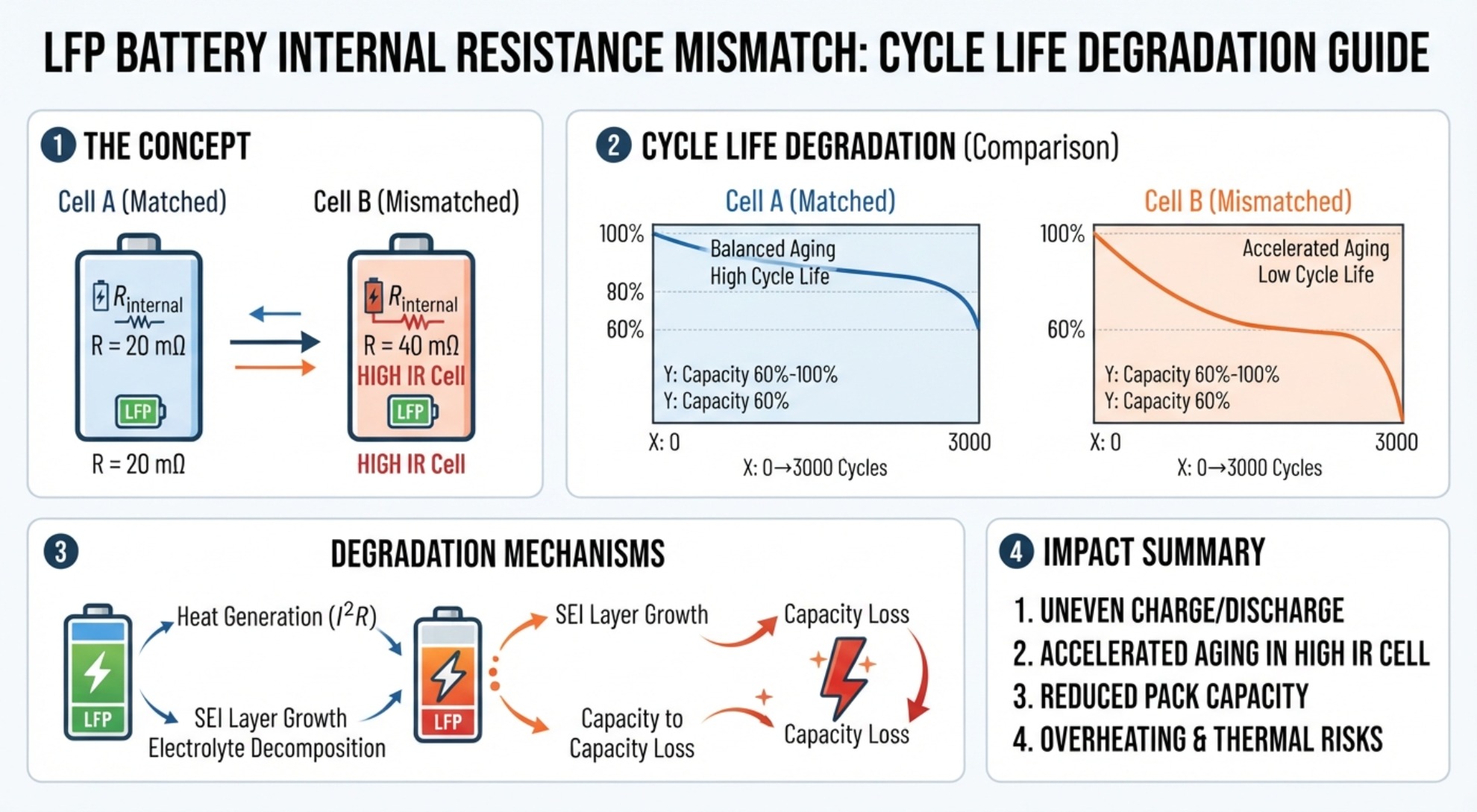
Discharging the battery at high C-rates (e.g., attempting to run a 10kW load continuously) generates significantly more internal heat due to internal resistance (I²R losses). The Peukert Effect, though far less pronounced in lithium-ion than in legacy lead-acid batteries, dictates that highly aggressive discharges slightly reduce the total deliverable capacity. High C-rate discharges induce voltage sag, which can cause the BMS to prematurely hit the low-voltage cutoff threshold, effectively stranding accessible energy and shortening runtime below theoretical expectations. Therefore, matching the load to the recommended continuous discharge current—typically between 50A and 140A for a 51.2V system—maximizes both the efficiency of the electrochemical reaction and the hourly runtime delivered to the home.
High Temperature Impact on Battery Capacity Fade
Runtime calculations are not immune to the laws of thermodynamics. Ambient environmental conditions exert profound influences on both the immediate daily performance and the long-term calendar life of a 15kWh lithium battery.
LFP batteries operate optimally in a controlled ambient temperature range of 15°C to 30°C (59°F to 86°F)27. At elevated temperatures, the internal electrochemical kinetics are highly accelerated. While this temporarily lowers internal resistance and can yield a slight boost in immediate capacity output, chronic exposure to heat induces parasitic side reactions at the anode and cathode interfaces.
Operating a battery continuously in environments above 35°C (95°F) drastically accelerates Solid Electrolyte Interphase (SEI) layer growth and lithium inventory loss. Experimental data indicates a severe correlation between operating temperature, depth of discharge, and total cycle life:
| Ambient Temperature | Depth of Discharge (DoD) | Estimated Cycle Life |
|---|---|---|
| 25°C (77°F) | 80% | ~5,000 - 6,000 cycles |
| 25°C (77°F) | 100% | ~3,500 - 4,000 cycles |
| 45°C (113°F) | 80% | ~3,500 cycles |
| 45°C (113°F) | 100% | ~2,000 cycles |
Exposure to extreme heat of 80°C or above triggers rapid internal chemical changes leading to permanent capacity reductions4. Consequently, mounting a 15kWh battery on a southern-facing exterior wall without shade in a hot climate will inevitably truncate both its daily runtime and its multi-year service life.
Cold Weather Performance & Heating Loads
Conversely, low temperatures heavily constrain lithium-ion mobility. At temperatures approaching 0°C (32°F), the increased viscosity of the electrolyte and the slower diffusion of lithium ions into the graphite anode severely inhibit charge acceptance, raising the risk of destructive lithium plating if charged aggressively. Cold temperatures also temporarily reduce the accessible discharge capacity, meaning a 15kWh battery may behave mathematically like a 12kWh battery during a severe winter freeze.
To mitigate this, premium modern battery systems, such as the EG4 All-Weather series, integrate self-heating pads10. These internal heating elements activate when internal temperatures drop to 0°C (32°F) and disengage once optimal temperatures are reached. However, these heaters consume power—drawing up to 224 Watts10. This introduces a significant parasitic load; if a winter grid outage occurs, the battery expends a portion of its own capacity merely to keep itself warm, directly cannibalizing the hours of runtime available to power the household.
Solar PV Integration: Maximizing 15kWh Battery Runtime with Panels
Analyzing battery runtime exclusively from a fully charged state without replenishment provides an incomplete picture of energy resilience. In modern hybrid systems, the 15kWh battery works symbiotically with the home's solar photovoltaic (PV) array.
During a grid outage, the presence of a solar array transforms the 15kWh battery from a static reserve into a dynamic buffer8. As the sun rises, the solar panels prioritize providing instantaneous power to the household loads. Any surplus power generation is then routed to charge the battery. Calculating the recharge time requires evaluating the solar array's output against the battery's capacity. Assuming a solar array utilizes high-efficiency 410W panels operating under 5 hours of peak sunlight per day, a single panel generates 2,050 Wh (2.05 kWh) daily. To fully recharge a depleted 15,000 Wh (15 kWh) battery, the system requires approximately 7.3 to 8 solar panels dedicated entirely to charging.
If a home requires a continuous 1.5 kW load, a 15kWh battery alone would deplete in approximately 8.3 hours. However, if an 8 kW solar array generates 5 kW of power during midday hours, 1.5 kW satisfies the house load directly, and the remaining 3.5 kW rapidly recharges the battery. Because the average overnight essential load (from sunset to sunrise) rarely exceeds 5 to 8 kWh, a 15kWh battery is perfectly sized to cycle through the night and reach the morning sun with a comfortable 30% to 50% state of charge remaining8. Through this daily cycle of daytime PV replenishment and nighttime battery discharge, a 15kWh system can provide infinite runtime, barring extreme multi-day severe weather events.
AC-Coupled vs DC-Coupled System Efficiency

The architectural methodology used to connect the 15kWh battery to the solar array impacts overall efficiency and resulting runtime.
- DC-Coupled: The solar panels and the battery share a single hybrid inverter. The DC generated by the PV array flows directly into the battery without needing to be converted to AC. This avoids multiple inversion penalties, frequently achieving round-trip efficiencies of 96% to 98%.
- AC-Coupled: Systems like the Tesla Powerwall 3, FranklinWH aPower, and Enphase IQ series utilize a battery with its own internal inverter, which sits parallel to an existing solar inverter. The solar PV generates DC, the solar inverter converts it to AC, and any excess AC power must be inverted back to DC by the battery for storage. When discharging, it is inverted back to AC. This multiple-inversion process drops round-trip efficiency to roughly 89% to 90.5%. An AC-coupled 15kWh battery will naturally yield slightly fewer hours of usable AC autonomy than a DC-coupled equivalent due to these cumulative conversion penalties.
Top 15kWh Home Battery Systems 2026: US Market Comparison
To contextualize theoretical models, it is essential to analyze the flagship 15kWh residential battery systems available in the 2026 market. Based on 2026 EnergySage market analysis , the competitive landscape features a dichotomy between highly integrated premium AC-coupled appliances.The competitive landscape features a dichotomy between highly integrated, premium AC-coupled appliances and flexible, high-value DC-coupled LFP server-rack arrays.
FranklinWH aPower 2 15kWh Battery Review
The FranklinWH aPower 2 has solidified its position as a premium integrated solution, offering exactly 15 kWh of usable capacity. Designed primarily as an AC-coupled unit, its most notable specification is a continuous output power of 10 kW, with an impressive 15 kW peak surge for 10 seconds19. This high peak power enables it to absorb the massive inrush currents required to start heavy-duty appliances, such as a 5-ton central air conditioning unit, without tripping the system19. The aPower series utilizes fan-less convection cooling for silent 30 dB(A) operation and can be scaled up to 15 units (225 kWh) per aGate controller. For installations requiring DC-coupling, FranklinWH offers the aPower S, which integrates the 15kWh battery with an 11.5 kW inverter featuring four independent MPPTs for direct solar connection.
EG4 WallMount All Weather 15kWh Battery
Occupying the high-value, DC-coupled segment, the EG4 WallMount All-Weather battery provides 14.3 kWh of storage utilizing 280Ah LFP cells at 51.2V Built for extreme environments, it features an IP65-rated enclosure, dual fire arrestors, an emergency stop function, and internal self-heating systems23. Crucially, the EG4 unit features a massive 200A maximum continuous discharge rating (yielding up to 10.24 kW of continuous power for 30 minutes, or 140A/7.1kW continuously without time limits) It supports more than 8,000 cycles at 80% DoD and pairs effortlessly with top hybrid inverter brands like Sol-Ark, Victron, and Growatt.
DeLong & RUiXU High-Capacity 15kWh Options
Several manufacturers, including DeLong Top Energy, Avepower, and RUiXU, utilize massive 300Ah to 314Ah Grade A prismatic cells (often manufactured by CALB) to construct precise 15.36 kWh blocks. DeLong's 15.36 kWh unit operates at 51.2V and allows a recommended discharge current of 100A and a maximum of 200A. These units typically claim lifespans exceeding 6,500 cycles and feature exceptionally low internal resistance20. They are heavily utilized for custom, scalable DC-coupled solar applications, providing superior value-per-kWh compared to integrated monolithic brand names.
15kWh Battery Cost Comparison US 2026
The broader market includes standard bearers like the Tesla Powerwall 3 (13.5 kWh, $998/kWh installed), which dominates with a 63.3% market share due to its sleek integration and brand recognition, despite offering slightly less capacity than the 15kWh standard. Enphase offers modularity with the IQ Battery 5P (5 kWh per unit), allowing users to stack three units to reach 15kWh, though at a higher premium cost ($1,057–$1,963/kWh installed). MidNite Solar's Powerflo 16 offers a massive 16 kWh capacity at an aggressive $338/kWh hardware price, making it a highly attractive option for capacity-focused buyers.
| Manufacturer & Model | Rated Capacity | Chemistry | Continuous Output | Coupling | Installed Cost Est. ($/kWh) |
|---|---|---|---|---|---|
| FranklinWH aPower 2 | 15.0 kWh | LFP | 10.0 kW (15kW Peak) | AC | $1,177 |
| EG4 WallMount All Weather | 14.3 kWh | LFP | 7.1 kW (10.2kW Peak) | DC | $986 |
| DeLong Top Energy | 15.36 kWh | LFP | 5.1 kW (10.2kW Peak) | DC | Variable |
| Tesla Powerwall 3 | 13.5 kWh | LFP | 11.5 kW | AC/DC | $998 |
| Enphase IQ 5P (x3) | 15.0 kWh | LFP | 11.5 kW | AC | $1,510 |
15kWh Battery Lifespan: Degradation, Warranties & Financial ROI
When analyzing how many hours a 15kWh battery will last, a temporal dimension must be introduced: the battery's age. The service life of a LiFePO4 battery is bifurcated into two parallel aging mechanisms: cycle life (physical wear from charging and discharging) and calendar life (passive degradation of the chemistry over time).
Lithium battery degradation does not manifest as sudden total failure; it is a gradual, predictable loss of total deliverable capacity. End of Life (EOL) in the energy storage industry is conventionally defined as the point when a battery retains only 60% to 70% of its initial capacity5. If a premium 15kWh battery promises 70% capacity retention at the end of a 15-year warranty period, its nominal capacity will have slowly reduced from 15kWh to 10.5kWh34. Subjecting this aged battery to the standard inverter efficiencies, the actual usable AC energy drops to roughly 8.7 kWh. Therefore, a household running a consistent 1.0 kW load will experience 12.4 hours of runtime in the first year of operation, but only 8.7 hours of runtime by the fifteenth year.
Battery Degradation Over 15-Year Lifespan

When analyzing how many hours a 15kWh battery will last, a temporal dimension must be introduced: the battery's age. The service life of a LiFePO4 battery is bifurcated into two parallel aging mechanisms: cycle life (physical wear from charging and discharging) and calendar life (passive degradation of the chemistry over time).
Lithium battery degradation does not manifest as sudden total failure; it is a gradual, predictable loss of total deliverable capacity. End of Life (EOL) in the energy storage industry is conventionally defined as the point when a battery retains only 60% to 70% of its initial capacity. If a premium 15kWh battery promises 70% capacity retention at the end of a 15-year warranty period, its nominal capacity will have slowly reduced from 15kWh to 10.5kWh. Subjecting this aged battery to the standard inverter efficiencies, the actual usable AC energy drops to roughly 8.7 kWh. Therefore, a household running a consistent 1.0 kW load will experience 12.4 hours of runtime in the first year of operation, but only 8.7 hours of runtime by the fifteenth year.
Warranty Throughput Limits Explained
To protect against extreme daily cycling, manufacturers link warranties to energy throughput—the cumulative total of energy discharged from the battery to the home over its lifetime35. The FranklinWH aPower 2 distinguishes itself with a rigorous 15-year warranty covering 60 Megawatt-hours (MWh) of aggregate energy throughput.
Discharging 60 MWh equates to 60,000 kWh. If a home discharges a full 10 kWh daily (an aggressive daily cycle), the battery handles 3,650 kWh annually. At this rate, it would require over 16.4 years to breach the 60 MWh cap, meaning the throughput limit comfortably outlasts the 15-year chronological warranty. Similarly, the EG4 WallMount guarantees up to 82.6 MWh in lifetime energy production over its 10-year design life, catering to off-grid users who cycle the battery heavily multiple times a day.
TOU Arbitrage & Virtual Power Plant Benefits
Beyond emergency backup, the primary function of a 15kWh battery in 2026 is active financial optimization. With utility frameworks increasingly shifting toward sophisticated Time-of-Use (TOU) tariffs that heavily penalize grid reliance during evening peak hours, batteries are tasked with intense daily cycling8. If a utility enforces peak pricing between 4:00 PM and 9:00 PM, a home drawing an average of 2.5 kW during this five-hour window requires 12.5 kWh of energy8. The usable yield of a 15kWh battery flawlessly covers this exact window, allowing the household to bypass expensive grid energy entirely, discharging the battery to its minimum safe DoD limit just as off-peak rates resume.
Furthermore, grid-interactive software allows decentralized 15kWh batteries to participate in Virtual Power Plants (VPPs). Utilities offer financial incentives to homeowners who permit their batteries to discharge into the broader grid during macroscopic grid strain. The robust 6,000 to 8,000 cycle life of LFP chemistry, combined with high-throughput warranties, empowers homeowners to monetize their battery assets aggressively without fear of accelerating failure. The battery's lifespan is no longer purely a measure of emergency readiness; it is a continuously amortizing financial asset.
Conclusion: 15kWh Battery Runtime Summary for Residential Use
The operational runtime of a 15kWh lithium battery cannot be reduced to a singular, static hour count. It is a highly variable outcome dictated by the interaction of household load magnitudes, inverter efficiencies, thermal environments, and the inevitable realities of electrochemical aging.
When operating at baseline efficiencies and standard depths of discharge, a 15kWh battery yields an approximate 12.4 kWh of immediately usable AC energy. How long this lasts ranges drastically from over 124 hours of ultra-low standby survival power to fewer than three hours when tasked with powering unrestrained central HVAC systems and high-resistance thermal appliances.
Supported by the unparalleled safety and stability of Lithium Iron Phosphate (LFP) chemistry, these systems effectively guarantee 6,000 to 8,000 cycles over a 10-to-15-year operational calendar life. While capacity fade will gradually compress the available runtime by up to 30% toward the end of a warranty cycle, the integration of intelligent energy management, dedicated solar PV replenishment, and smart load circuitry ensures that a 15kWh module remains the gold standard for residential energy storage. Whether deployed for multi-day emergency resilience against extreme weather or aggressive daily financial arbitrage against peak utility rates, the 15kWh battery provides a precisely calculated, highly dependable foundation for modern household energy independence.
What Can a 15kWh Battery Power?
Why the Next Generation Redefines Home Storage Measurement