


LiFePO4 Home Energy Storage Guide 2026
LiFePO4 Home Energy Storage Guide 2026: Practical Buyer’s Breakdown
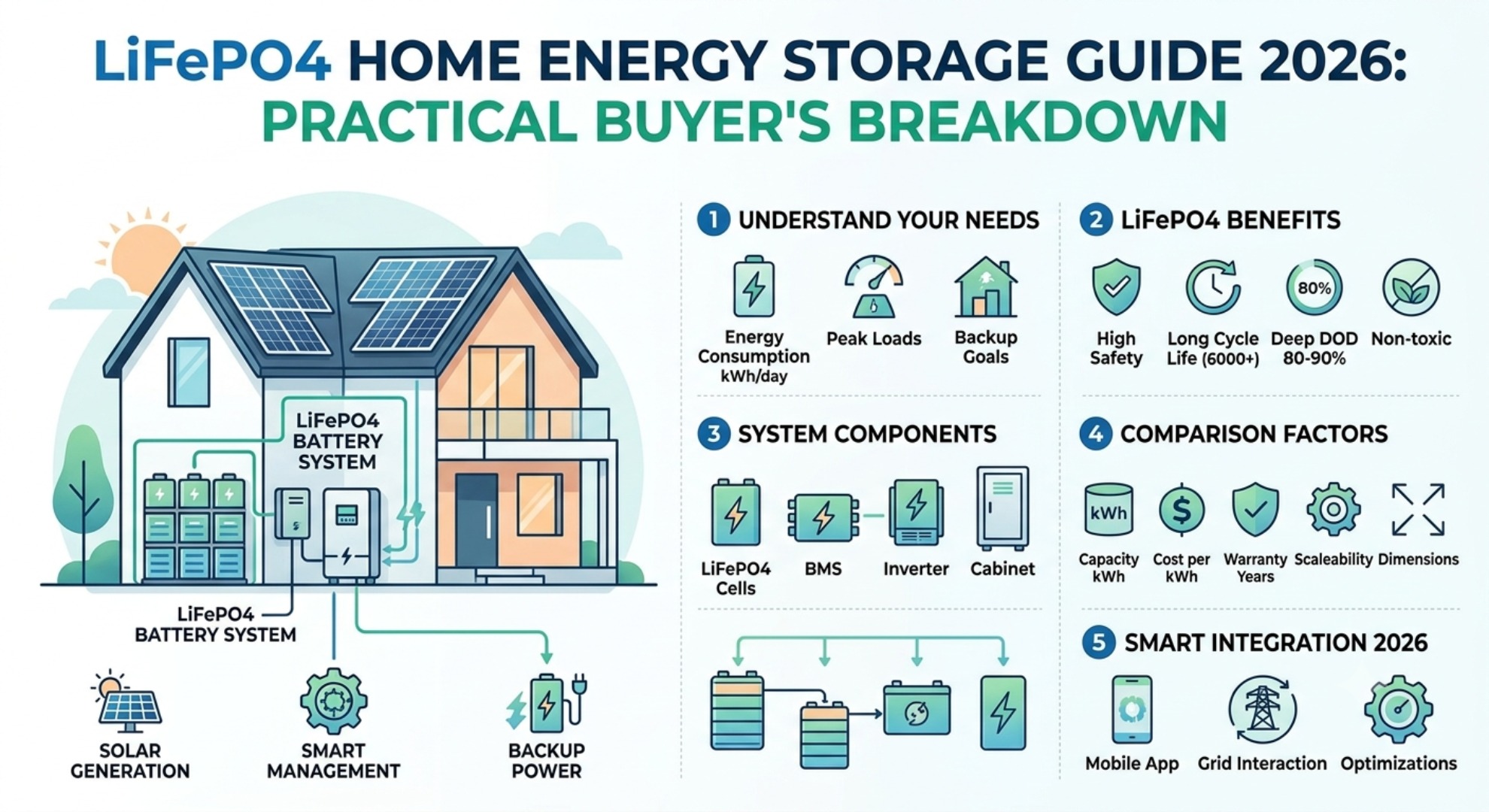
Table of Contents
- 1. The Four Main Battery Types For Home Solar Storage
- 2. LFP vs NMC: Real-World Performance For Households
- 3. Cycle Life: Why LFP Lasts Far Longer For Daily Solar Use
- 4. Usable Capacity & Efficiency: LFP Gets More Power From Your Solar Panels
- 5. Thermal Safety: Why LFP Is The Low-Risk Option For Indoor Home Installs
- 6. Full Side-by-Side Comparison Of All Four Storage Chemistries
- 7. How To Pick The Right LFP Battery For Your Home’s Energy Needs
The Four Main Battery Types For Home Solar Storage
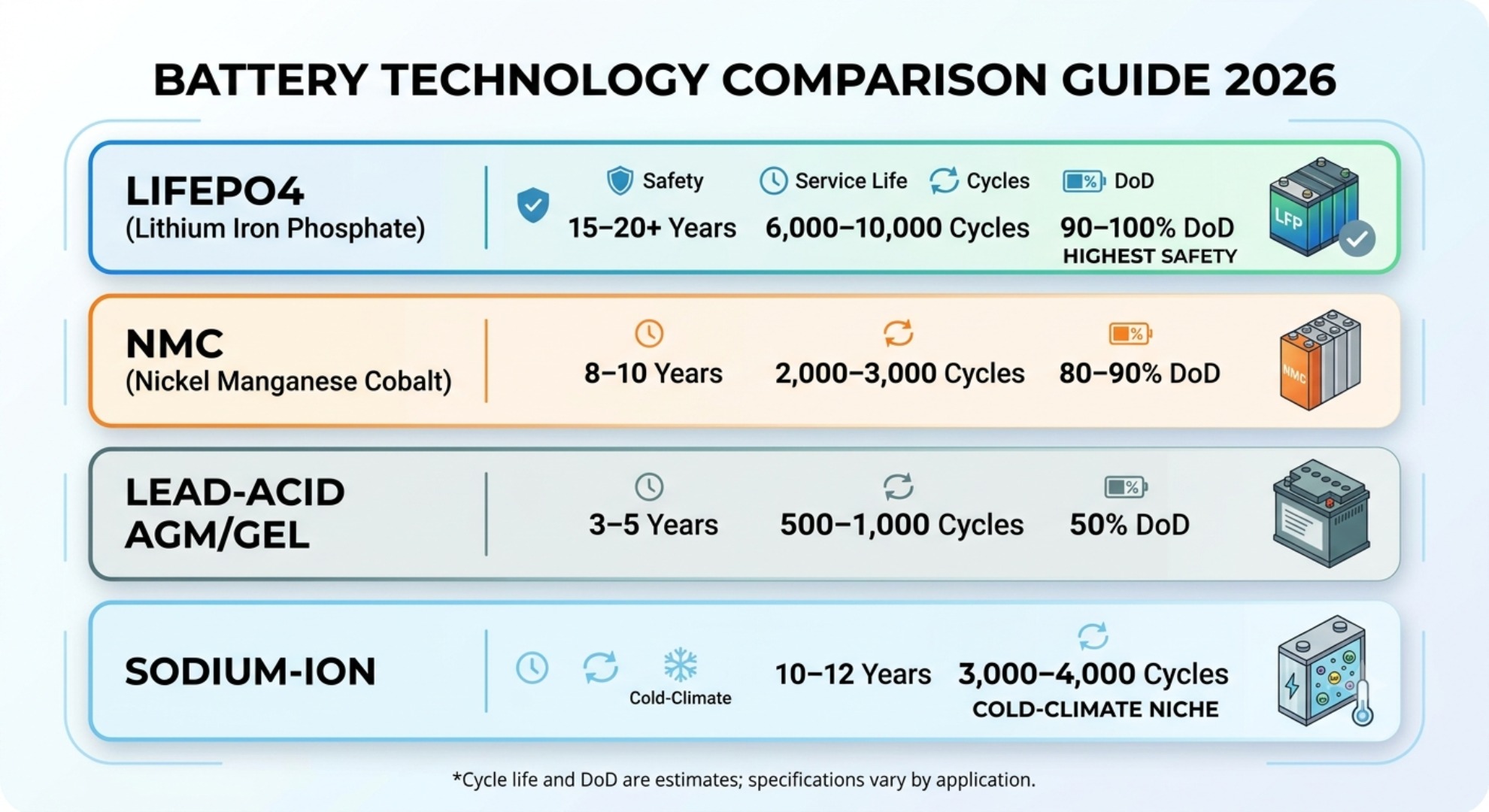
When you start researching home battery storage, you’ll quickly see four common chemistries sold to residential solar customers. As power rates keep climbing and grid blackouts grow more frequent, most homeowners want a setup that’ll run reliably for years without constant maintenance or early replacement costs. From years of installing solar storage systems, I’ve found LiFePO4 (LFP) works best for nearly every standard household.
Each battery style carries clear tradeoffs, and none other than LFP balance long life, safety and running costs for daily charging and discharging. Let’s break down what each one brings to the table, and where each makes sense to use.
Lithium Iron Phosphate (LiFePO4 / LFP) – Go-To For Most Home Solar Setups
LFP makes up over 90% of new residential storage installs across the globe in 2026, and there’s good reason for that. It cuts out expensive, heat-sensitive cobalt and nickel, relying on widely available iron and phosphate materials instead. The cell structure stays stable even after thousands of daily charge cycles, so capacity fade happens very slowly over time.
It’s a touch heavier than compact NMC lithium cells, but home batteries sit on floors or wall mounts permanently. Weight barely matters when you’re prioritizing decades of safe, consistent performance inside living spaces.
Nickel Manganese Cobalt (NMC) – Only Useful For Tiny Indoor Spaces
NMC found its footing in electric vehicles thanks to its high energy density, which lets manufacturers pack lots of power into smaller frames. That compact size is its only real upside for home storage.
The downsides show fast in residential use: NMC cells break down faster in warm room temperatures, you can’t drain them fully without speeding up wear, and thermal risks are far higher than LFP. I only suggest NMC if your wall space is extremely limited, and you can keep the room climate controlled year-round. Even then, you’ll need to budget for a battery replacement much sooner.
Lead-Acid Batteries (AGM & Gel) – Cheap Upfront, Poor Long-Term Value
AGM lead-acid batteries used to be the default budget pick for off-grid cabins decades ago. They cost less to buy upfront, but that’s where the benefits end.
You can only safely discharge them to half their total capacity, they need regular checks and maintenance, and most units stop working well after just 3 to 5 years. If you plan to cycle a battery daily with solar power, lead-acid will rack up replacement fees that easily outpace any initial savings.
Sodium-Ion Batteries – Cold-Climate Backup Only
Sodium-ion storage is a newer cobalt-free option hitting the market, and it handles freezing outdoor temperatures better than most lithium packs. Raw material costs are low too, but the technology hasn’t matured enough for daily heavy solar cycling.
Cycle counts lag well behind LFP, and usable capacity is capped lower. It’s fine as a secondary backup power source for remote cold locations, but it won’t replace LFP for households aiming to cut grid reliance every single day.
LFP vs NMC: Real-World Performance For Households

If you’re set on lithium storage, your two main choices are LFP and NMC. When we run through every metric that impacts daily home use, LFP holds a clear edge for stationary solar systems. Installers and battery brands have shifted almost entirely to LFP for standard residential builds because of these consistent performance gaps.
| METRIC | LFP (LiFePO4) – Standard Home Storage Pick | NMC – Compact Niche Option |
|---|---|---|
| Cycle Life | 6,000–10,000 full cycles, 15–20 years of daily use | 2,000–3,000 cycles, service life limited to 8–10 years |
| Round-Trip Efficiency | 95%–96%, minimal energy lost during conversion | 90%–92%, more of your solar power gets wasted each day |
| Thermal Breakdown Threshold | ~500°C, huge safety buffer against overheating | ~210°C, high risk of thermal runaway under heavy load |
| Daily Usable DoD | Up to 100% full discharge without cell damage | 80%–90% hard limit to slow premature degradation |
Cycle Life: Why LFP Lasts Far Longer For Daily Solar Use

Cycle life tells you how many full charge-discharge loops a battery can handle before its usable capacity drops to 80% of original output. This single number makes the biggest difference to your total long-term spending on solar storage.
Top-tier LFP units hit 6,000 up to 10,000 complete cycles. If you charge and drain your battery once a day, that translates to 15 to 20 years of steady solar self-consumption with barely noticeable power loss. NMC tops out at 3,000 cycles max, so most homeowners will need a full battery swap halfway through their solar panel’s service life. Lead-acid and sodium-ion don’t come close to matching that daily cycling durability for residential solar setups.
Usable Capacity & Efficiency: LFP Gets More Power From Your Solar Panels
Most homeowners install storage to make full use of their rooftop solar generation, and LFP’s depth of discharge rating lets you tap every kilowatt-hour you capture each midday.
Its stable chemical makeup lets you drain the battery to 100% every evening without speeding up wear. NMC systems lock you out of 10–20% of their total capacity to avoid early failure, so you pay for power you can never actually use day-to-day. Pair that with LFP’s 95–96% round-trip efficiency, and less sunlight gets lost during DC to AC power conversion. No other battery chemistry matches this consistent efficiency for daily household cycling.
Thermal Safety: Why LFP Is The Low-Risk Option For Indoor Home Installs

Safety inside living areas can’t be overlooked when picking a battery that’ll run 24/7 in your house. LFP’s thermal stability makes it the least risky lithium option for indoor wall or garage mounting.
The cathode material only starts breaking down at roughly 500°C, creating plenty of protection against overcharging, short circuits, or sustained high room temperatures. NMC cells start decomposing at just 210°C, releasing oxygen that fuels fires if cooling fails or you run heavy loads for hours. Lead-acid risks toxic gas venting, and while sodium-ion holds decent stability, it still can’t match LFP’s fire-resistant chemistry for year-round indoor residential placement. For any family installing storage close to living spaces, LFP is the sensible low-hazard choice.
Full Side-by-Side Comparison Of All Four Storage Chemistries
This matrix stacks all four common battery types against each other on every key metric homeowners care about. It’s easy to see LFP hits all the main boxes for standard solar storage: long working life, full usable capacity, strong fire safety, and the lowest total running cost over decades.
| Specification Metric | LFP (Lithium Iron Phosphate) – Best All-Round For Home Storage | NMC (Nickel Manganese Cobalt) | Lead-Acid (AGM / Gel) | Sodium-Ion (Na-Ion) |
|---|---|---|---|---|
| Expected Lifespan | 15–20+ Years | 8–10 Years | 3–5 Years | 10–12 Years |
| Cycle Durability | 6,000–10,000+ daily full cycles | 2,000–3,000 | 500–1,000 | 3,000–4,000 |
| Recommended DoD | 90%–100% full usable capacity | 80%–90% | 50% strict shallow discharge limit | 80%–90% |
| Energy Density | Moderate (~160 Wh/kg) – irrelevant for stationary home mounts | High (~250 Wh/kg) – only advantage for extremely tight wall spaces | Low (~35 Wh/kg) | Moderate (~140 Wh/kg) |
| Fire Safety Level | Highest (Near-incombustible for indoor household use) | Moderate thermal runaway risk | High toxic gas venting risk | Good stability, secondary to LFP for full-time home use |
| Levelized Cost ($/kWh) | Lowest total lifetime cost for daily solar cycling | Medium–High, frequent replacement drives up expenses | Very high recurring replacement costs over time | Low raw material cost, shorter lifespan erodes savings long-term |
How To Pick The Right LFP Battery For Your Home’s Energy Needs
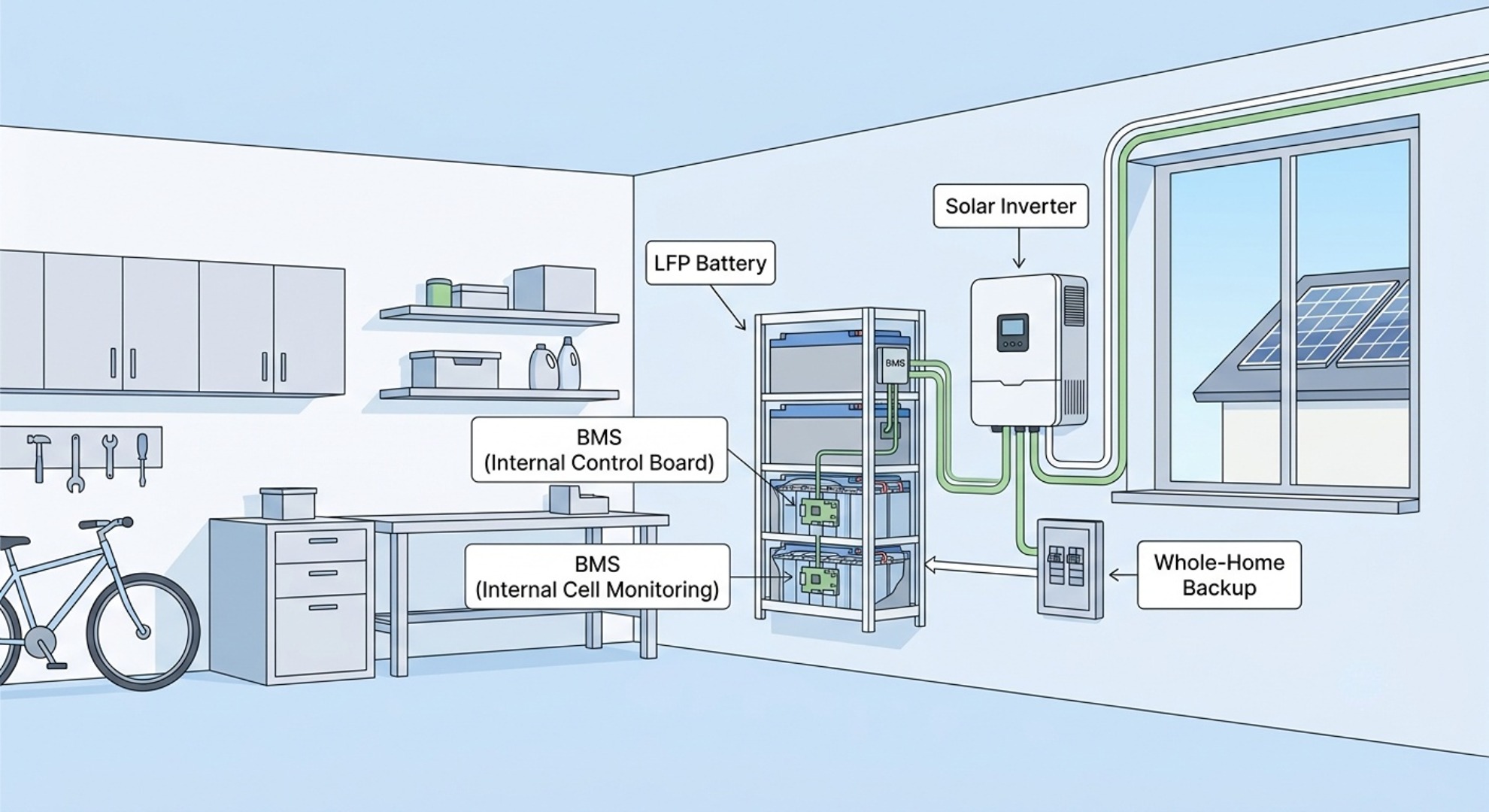
When you’re ready to buy residential backup storage, your main focus should land on sourcing a reliable LFP lithium iron phosphate system. Your exact LFP model depends on household power usage, installation spot and local climate. Other battery types only make sense in very specific edge cases.
1. Whole-home daily solar self-consumption: Stick with a premium LFP battery pack. Its unmatched cycle count lets you fully charge and discharge every single day for decades without heavy capacity loss, cutting your grid power draw month after month.
2. Very limited indoor wall space: You can look into compact NMC units only if space is extremely tight and your room stays cool and consistent year-round. Just know you’ll accept a shorter working lifespan and higher fire risk compared to LFP as a tradeoff.
3. Outdoor installs in freezing weather: Shop for LFP systems built with factory heating pads to keep charging performance steady through cold winters. Sodium-ion works as a cheaper secondary backup, but it can’t match LFP’s long-term durability for daily use.
4. Smart grid peak shaving & solar integration: Pair your LFP storage with a quality BMS (battery management system) that supports automated time-of-use shifting and smooth connection to your solar inverter, to slash seasonal energy bills as much as possible.
How to Choose the Best Home Solar Battery
LiFePO4 Battery Not Charging: 7 Main Causes, Troubleshooting & Fixes