


LFP Battery Internal Resistance Mismatch Cycle Life Guide
LFP Battery Internal Resistance Mismatch: Cycle Life Degradation Guide
1. What Is Internal Resistance Mismatch in LFP Battery Cells?

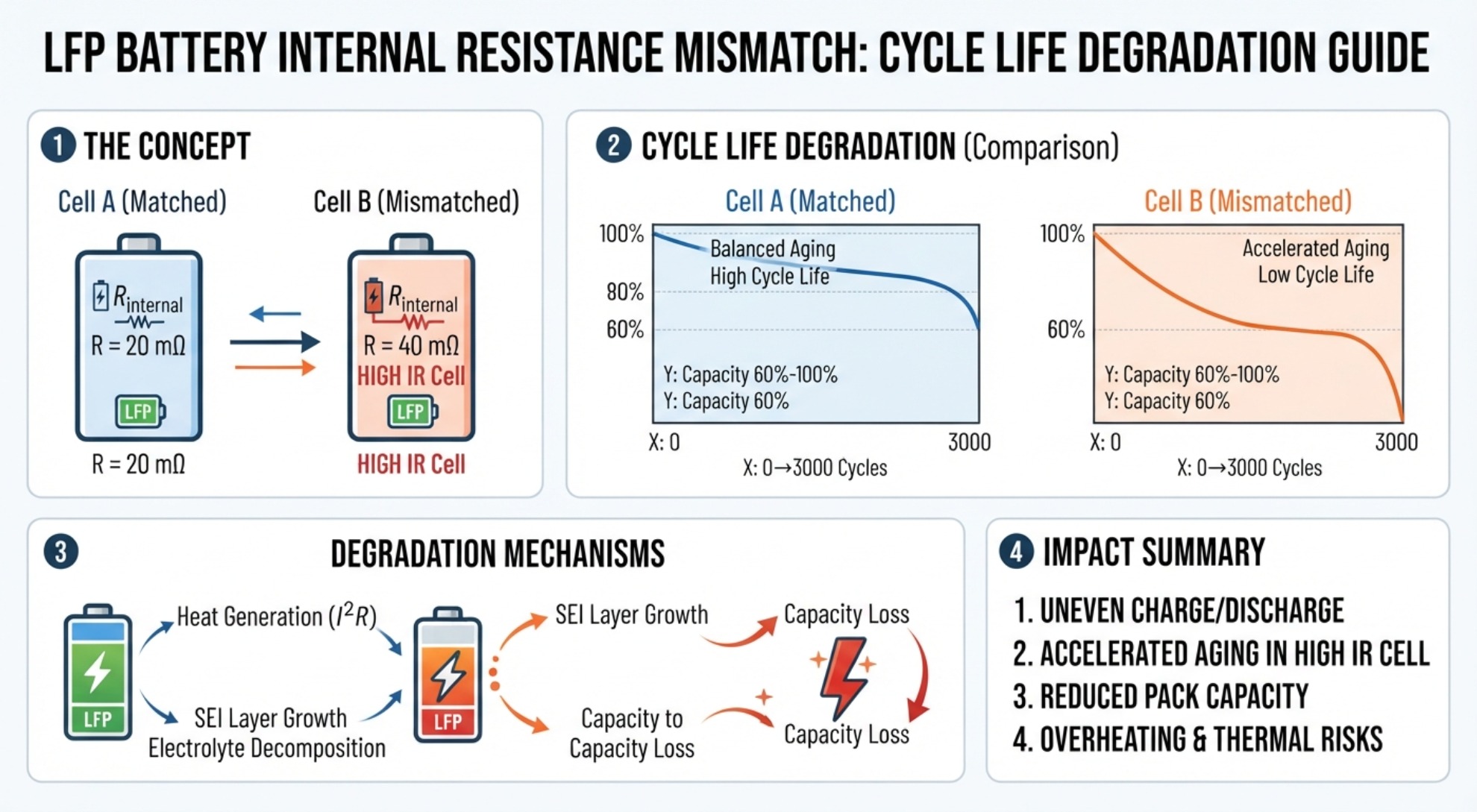
In grid‑scale energy storage systems and electric transportation, lithium iron phosphate (LFP) technology is widely adopted due to its superior thermal stability, safety characteristics, and long operational life. However, when individual cells are connected into multi‑cell series or parallel configurations, subtle manufacturing variations in electrode coating density, tab welding, or electrolyte volume lead to non‑uniform electrical properties. This variance creates an internal resistance mismatch, which alters how individual cells process electrical current and convert power under dynamic load.
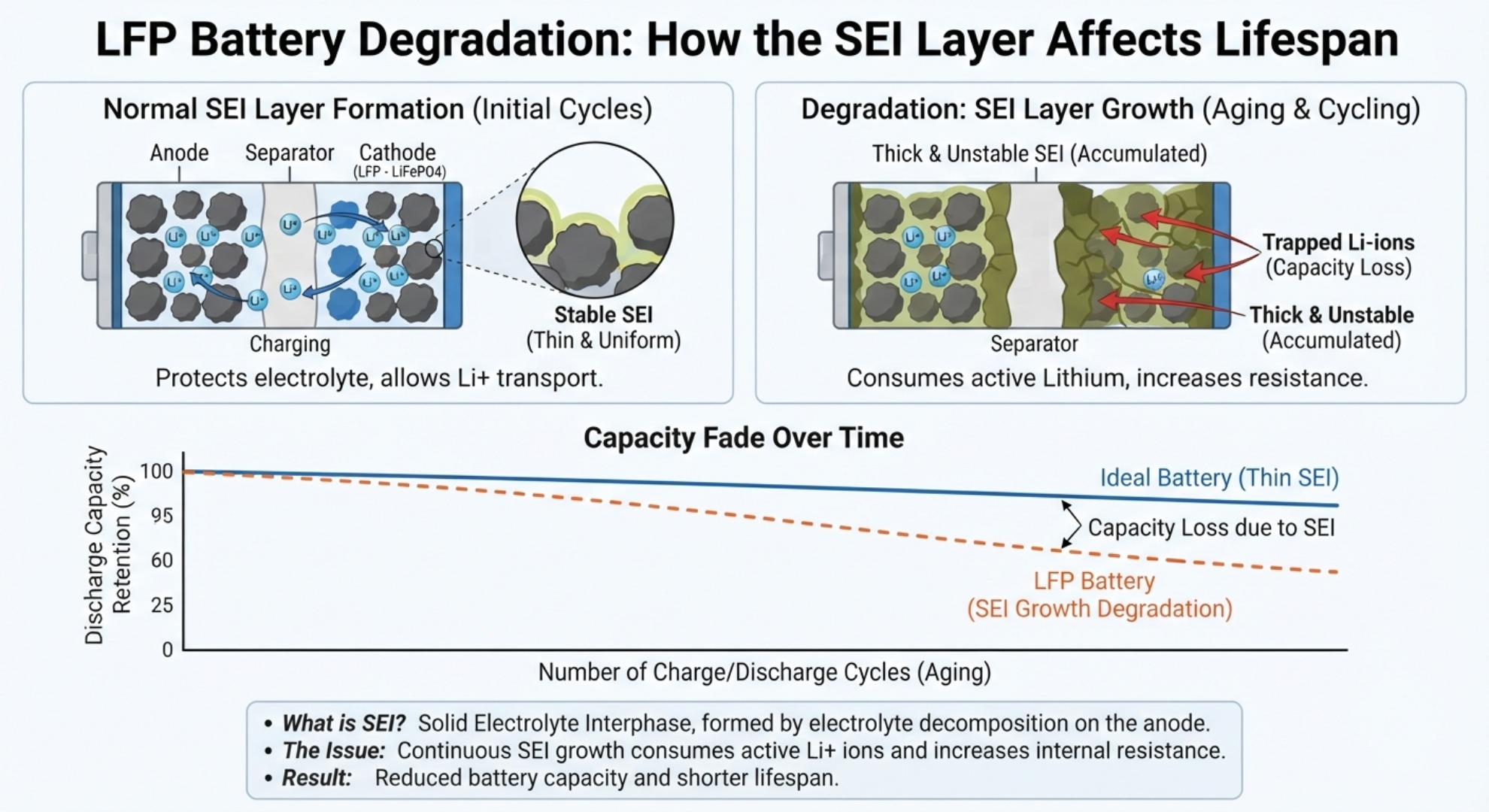
Over extended operational service, continuous chemical reactions alter internal battery architecture. The ongoing growth of the solid electrolyte interphase (SEI) layer on the graphite anode consumes active lithium ions while steadily elevating ohmic resistance. When initial cell impedance varies across a single battery module, this electrochemical degradation accelerates heterogeneously, causing healthier cells to carry additional burden and shortening overall system service life.
2. How Resistance Mismatch Accelerates LFP Battery Degradation
Uneven Current Distribution & Thermal Degradation in LFP Packs
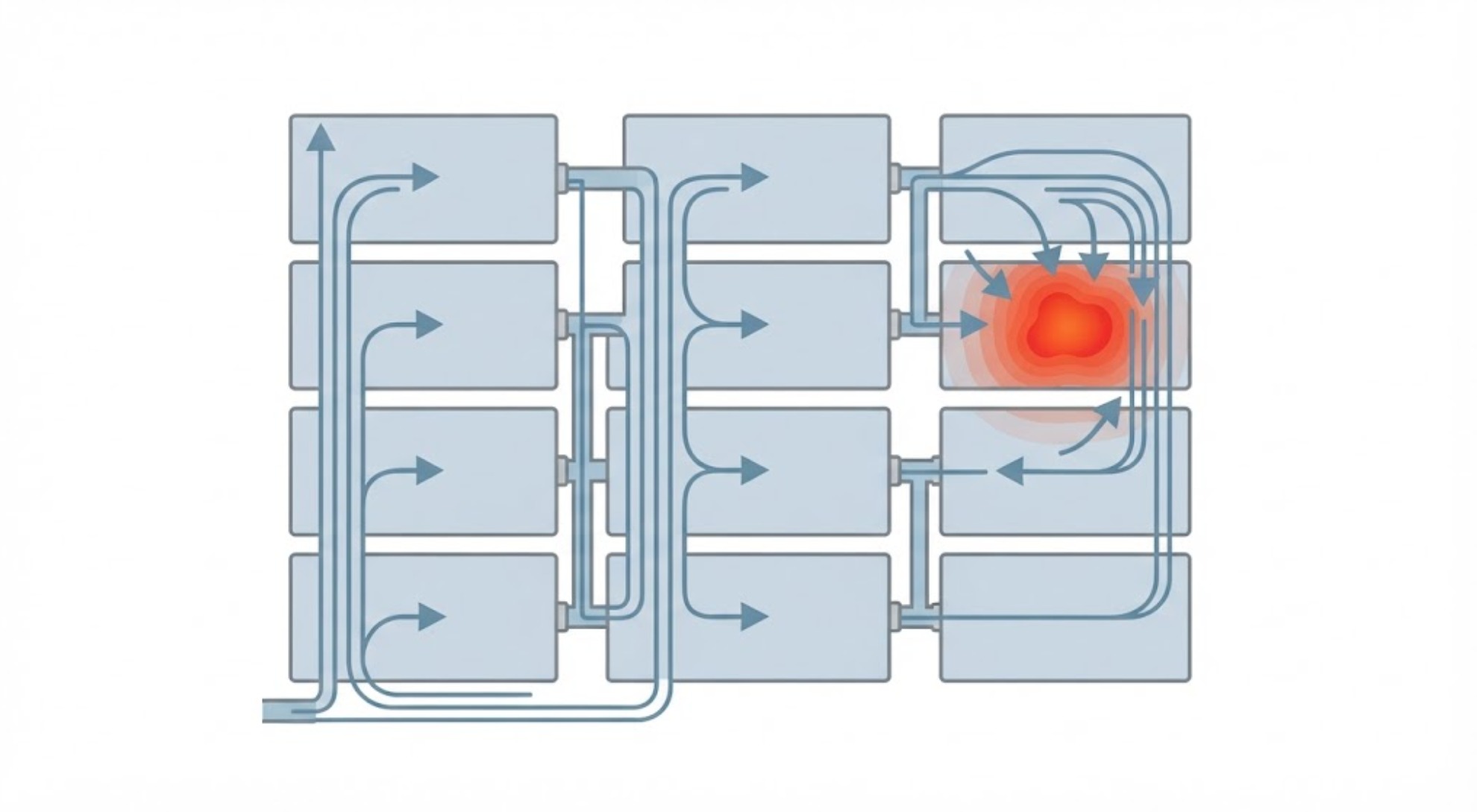
When cells with varying equivalent series resistance are wired in parallel strings, electric current automatically routes along the path of minimal opposition. Consequently, the cell with lower impedance absorbs a disproportionately high current share, inducing localized current crowding and elevated electrochemical stress. In series strings, the same total current \(I\) passes through every component, but the high‑resistance cell generates significantly more waste heat according to Joule heating principles:
This localized thermal escalation generates sharp thermal gradients across the battery pack. The severity of these thermal gradients often depends on the cooling efficiency inherent in prismatic vs cylindrical LFP cells, as each format handles internal heat dissipation differently. Because elevated temperatures accelerate electrolyte breakdown, binder degradation, and gas evolution, high‑resistance cells suffer from accelerated thermal degradation. This creates a self‑reinforcing feedback loop where rising impedance generates localized heat, which in turn degrades the cell further.
Premature Voltage Cutoff & LFP Battery Capacity Fade

Internal resistance directly governs cell overpotential, which defines the discrepancy between open‑circuit voltage and terminal voltage under load:
During high‑rate charging, a cell with elevated internal resistance exhibits an artificial voltage spike and reaches its upper voltage limit prematurely. Conversely, under heavy discharge demand, its terminal voltage drops rapidly, triggering the lower safety threshold before the rest of the pack depletes its energy. This causes severe battery pack capacity fade, as usable energy remains trapped within healthier cells that the battery controller cannot safely access.
| Operational State | Low Internal Resistance Cell | High Internal Resistance Cell | System‑Wide Impact |
|---|---|---|---|
| Charging | Operates at normal overpotential | Reaches upper voltage ceiling prematurely | Incomplete charge cycle; reduced stored energy |
| Discharging | Maintains stable operating voltage | Experiences rapid voltage drop (\(I \cdot R\)) | Premature low‑voltage cut‑off; trapped capacity |
| Thermal Output | Minimal resistive heat dissipation | High \(I^2 R\) heat generation | Module‑level thermal gradients & hot spots |
During fast‑charging routines, high resistance causes sudden terminal voltage spikes that trigger protection firmware early. As a result, the charger stops delivering current before the pack achieves full state of charge, compromising overall energy density and system performance.
3. Secondary Reliability Risks from LFP Resistance Imbalance
SOC Drift & Cell Desynchronization in LFP Battery Modules
Persistent voltage discrepancies disrupt uniform energy throughput, causing widespread state of charge (SOC) divergence across interconnected series strings. As cycle numbers increase, the SOC gap between high‑resistance and low‑resistance cells widens, forcing balancing circuits to operate continuously to prevent early cutoffs during standard charge‑discharge routines.
Micro‑Climatic Degradation & LFP Battery Safety Hazards
Uneven heat distribution alters local aging kinetics, driving localized separator breakdown and micro‑structural stress. Under sustained high‑discharge conditions, extreme resistance divergence can compromise internal insulation layer integrity, increasing self‑discharge rates and elevating thermal runaway risks during aggressive fast‑charging operations.
4. Engineering Solutions to Extend LFP Battery Cycle Life
Precision Cell Sorting & Impedance Screening for LFP Batteries
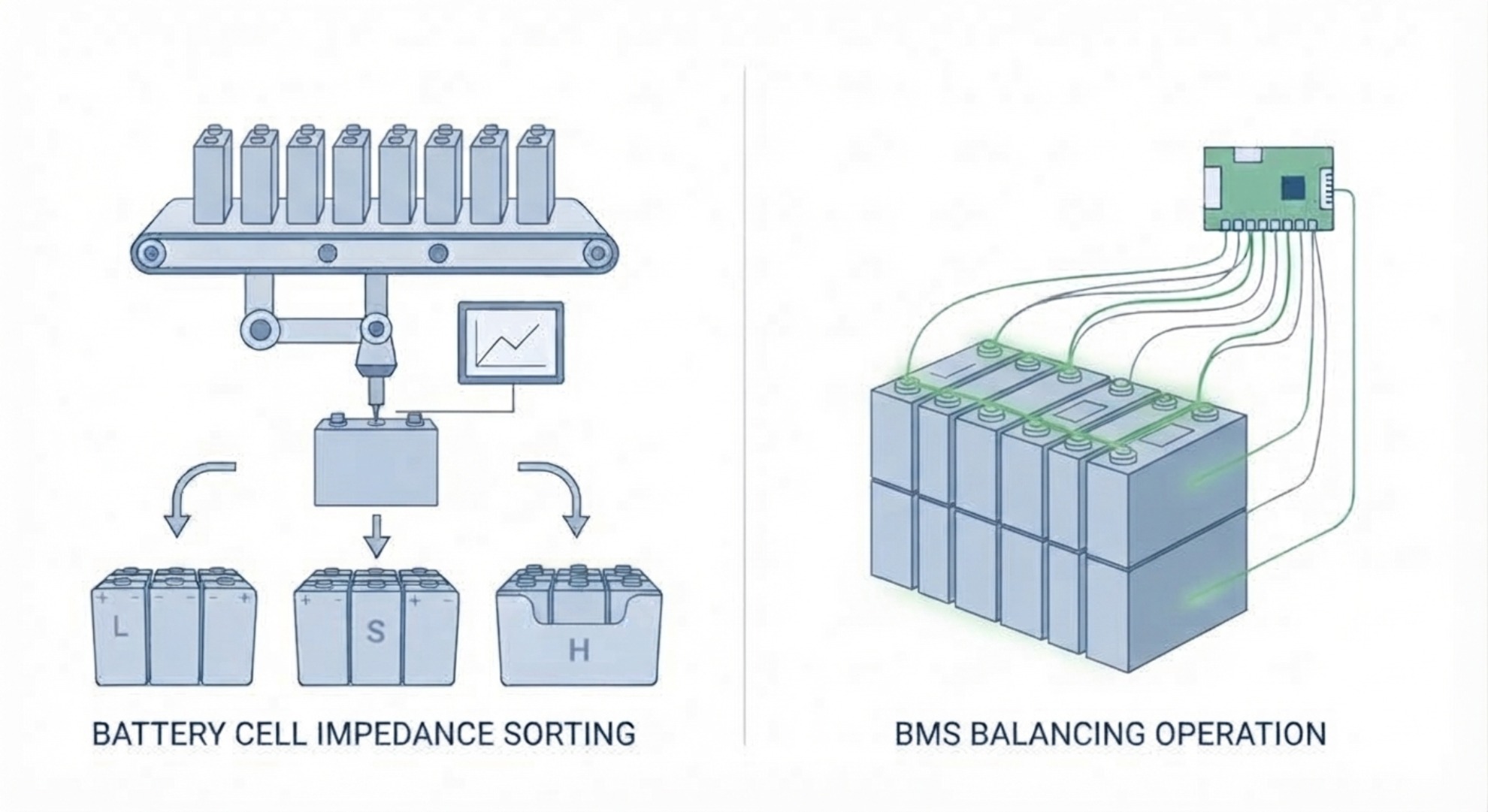
Mitigating resistance imbalance begins during manufacturing through comprehensive quality control. Advanced production lines utilize multi‑frequency electrochemical impedance spectroscopy (EIS) combined with direct‑current internal resistance (DCIR) testing to categorize raw cells into tight impedance bands—typically within a \(\pm 2\%\) to \(\pm 5\%\) tolerance window—ensuring balanced current sharing and uniform aging rates.
Advanced BMS Balancing to Extend LFP Battery Service Life
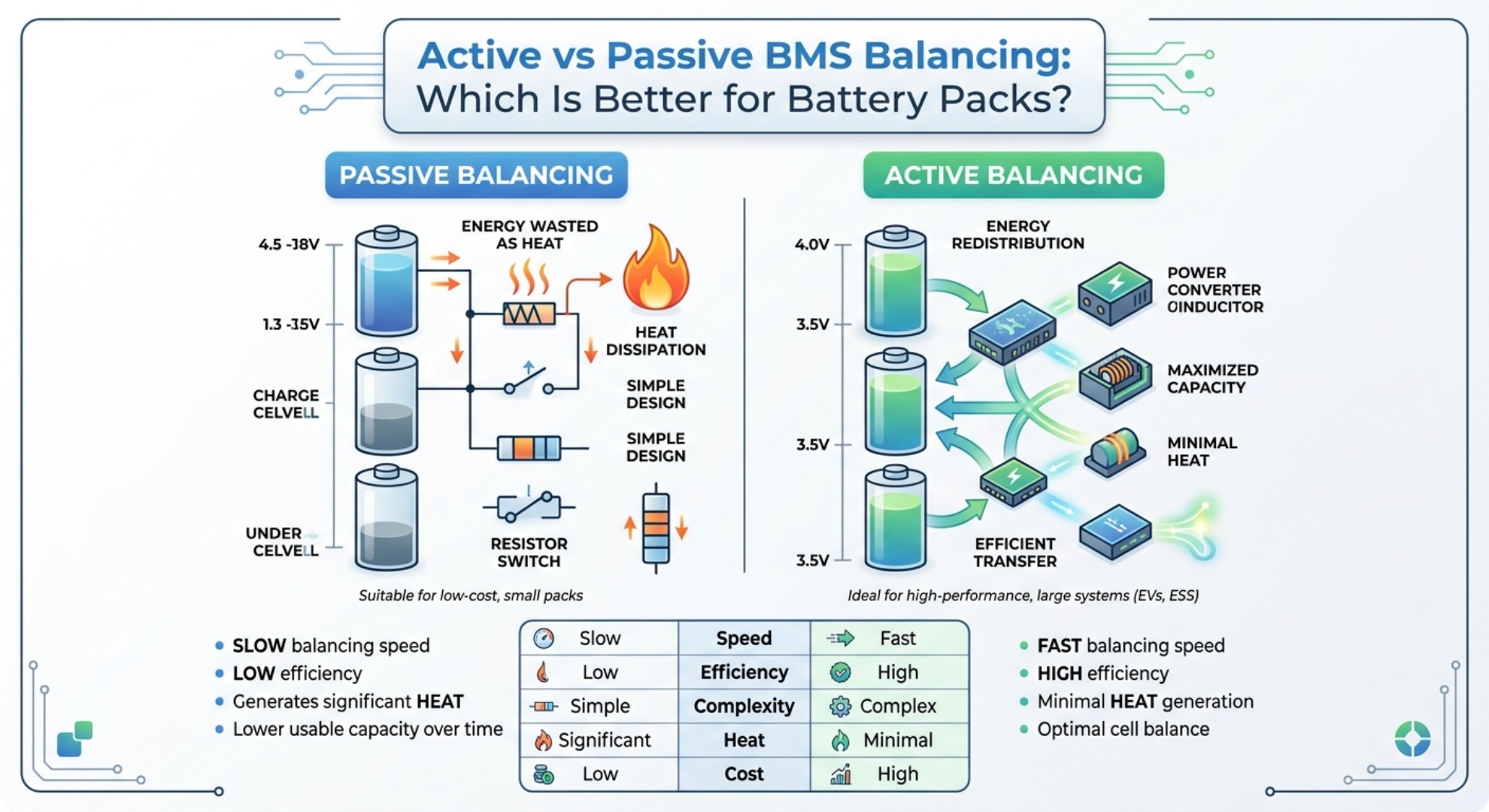
While initial sorting establishes baseline uniformity, dynamic resistance growth requires real‑time control. A modern battery management system (BMS) employs real‑time estimation algorithms to continuously track cell impedance and temperature. By applying active cell balancing strategies that transfer charge between cells via capacitive or inductive circuits, the system neutralizes SOC drift, suppresses resistance growth impact, and maximizes overall LFP battery pack service life.
Grade A vs Grade B LFP Cells: How to Spot Quality Differences
Prismatic vs Cylindrical LFP Cells: Which Is Better for Home Storage?