


LiFePO4 Cycle Life vs Calendar Life
LiFePO4 Cycle Life vs Calendar Life: Battery Lifespan Guide

Table of Contents
- 1. LiFePO4 Battery Degradation Mechanisms Explained
- 2. LiFePO4 Cycle Life: Definition and IEC Measurement Standards
- 3. LiFePO4 Calendar Life: Passive Aging and Chemical Degradation
- 4. Cycle Life vs Calendar Life: Key Degradation Factors
- 5. LiFePO4 Cycle Life vs Calendar Life: Side-by-Side Comparison
- 6. Maximize LiFePO4 Battery Life: Solar Storage Best Practices
- 7. Frequently Asked Questions About LiFePO4 Battery Life
Understanding how energy storage systems age requires distinguishing between usage-driven wear and passive degradation over time. Evaluating a LiFePO4 battery lifespan depends on analyzing both battery capacity retention metrics and lithium iron phosphate cell degradation pathways under different operational environments.
LiFePO4 Battery Degradation Mechanisms Explained
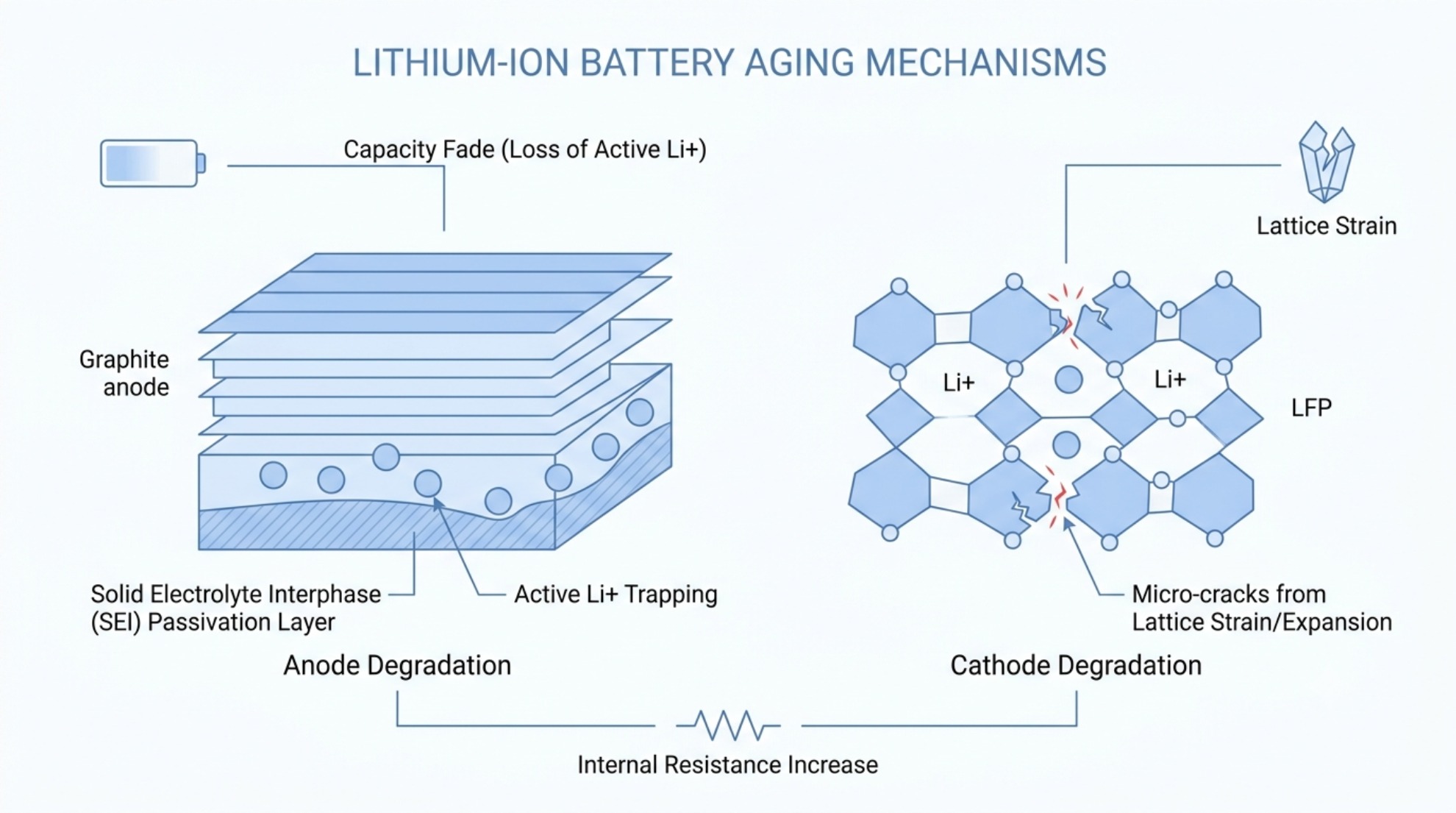
Two distinct aging modes govern LFP battery performance loss: cycle aging caused by repeated charge-discharge usage, and calendar aging triggered by time and storage conditions regardless of usage. Each follows unique chemical and mechanical failure modes that dictate overall battery service life. For a deeper understanding of lithium iron phosphate aging mechanisms, including capacity loss causes and prevention strategies, read our complete guide on LiFePO4 battery degradation factors .
LiFePO4 Cycle Life: Definition and IEC Measurement Standards
LiFePO4 cycle life ratings quantify how many full charge-and-discharge cycles a cell can complete before its capacity drops to 80% of its original rating, which is commonly defined as the End-of-Life threshold. According to testing protocols established by the International Electrotechnical Commission (IEC 62619), a single cycle represents drawing 100% of the nominal capacity and fully recharging it. The depth of discharge impact directly determines total cycle count. Reducing depth of discharge (DoD) from 100% to 80% can significantly increase usable cycles and help preserve battery state of health.
LiFePO4 Calendar Life: Passive Aging and Chemical Degradation
Conversely, battery calendar life refers to time-dependent degradation that occurs continuously, regardless of whether current flows through the battery terminals. Research from battery aging studies shows that passive aging is mainly influenced by storage temperature, voltage conditions, and chemical side reactions inside the cell. Over months and years, parasitic chemical reactions gradually increase internal resistance, consume active lithium ions, and reduce available battery capacity.
Cycle Life vs Calendar Life: Key Degradation Factors
Active usage accelerates mechanical and electrochemical fatigue within the cell structure. Primary lithium battery cycle degradation factors include lattice expansion stress during ion intercalation, high current charging, and heat generation during operation. High C-rate charging can increase lithium plating risk and accelerate capacity loss during intensive cycling conditions.
Mechanical Strain + C-rate Heat + Ion Plating
High SoC Voltage + Ambient Heat + Passive SEI Growth
In contrast, calendar degradation operates silently during long idle periods. The primary driver of calendar aging is keeping cells at high voltage levels for extended periods. High state of charge storage accelerates electrolyte decomposition, while excessive temperature exposure during downtime can significantly reduce lithium battery shelf life.
LiFePO4 Cycle Life vs Calendar Life: Side-by-Side Comparison

| Operational Feature | Cycle Life Degradation | Calendar Life Degradation |
|---|---|---|
| Primary Trigger | Charge/discharge throughput | Continuous elapsed time |
| Main Accelerators | High DoD, high C-rate charging | High temperature, 100% SoC storage |
| Physical Mechanism | Micro-cracking, electrode stress | SEI layer growth and chemical aging |
| Dominant Application | Solar daily cycling, peak shaving | UPS, emergency backup power |
| Typical Range | 4,000 – 8,000 cycles | 10 – 15+ years |
Maximize LiFePO4 Battery Life: Solar Storage Best Practices
Determining solar energy storage life expectancy requires evaluating which aging mechanism dominates your specific application. For daily solar self-consumption systems, cycle aging usually becomes the primary factor, while backup batteries are more affected by calendar aging. Understanding these differences helps optimize battery replacement planning and reduces the total cost of ownership of energy storage systems.
Implementing proactive battery optimization strategies can extend real-world durability beyond standard manufacturer ratings. Configuring battery management system parameters to limit maximum charging levels and avoiding prolonged deep discharge can significantly slow degradation. Understanding the main causes of capacity loss is essential for improving long-term performance. Learn more in our detailed guide about LiFePO4 battery degradation and the key factors affecting battery lifespan. Maintaining an optimal SOC storage range between 40% and 60% during long-term storage can further protect battery chemistry and maximize service life.
Frequently Asked Questions About LiFePO4 Battery Life
1. How long does a LiFePO4 battery last?
A LiFePO4 battery typically lasts 10 years or more under proper operating conditions. High-quality lithium iron phosphate batteries can achieve 4,000–8,000+ charge cycles before reaching approximately 80% of their original capacity. Actual lifespan depends on depth of discharge, operating temperature, charging methods, and battery management system protection.
2. What is the difference between LiFePO4 cycle life and calendar life?
LiFePO4 cycle life measures how many charge and discharge cycles a battery can complete before significant capacity loss occurs. Calendar life refers to battery aging caused by time, temperature, voltage conditions, and storage environment even when the battery is not actively used. Both cycle life and calendar life determine the overall lifespan of a lithium battery energy storage system.
3. What factors reduce LiFePO4 battery lifespan?
The main factors that reduce LiFePO4 battery lifespan include high temperatures, frequent deep discharge cycles, prolonged storage at 100% state of charge, excessive charging current, and improper battery management system settings. Maintaining proper temperature control and optimized charging parameters can significantly reduce battery degradation.
4. Is LiFePO4 better than other lithium batteries for solar storage?
Yes. LiFePO4 batteries are widely used in solar energy storage because they provide longer cycle life, excellent thermal stability, improved safety, and reliable long-term performance. For residential solar battery systems, LiFePO4 offers a strong balance between durability, safety, and lifetime cost.
5. How can I extend my LiFePO4 battery lifespan?
You can extend LiFePO4 battery lifespan by avoiding extreme temperatures, limiting deep discharge cycles, maintaining an appropriate state of charge range, using compatible charging equipment, and ensuring correct BMS configuration. For long-term storage, keeping the battery around 40–60% state of charge helps minimize calendar aging.
7 Pro Tips to Double LiFePO4 Solar Battery Life
LiFePO4 Battery Degradation: Key Factors & Extension Guide