


Solar Battery System: Complete Home Energy Storage Guide
Solar Battery System: A Complete Guide to LiFePO4 Home Energy Storage
Solar panels do not always generate electricity when a household needs it most. During sunny hours, a home's solar array may produce more power than the family is using. In the evening, however, electricity demand can remain high even though solar production has dropped.
A solar battery system helps address this mismatch by storing available solar energy for later use. Depending on the system design, the stored electricity can support evening consumption, reduce reliance on grid electricity, or supply selected household loads during a power outage.
Choosing a suitable system requires more than comparing battery capacity. Battery chemistry, usable energy, inverter compatibility, charging conditions, and installation requirements all affect how well the system performs.
This guide explains how residential solar battery systems work, what to consider when selecting a LiFePO4 battery, and how JM Energy Tech's 15kWh battery fits into a home energy storage application.
Homeowners comparing different storage options can also explore our guide to home battery storage systems for more information about residential energy storage.
- What Is a Solar Battery System?
- How Does a Solar Battery System Work?
- What Are the Main Components of a Solar Battery System?
- Why Consider a LiFePO4 Solar Battery System?
- How Should You Choose a Solar Battery System for Your Home?
- Battery and Inverter Compatibility: What Should You Check?
- Is a 15kWh LiFePO4 Battery Suitable for Your Home?
- Installation, Safety, and Battery Maintenance
- Choosing a Solar Battery Manufacturer: What Matters?
- FAQs
- Conclusion
1. What Is a Solar Battery System?
A solar battery system stores electricity generated by solar panels so it can be used when solar production is insufficient or unavailable.
A typical residential system includes:
- Solar panels that generate electricity.
- A battery that stores electrical energy.
- An inverter that manages electrical conversion and power flow.
- A Battery Management System (BMS) that monitors battery operating conditions.
- Electrical protection and monitoring equipment.
The system configuration depends on the property's energy requirements and connection to the utility grid.
Grid-Tied Solar Battery System
This setup remains connected to the utility grid. The battery stores available solar energy for later use, while the grid can provide electricity when solar and battery supply are insufficient.
Off-Grid Solar Battery System
An off-grid system operates without a regular utility connection. It relies on solar generation, battery storage, and appropriate backup generation where required. Careful system sizing is essential because available stored energy must cover demand during periods of limited sunlight.
Hybrid Solar Battery System
A hybrid system combines solar panels, battery storage, and grid electricity. It can manage energy between these sources according to system settings and household requirements.
Before selecting a configuration, homeowners should identify whether their priority is higher solar self-consumption, backup power, or operation without grid access.
To understand the battery technology behind these systems, see our guide to lithium solar batteries.
2. How Does a Solar Battery System Work?
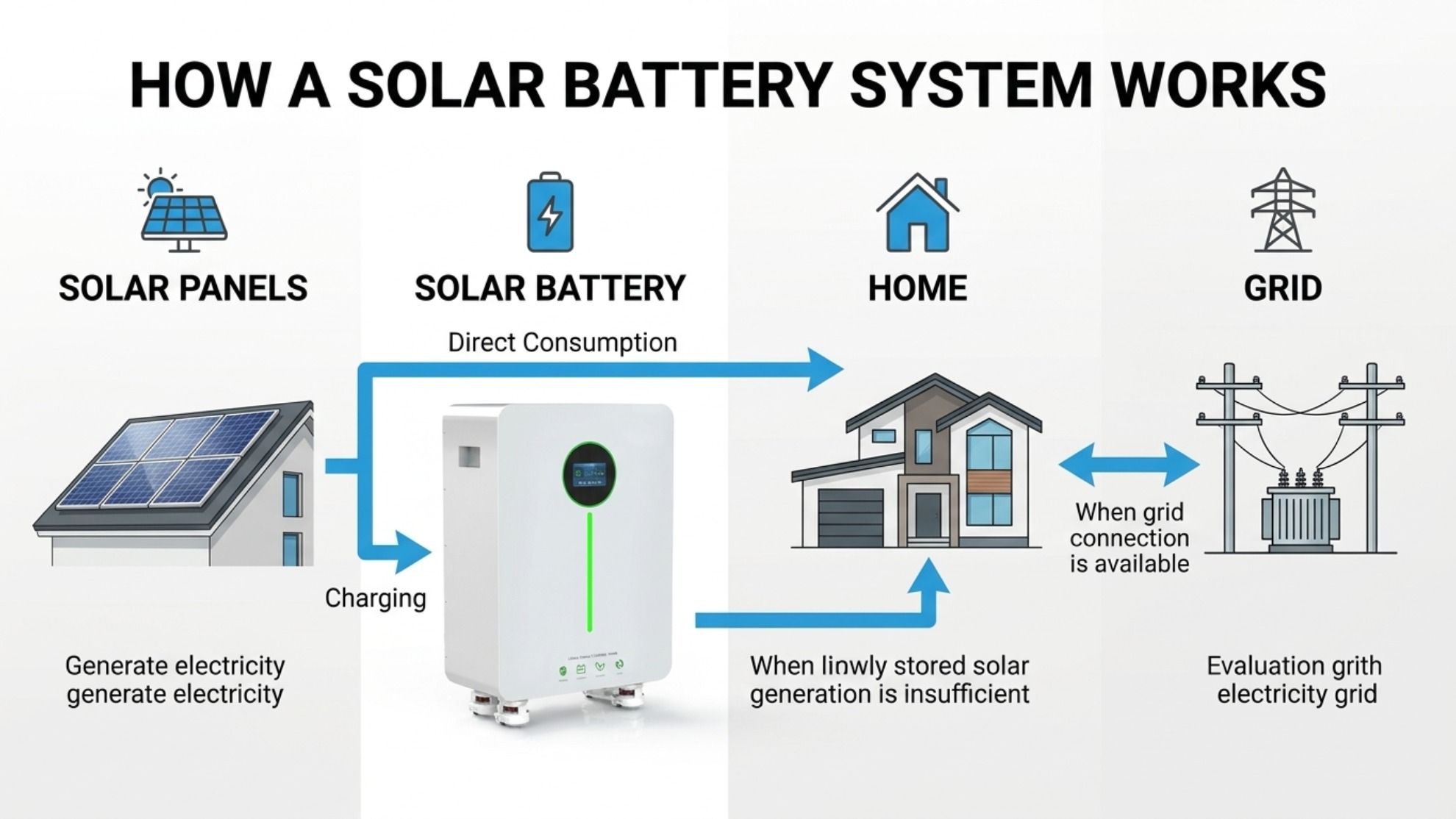
A residential solar battery system moves electricity between solar generation, household loads, battery storage, and the grid.
During the day, solar panels generate electricity. The system supplies household demand first. If solar production exceeds immediate consumption, the available surplus can charge the battery, subject to the inverter's settings and the battery's permitted charging limits.
When solar production decreases, stored energy can be discharged to supply connected loads.
The process generally involves four stages:
- Solar generation: Panels convert sunlight into electricity.
- Household consumption: Available solar energy supplies appliances and other loads.
- Battery charging: Surplus electricity charges the battery within its operating limits.
- Battery discharging: Stored energy is supplied to household loads when needed.
For example, a household may generate more solar electricity around midday than it consumes. Rather than relying entirely on grid electricity after sunset, the family can use energy stored during the day.
However, backup operation requires more than simply having a battery. Some grid-connected solar systems shut down during a utility outage. The inverter, transfer equipment, and electrical configuration must specifically support backup operation.
For a closer look at LiFePO4 battery technology and its role in solar energy storage, read our guide to LiFePO4 batteries for solar energy storage.
3. What Are the Main Components of a Solar Battery System?
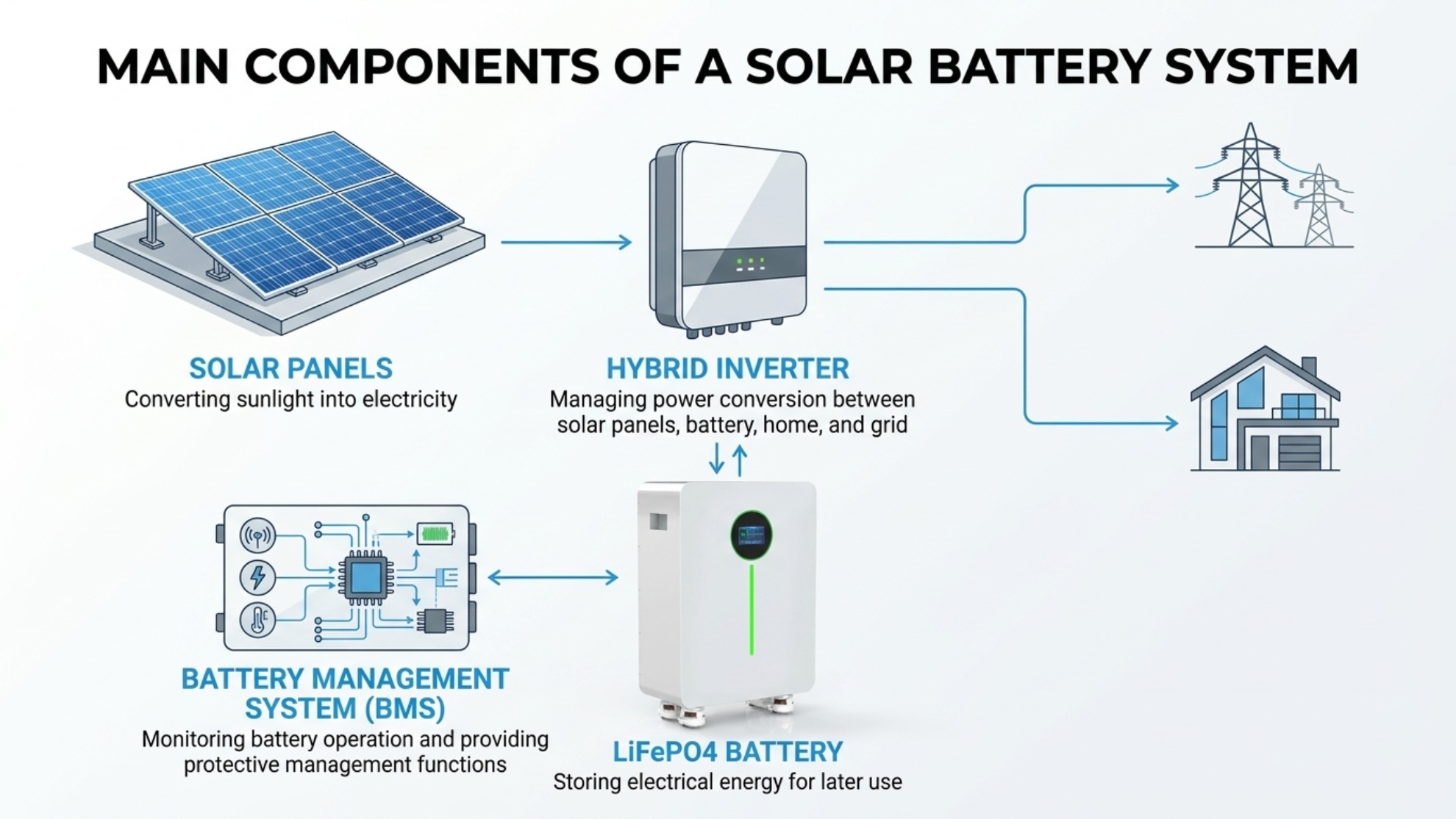
The performance of a solar battery system depends on how its components work together.
Solar Panels
Solar panels generate electricity from sunlight. Their output is affected by panel capacity, roof orientation, shading, weather, and installation conditions. The solar array should be sized with both household consumption and battery charging requirements in mind.
LiFePO4 Battery
The battery stores electricity for later use. Its nominal energy rating describes its rated storage capacity, but the energy available to household appliances depends on discharge limits and conversion losses.
Solar Inverter
The inverter manages electrical conversion and power flow between the solar array, battery, household loads, and grid where applicable. Its supported battery voltage range, charging limits, and communication functions must match the selected battery.
Battery Management System (BMS)
The BMS monitors battery operating conditions and manages protection functions. Depending on the battery design, these may include protection against overvoltage, undervoltage, excessive current, and temperature-related operating conditions.
Monitoring and Electrical Protection
Monitoring equipment allows users and installers to review system status. Properly rated cables, breakers, isolation devices, and other electrical protection components are also essential.
4. Why Consider a LiFePO4 Solar Battery System?
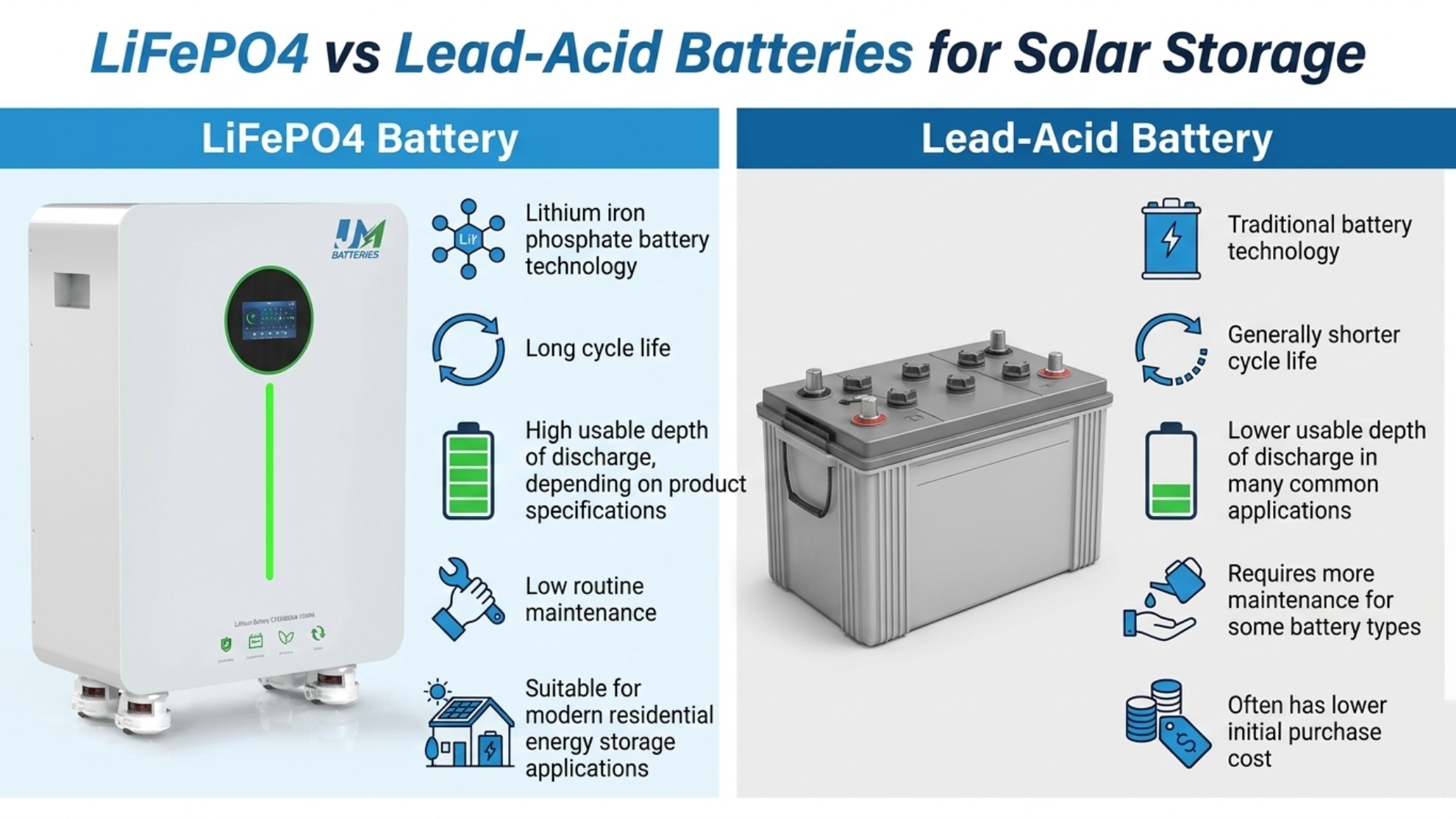
Lithium iron phosphate, commonly called LiFePO4 or LFP, is widely used in residential energy storage.
One reason is its cycle-life potential. A battery used for regular solar charging and discharging needs to withstand repeated operation over time. LiFePO4 batteries are often selected for applications where frequent cycling is expected.
Compared with traditional flooded lead-acid batteries, LiFePO4 products generally require less routine maintenance and can support deeper discharge, depending on the manufacturer's specifications.
| Comparison Factor | LiFePO4 | Lead-Acid |
|---|---|---|
| Cycle life | Generally longer | Generally shorter |
| Routine maintenance | Generally low | Flooded types require regular maintenance |
| Discharge depth | Often supports deeper discharge | Often operated with more conservative discharge limits |
| Weight | Generally lighter for comparable storage applications | Generally heavier |
| Common applications | Residential and other energy storage systems | Backup and selected storage applications |
These are general technology comparisons, not guarantees for every battery. Actual performance depends on cell quality, battery design, temperature, charging settings, discharge depth, and operating conditions.
When evaluating a LiFePO4 solar battery, buyers should pay particular attention to:
- Cycle life: The number of charge and discharge cycles specified under stated test conditions.
- Depth of Discharge (DoD): The proportion of nominal battery capacity used during a discharge cycle.
- BMS protection: The operating conditions monitored and protected by the battery management system.
- Warranty: The coverage period, operating conditions, exclusions, and claim requirements.
JM's selected 15kWh residential battery is specified at more than 8,000 cycles at 80% DoD and carries a 10-year warranty. These are manufacturer-provided product specifications. Buyers should consult the latest product datasheet and warranty document for the applicable test conditions and coverage details.
5. How Should You Choose a Solar Battery System for Your Home?
The right battery depends on how the household intends to use stored electricity.
A family that wants to keep a refrigerator, lights, and internet equipment running during an outage has different requirements from a household seeking to cover a large share of its evening electricity consumption.
Review Household Electricity Consumption
Start with electricity bills and, if available, actual energy monitoring data. Identify when consumption is highest and which appliances account for the largest share.
Identify Essential Backup Loads
List the appliances that need to operate during a power outage. Their combined energy consumption and power requirements help determine the battery capacity and inverter output needed.
Understand Nominal and Usable Capacity
A battery's nominal energy rating does not mean all of that energy will be delivered as AC electricity. The permitted DoD, inverter efficiency, and system operating settings affect the usable energy.
Check Solar Generation
The solar array must produce enough electricity to serve daytime loads and recharge the battery. Seasonal changes, shading, and local weather can affect how much energy is available.
Consider Future Requirements
If household electricity consumption may increase, discuss expansion options with the battery and inverter manufacturers before purchasing. Not every battery supports expansion, and approved configurations may have specific limits.
A larger battery is not automatically a better investment. If the solar array cannot regularly recharge it, or the household rarely needs the additional storage, the extra capacity may provide limited practical value.
6. Battery and Inverter Compatibility: What Should You Check?
A battery and inverter can have similar voltage ratings and still be incompatible. Installers should verify the exact combination before commissioning a system.
For a 51.2V LiFePO4 battery, check the inverter manufacturer's supported battery voltage range. Do not rely only on a general product description such as "48V inverter."
Communication also matters. CAN and RS485 are communication interfaces, but using the same interface does not guarantee that two devices support the same protocol or settings.
Before installation, confirm:
- Voltage range: The inverter must support the battery's specified operating voltage.
- Communication protocol: Check the protocol, pinout, and communication settings required by both manufacturers.
- BMS integration: Confirm that the inverter can correctly interpret the battery's status and protection information.
- Charging and discharging limits: Configure the inverter within the battery manufacturer's permitted limits.
- Exact model and firmware: Verify the inverter model and relevant firmware version rather than assuming all products from one brand are compatible.
If communication is unavailable, only use an alternative operating mode when it is explicitly permitted by the relevant manufacturers. Disabling communication without confirming the operating requirements can lead to incorrect charging or protection behavior.
For additional technical guidance, see Why Battery and Inverter Compatibility Matters.
For a practical verification process, follow our guide on how to check battery and inverter compatibility.
7. Is a 15kWh LiFePO4 Battery Suitable for Your Home?
A 15kWh battery may suit a household with substantial evening energy use or a requirement to support selected backup loads.
JM Energy Tech's residential model has the following manufacturer-provided specifications:
| Specification | JM 15kWh Battery |
|---|---|
| Battery chemistry | LiFePO4 |
| Nominal voltage | 51.2V |
| Capacity | 300Ah |
| Nominal energy | 15kWh |
| Cycle-life specification | 8,000+ cycles |
| DoD reference | 80% |
| Warranty | 10 years |
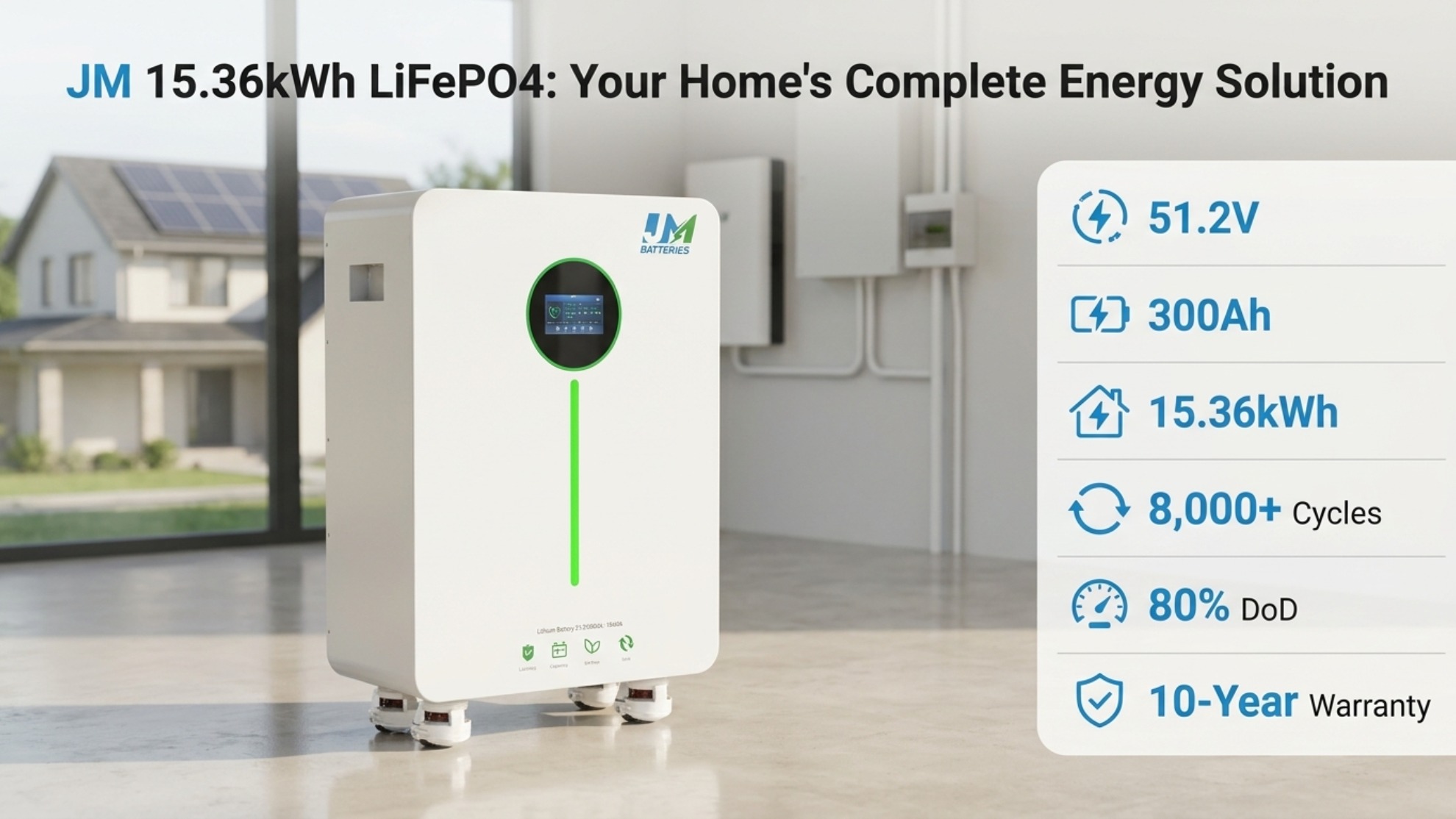
The 51.2V and 300Ah ratings correspond to a nominal energy capacity of 15kWh.
Illustrative Residential Application
Consider a home with rooftop solar panels and relatively high electricity consumption in the evening.
During daylight hours, solar generation supplies the household and charges the battery with available surplus electricity. After sunset, stored energy can supply connected household loads through a compatible inverter.
If the system includes an inverter and electrical configuration designed for backup operation, the battery may also support designated circuits during a grid outage.
Whether 15kWh is sufficient depends on actual household consumption, the appliances being supported, inverter output, permitted discharge, and available solar generation. A capacity rating alone cannot establish how many hours a household can operate.
This is an illustrative system scenario, not a documented customer installation or measured performance result.
For detailed product specifications and purchasing information, visit the JM 15kWh Battery Pack.
8. Installation, Safety, and Battery Maintenance
Battery installation should follow the manufacturer's instructions and applicable local electrical requirements. Incorrect wiring, unsuitable protection devices, or inappropriate inverter settings can affect both system operation and safety.
Installers should pay attention to:
- Using correctly rated cables, connectors, breakers, and isolation devices.
- Checking polarity and electrical connections before commissioning.
- Following the battery's specified operating temperature limits.
- Setting charging and discharging parameters according to the product documentation.
- Keeping the installation area suitable for the equipment and accessible for inspection.
- Using qualified professionals for electrical work and system commissioning.
Two standards often discussed in relation to lithium batteries are UN38.3 and IEC 62619. They have different purposes.
UN38.3
UN38.3 covers tests used to assess lithium batteries for transportation. It should not be described as a complete residential installation safety certification.
IEC 62619
IEC 62619 specifies safety requirements and tests for certain industrial secondary lithium cells and batteries, including relevant stationary applications. Buyers should request and review the actual product documentation rather than assuming a battery complies simply because the standard is mentioned in its marketing materials.
A BMS is an important part of battery protection, but it does not replace correct installation, external electrical protection, or compliance with local requirements.
For ongoing maintenance, follow the manufacturer's instructions, review system alerts, and arrange professional inspection if unusual operating conditions or visible damage are found.
9. Choosing a Solar Battery Manufacturer: What Matters?
For solar installers, distributors, and wholesalers, selecting a battery manufacturer is a long-term business decision. Product specifications are important, but manufacturing consistency, technical support, customization options, and supply capability also matter.
JM Energy Tech was established in 2017 and operates a manufacturing facility of more than 28,000 square meters in Dongguan, China.
According to the company's published business information, its manufacturing operations include battery research and development, LiFePO4 battery pack assembly, quality inspection, and production management. The company also reports a workforce of more than 150 technical and production personnel and a monthly production capacity of over 8,000 units.
JM provides OEM and ODM services for customers seeking customized residential energy storage products.
For overseas distributors and wholesalers, it is worth discussing product configuration, branding requirements, technical documentation, order quantities, and after-sales arrangements before placing an order. Installers should confirm the specifications and inverter compatibility of the exact battery model they intend to deploy.
A reliable manufacturer relationship should extend beyond the initial purchase. Clear technical documentation, consistent product specifications, and accessible support are important throughout installation and after-sales service.
Learn more about JM Energy Tech's manufacturing capabilities, including its production, R&D, and quality management operations.
FAQs
1. What Is a Solar Battery System?
A solar battery system stores electricity generated by solar panels for later use. It can help households use more of their own solar generation and, when properly configured, provide backup power.
2. How Does a Solar Battery System Work?
Solar panels generate electricity during the day. The system supplies household demand first, and available surplus energy can charge the battery. Stored energy can then supply connected loads when solar production decreases.
3. Is LiFePO4 Better Than Lead-Acid for Solar Storage?
LiFePO4 generally offers longer cycle-life potential and lower routine maintenance requirements than traditional flooded lead-acid batteries. The best choice depends on the application, product quality, operating conditions, and total system cost.
4. How Long Does a LiFePO4 Solar Battery Last?
Service life depends on cycle frequency, DoD, temperature, charging conditions, and calendar aging. JM's selected battery specifies 8,000+ cycles at 80% DoD. Buyers should review the manufacturer's test conditions and warranty documentation when interpreting this figure.
5. Can a Solar Battery System Work Without Grid Power?
Yes. An off-grid system can operate without a utility connection. A grid-connected system can provide backup during an outage only when its inverter and electrical configuration support that function.
6. What Inverter Is Compatible with a 51.2V Solar Battery?
The inverter must support the battery's voltage range, charging and discharging limits, and required communication settings. Compatibility should be confirmed for the exact battery and inverter models.
7. Is a 15kWh Battery Enough for a Home?
It may be suitable for households with substantial energy storage needs, but capacity requirements vary. Daily consumption, backup loads, inverter output, and solar generation all affect whether 15kWh is sufficient.
8. Can I Expand My Solar Battery Storage System?
That depends on the battery's approved configuration, BMS requirements, inverter limitations, and manufacturer instructions. Confirm that expansion is supported before connecting additional batteries.
Conclusion
A solar battery system can make rooftop solar more useful by storing available electricity for periods when solar production is low. Choosing the right system requires consideration of household demand, battery chemistry, usable capacity, inverter compatibility, and installation requirements.
For residential applications, LiFePO4 is worth considering because of its cycle-life potential and relatively low routine maintenance requirements. JM Energy Tech's 51.2V 300Ah, 15kWh battery is one option for households seeking residential solar storage, with a specified cycle life of 8,000+ cycles at 80% DoD and a 10-year warranty.
Homeowners can evaluate the battery against their energy needs, while installers and distributors can contact JM Energy Tech to discuss product specifications, technical documentation, and OEM/ODM requirements.

JM New Energy Technology



Lithium Batteries: Types, Uses, Benefits & Buying Guide
Home Energy Storage System: Costs, Savings & ROI