


Home Battery Storage: Costs, Benefits & How to Choose a System
Home Battery Storage: Costs, Benefits & How to Choose a System
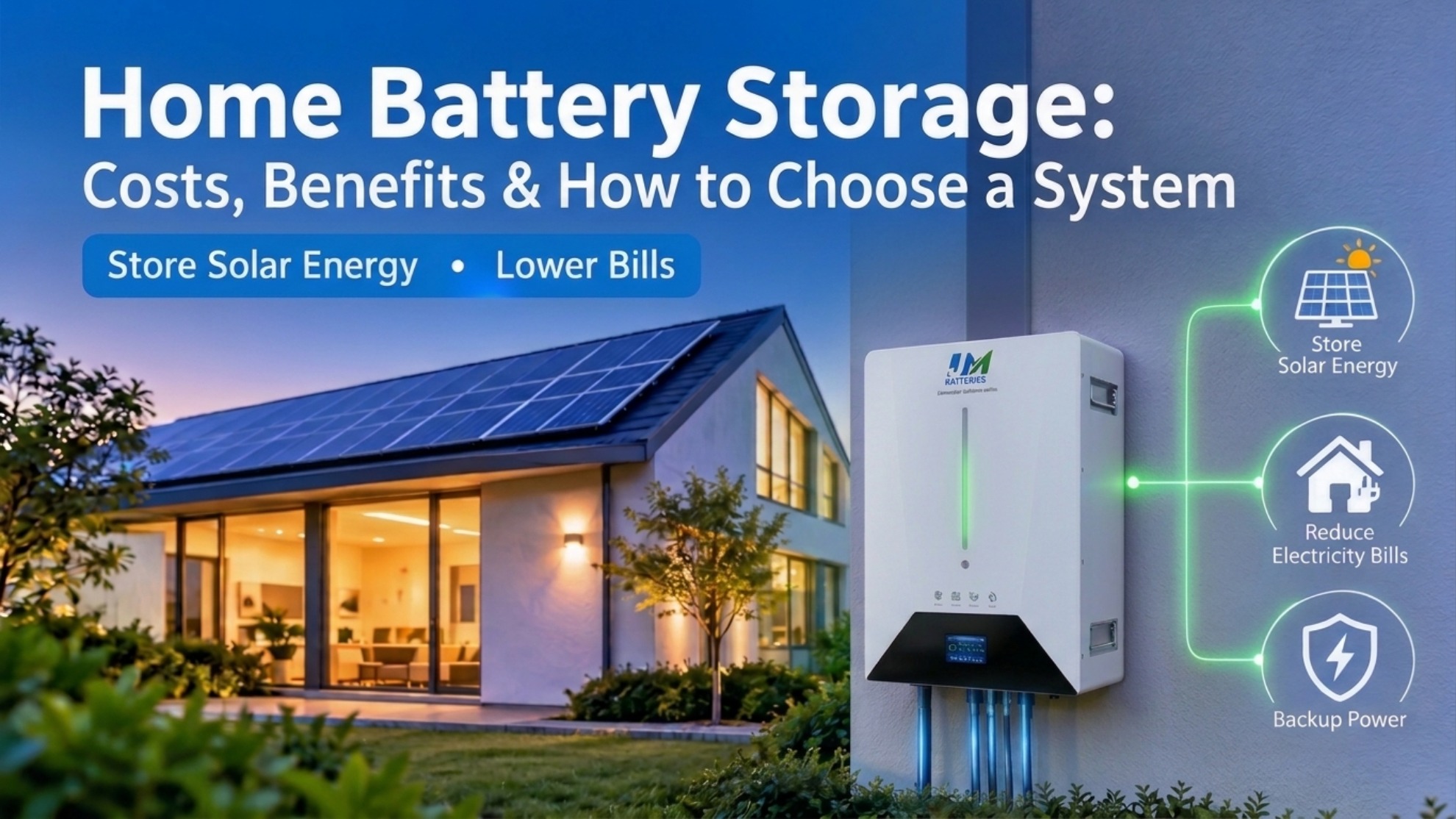
Solar panels generate electricity during the day, but many households use more power in the evening. Without battery storage, surplus solar electricity may be sent back to the utility grid, while homeowners purchase electricity again when solar production decreases.
Home battery storage offers a way to use more of that electricity. It stores energy for later consumption, provides backup power when properly configured, and gives homeowners more flexibility in managing electricity costs. However, choosing a suitable system requires more than comparing battery capacities. Cost, battery chemistry, inverter compatibility, and household energy consumption all matter.
What Is Home Battery Storage?
Home battery storage is a system that stores electricity for use at a later time. Most residential systems use rechargeable lithium-ion batteries and can operate alongside solar panels or charge directly from the utility grid, depending on their configuration.
For example, a home may generate more solar electricity than it needs around midday. A battery can store some of this surplus energy and release it in the evening when solar production falls.
A typical home battery storage system includes several components:
- Battery cells: Store electrical energy and determine the battery pack's basic characteristics.
- Battery Management System (BMS): Monitors voltage, current, temperature, and protection limits.
- Inverter: Converts and manages electricity between battery DC power and household AC power.
- Monitoring and energy management: Tracks battery operation and coordinates energy flow.
For residential solar applications, these components must work together. Battery voltage, BMS communication, and inverter settings all influence system performance.
How Does Home Battery Storage Work?
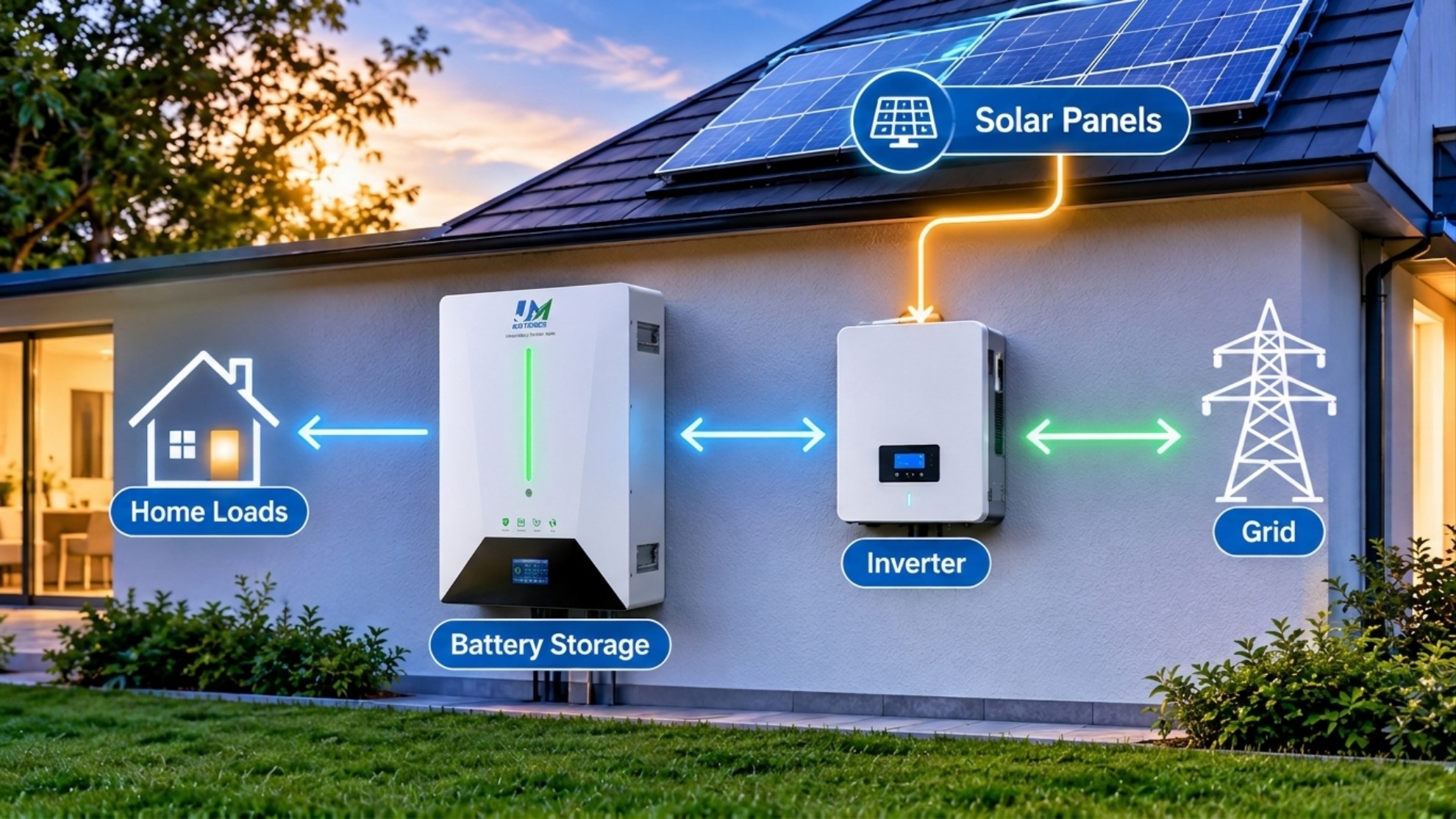
A home battery stores electricity when energy is available and supplies it when household demand increases or solar generation decreases. Its operating process depends on the inverter and electrical configuration.
Solar Charging
During the day, solar panels generate electricity for household appliances. Any suitable surplus electricity can charge the battery. In the evening, the stored energy can supply lighting, refrigerators, and other household loads.
This arrangement allows homeowners to use more of their own solar generation instead of relying entirely on electricity purchased from the grid.
Grid Charging
Some battery systems can also charge from the utility grid. This can be useful where electricity prices vary throughout the day. A homeowner may charge the battery during lower-price periods and use the stored energy when electricity costs more.
However, grid charging depends on inverter capabilities, battery specifications, and utility requirements. Not every residential system supports this function.
Backup Power During Outages
A standard grid-connected solar installation usually shuts down when the utility grid fails. To provide backup power, a system needs suitable isolation and transfer equipment, along with an inverter capable of operating independently of the grid.
Some installations support selected essential circuits, while others are designed for larger household loads. The battery alone does not guarantee whole-home backup.
What Are the Benefits of Home Battery Storage?
Backup Power for Essential Appliances
A properly configured home battery system can keep selected appliances operating during a power outage. Common backup loads include refrigerators, lighting, internet equipment, and essential electronics.
How long the battery lasts depends on its usable energy capacity and the connected loads. The inverter's continuous and surge power ratings also determine which appliances can operate together.
Homeowners planning a backup installation should identify their essential electrical loads before choosing a battery. Our guide to the home battery backup system explains additional selection considerations.
Better Solar Energy Self-Consumption
Solar generation and household demand do not always occur at the same time. A battery can store excess daytime generation and make it available when the household needs electricity later.
This may be particularly useful in areas where exported solar electricity receives less compensation than electricity purchased from the utility.
Potential Electricity Bill Savings
With time-of-use electricity rates, a battery may help shift electricity consumption away from expensive periods. It can also reduce evening grid purchases by using stored solar energy.
Actual savings depend on electricity prices, export compensation, system efficiency, installation costs, and how frequently the battery is used. Installing a larger battery does not automatically produce greater financial savings.
What Types of Home Battery Storage Are Available?
LiFePO4 Battery Storage
Lithium iron phosphate (LiFePO4 or LFP) is widely used in residential energy storage. It offers favorable thermal stability characteristics compared with several other common lithium-ion chemistries and is suitable for repeated charging and discharging.
LiFePO4 batteries are available in different capacities and installation formats. However, product quality, cell consistency, BMS protection, operating temperature, and charging limits still affect actual performance and service life.
NMC Lithium-Ion Battery Storage
Nickel manganese cobalt (NMC) batteries can provide higher energy density in certain designs. This may be useful when installation space or weight is an important consideration.
Neither LFP nor NMC is automatically the best choice for every household. Buyers should compare usable capacity, power output, safety characteristics, warranty conditions, and complete system costs.
Common Installation Formats
Residential batteries are available in wall-mounted, floor-standing, and stackable designs. Wall-mounted units can save floor space, while floor-standing systems may suit larger installations. Modular batteries allow additional capacity when the manufacturer supports expansion.
Before expanding an existing battery bank, check voltage compatibility, maximum module quantity, current limits, and BMS communication requirements.
How Much Does Home Battery Storage Cost?
The cost of home battery storage depends on more than the battery itself. A complete installation may include battery modules, an inverter, electrical protection, wiring, backup equipment, permits, and labor.
Battery Capacity and Equipment Costs
Larger batteries generally store more electricity, but the appropriate capacity depends on household demand. A family that only needs backup for essential appliances may not require the same system as one planning to operate several major appliances.
It is also important to distinguish battery-only prices from complete installed system costs. Two quotations should be compared using the same equipment and installation scope.
Installation and Additional Expenses
Existing solar equipment can affect installation costs. If the current inverter is not compatible with battery storage, additional equipment or an inverter replacement may be necessary.
Other expenses can include electrical panel upgrades, backup switching equipment, mounting hardware, installation labor, and local permits.
Homeowners in the United States should also check current state and utility incentives rather than assume that former federal residential clean energy tax credits remain available. Refer to the IRS Residential Clean Energy Credit guidance for current policy information.
How to Choose the Right Home Battery Storage System
Understand Household Electricity Consumption
Start with electricity bills or smart-meter data. Identify average daily consumption, evening demand, and the appliances that must remain operational during outages.
Separating essential loads from optional high-power appliances helps prevent the system from being unnecessarily large or undersized.
Match Battery Capacity with Power Output
Battery capacity is measured in kilowatt-hours (kWh), while power output is measured in kilowatts (kW). Capacity describes how much energy can be stored; power describes how quickly electricity can be supplied to connected loads.
A 15 kWh battery paired with a 5 kW continuous-output inverter cannot operate unlimited appliances simultaneously. High-power equipment may also require additional startup power.
Check Battery and Inverter Compatibility
Compatibility involves voltage range, charging and discharging current, communication protocols, and protection settings. If the battery uses CAN or RS485 communication, the inverter must support the appropriate protocol and configuration.
Physical connection alone does not establish full compatibility. Review manufacturer documentation and approved combinations before installation. See our guides on why battery and inverter compatibility matters and how to check battery and inverter compatibility.
Compare Cycle Life and Warranty
Advertised cycle life should always be considered alongside depth of discharge, temperature, charging rate, and capacity retention at the end of testing. Warranty coverage, operating limits, and energy-throughput conditions are equally important.
Home Battery Storage Examples
The following examples are illustrative scenarios, not verified customer installations or measured field-test results. Actual system performance depends on usable capacity, inverter efficiency, connected loads, and operating conditions.
Case 1: A Solar-Powered Home
A family uses approximately 18 kWh of electricity per day and has rooftop solar panels. On sunny days, around 6–8 kWh of surplus solar generation may be available.
A proposed 10 kWh LiFePO4 battery could store some of this excess energy and supply household loads in the evening. The objective is to increase solar self-consumption rather than eliminate the electricity bill entirely.
The actual financial benefit depends on electricity prices, export compensation, battery utilization, and system efficiency.
Case 2: A Home with Frequent Power Outages
A family uses approximately 4–5 kWh per day for essential appliances, including refrigeration, lighting, and internet equipment.
A proposed 12 kWh battery with a backup-compatible inverter and dedicated essential-load panel could support these circuits during outages. However, usable battery capacity, inverter losses, reserve settings, and appliance demand determine the actual runtime.
The inverter must also provide sufficient continuous and surge power for the connected equipment.
Case 3: A High-Consumption Household
A larger family uses approximately 30 kWh per day and is considering a 15 kWh LiFePO4 battery with a 5 kW continuous-output hybrid inverter.
This configuration could support selected circuits and provide some backup flexibility. However, it would not automatically operate every household appliance. Load management may be necessary, particularly for air conditioning and other high-power equipment.
These examples show why battery selection should be based on actual household energy requirements, not capacity alone.
Is Home Battery Storage Worth It?
Home battery storage is more attractive for households with frequent outages, high electricity prices, favorable time-of-use rates, or limited compensation for exported solar energy.
For homes with reliable grid connections, low electricity prices, and little backup demand, the investment may be harder to justify.
Battery degradation, warranty coverage, installation expenses, and long-term maintenance should also be considered. A battery can provide practical backup value even when its electricity savings alone do not justify the entire installation cost.
The best way to evaluate a system is to compare its total cost with the household's actual energy requirements and the value of the backup power it provides.
FAQ
1. Can Home Battery Storage Work Without Solar Panels?
Yes. Some systems support grid charging and can store electricity for later use. However, without solar or another charging source, the battery cannot recharge itself during an extended grid outage.
2. How Much Home Battery Storage Does a House Need?
Capacity depends on daily electricity use, essential loads, desired backup duration, and available charging sources. Household consumption data is the best starting point.
3. Can a Home Battery Power an Entire House?
Yes, if the system has sufficient usable energy, inverter output, backup equipment, and suitable electrical integration. Some installations support only selected circuits.
4. Are LiFePO4 Batteries Suitable for Home Storage?
Yes. LiFePO4 batteries are widely used in residential storage because of their thermal stability characteristics and suitability for repeated cycling. Product quality and proper protection remain essential.
5. Does Home Battery Storage Require a Special Inverter?
A compatible battery inverter or hybrid inverter is required. Voltage range, current limits, BMS communication, and backup functionality must match the battery specifications.
6. Can Home Battery Storage Be Expanded Later?
Some systems support modular expansion. Before adding batteries, verify approved models, inverter capacity, communication requirements, and manufacturer limits.
Conclusion
Home battery storage can help households use more solar electricity, manage energy consumption, and maintain essential power during outages. Its value depends on how well the battery capacity, inverter output, and system configuration match actual household needs.
Before purchasing, compare battery chemistry, usable capacity, inverter compatibility, warranty terms, and total installation costs. A properly matched system is generally more useful than simply choosing the largest battery available.
How Long Does It Take to Charge a Solar Battery
LiFePO4 Batteries for Solar Energy Storage: Benefits, Applications & How to Choose