


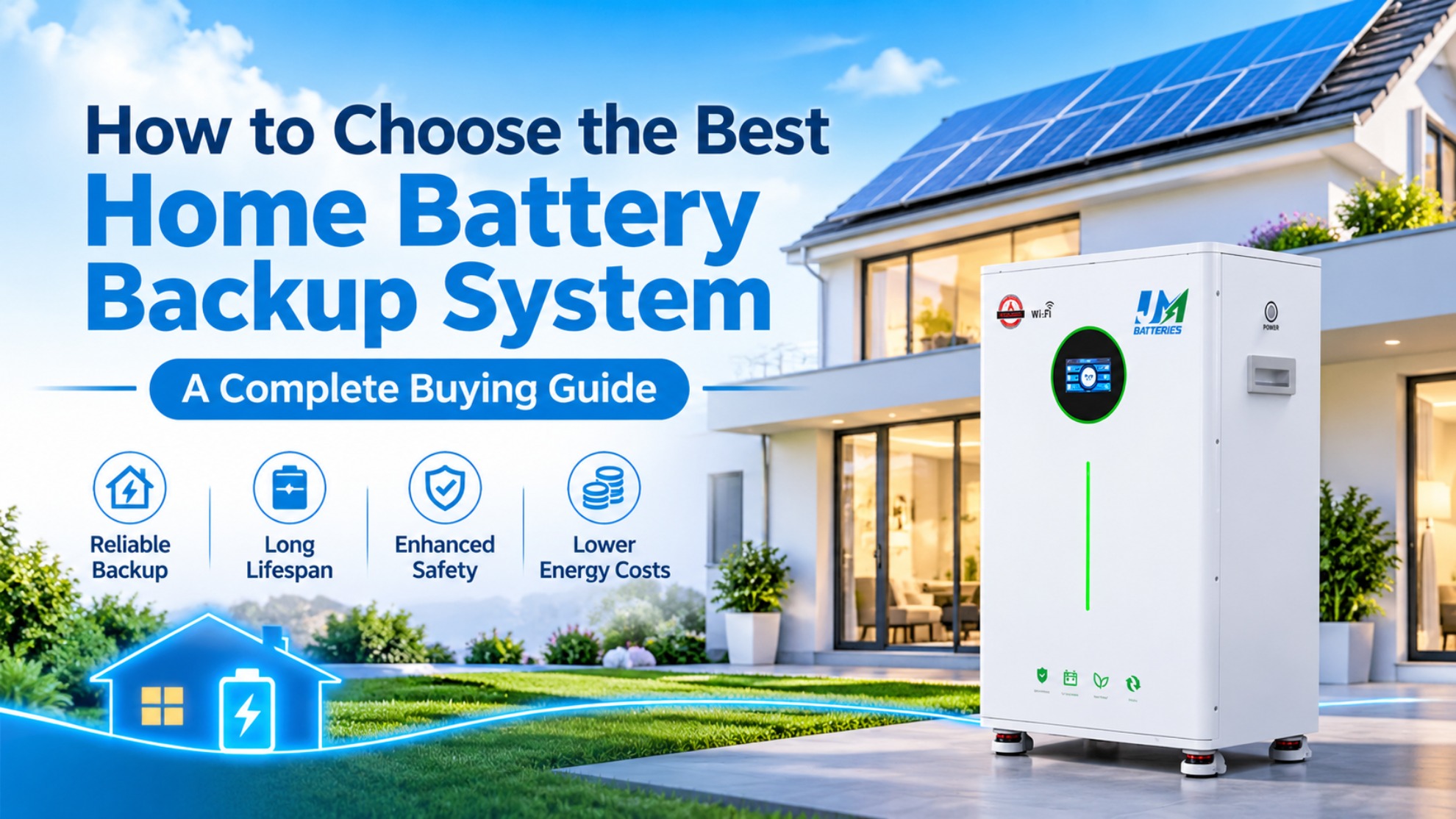
How to Choose the Best Home Battery Backup System
How to Choose the Best Home Battery Backup System: A Complete Buying Guide
A home battery backup system is no longer simply an emergency power source. For many households, it has become an important part of managing electricity costs, making better use of solar energy, and maintaining power during grid interruptions. Choosing the right system, however, involves more than comparing battery capacity or looking for the lowest price.
Battery chemistry, usable capacity, inverter compatibility, system voltage, installation requirements, safety features, warranty conditions, and supplier reliability all influence the final result. A battery that looks suitable on paper may not perform as expected if its communication protocol is incompatible with the inverter or its power rating is insufficient for the household's loads.
This guide explains how to evaluate a home battery backup system from both a technical and procurement perspective. It is intended for homeowners, solar installers, distributors, and wholesalers who need to compare residential energy storage solutions with a clear understanding of their practical requirements.
- What Is a Home Battery Backup System?
- How to Choose the Right Battery Capacity
- Why LiFePO4 Is a Suitable Choice
- Low-Voltage vs. High-Voltage Systems
- Compare Home Battery System Types
- Check Battery-Inverter Compatibility
- Evaluate Safety, BMS, and Certifications
- Lifespan, Cycle Life, and Warranty
- Understand the Total System Cost
- How to Evaluate a Battery Manufacturer
- Three Practical Home Battery Selection Examples
- Home Battery Buying Checklist
- Why Consider JM Batteries?
- FAQ
1. What Is a Home Battery Backup System?
A home battery backup system stores electrical energy and makes it available when household demand exceeds the available power supply or when the grid is interrupted. Depending on the system design, the battery can store electricity generated by solar panels, electricity purchased from the grid, or energy from another compatible charging source.
A typical residential energy storage system includes several main components:
- Battery modules: Store electrical energy for later use.
- Battery Management System (BMS): Monitors battery conditions and manages protective functions.
- Inverter: Converts DC battery power into AC electricity for household appliances. Hybrid inverters may also manage solar generation and grid interaction.
- Solar panels: Generate electricity when a solar charging configuration is installed.
- Protection and distribution equipment: Includes appropriate breakers, disconnects, wiring, and other electrical protection components.
- Monitoring and communication: Allows users or installers to monitor operating status and system information.
These components must work together. Battery capacity alone does not determine how well a system performs. The inverter's output power, battery discharge limits, wiring, protection devices, and system configuration also affect the usable performance of the installation.
How Does a Home Battery Backup System Work?
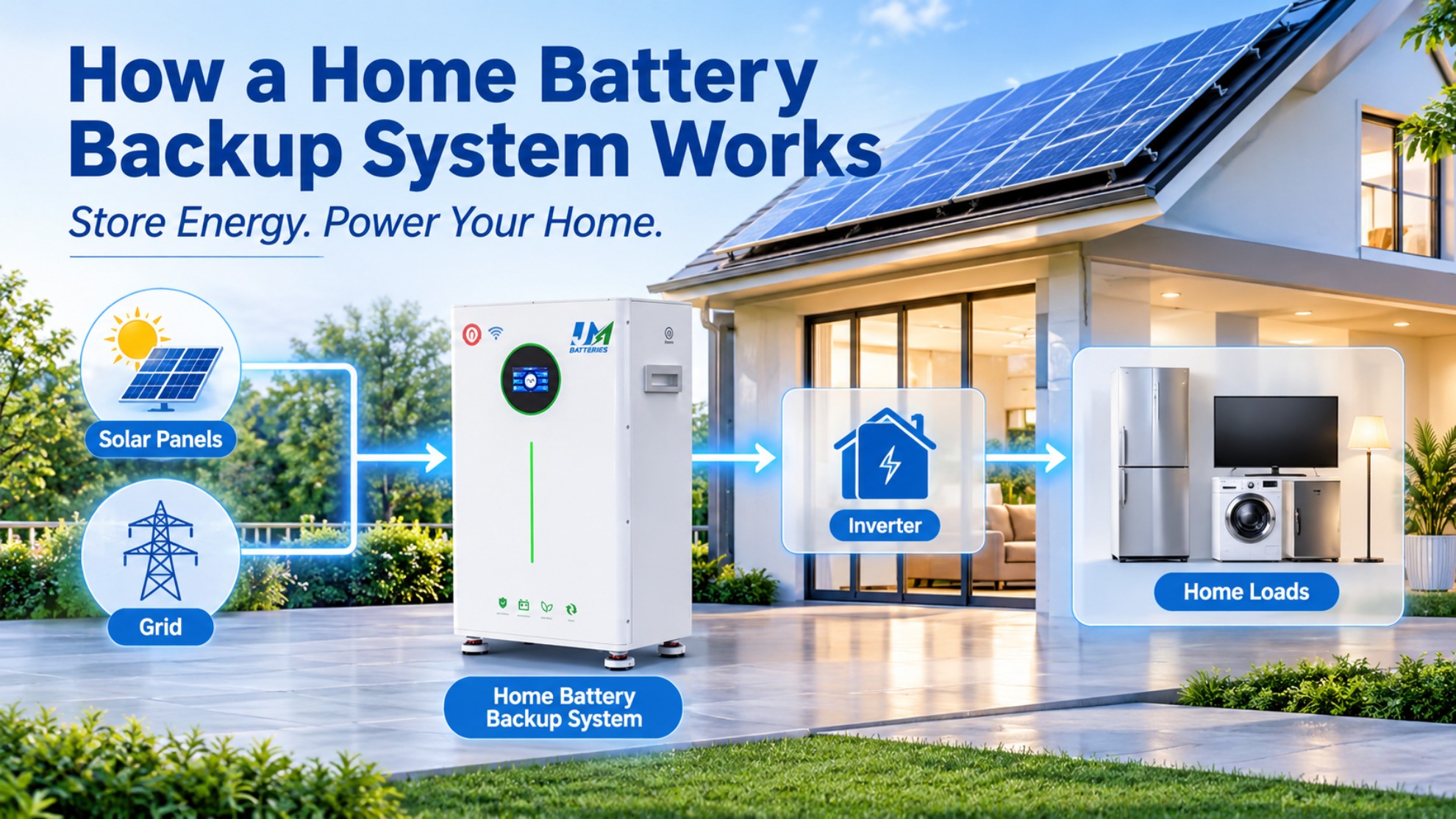
During normal operation, the system can charge the battery using solar energy or another supported power source. The stored energy is then used when household demand requires it, according to the inverter's operating settings.
When the grid fails, a properly designed backup system can supply selected household circuits or, where the equipment supports it, a larger portion of the home. Not every grid-connected solar system provides backup power during an outage. Backup operation requires suitable inverter functionality, electrical isolation, and an installation designed for that purpose.
For a basic explanation of battery operation, see how lithium-ion batteries work.
Common Applications
- Emergency backup: Keeps essential appliances operating during power interruptions.
- Solar self-consumption: Stores surplus solar electricity for use after sunset.
- Time-of-use management: Stores energy when electricity is less expensive and uses it during higher-price periods, where tariffs and system settings make this practical.
- Off-grid operation: Supplies electricity in locations without a reliable grid connection, when the battery, inverter, generation source, and system design are suitable.
2. How to Choose the Right Battery Capacity
Battery capacity is one of the first specifications buyers compare, but the largest battery is not automatically the best choice. A suitable capacity should reflect actual household energy consumption, the appliances that need backup power, the expected backup duration, and the charging opportunities available.
Start With Household Electricity Consumption
Review electricity bills, smart meter records, or energy monitoring data to understand typical daily consumption. However, total household consumption does not always represent the energy that must be supplied during an outage.
Separate essential loads from optional loads. Essential loads may include:
- Refrigerators and freezers
- Lighting
- Internet routers and communication equipment
- Fans and selected ventilation equipment
- Computers and basic electronic devices
- Selected water pumps or other essential equipment
Air conditioners, electric water heaters, ovens, induction cookers, and other high-power appliances can significantly increase battery and inverter requirements. Their starting current and operating patterns should also be considered.
Understand Rated Capacity and Usable Capacity
A battery's rated capacity describes its nominal energy storage capability. The amount of energy available to the household depends on the permitted depth of discharge, operating conditions, battery protection settings, and conversion losses in the system.
For consistent comparison in this guide, the LiFePO4 battery examples use an 80% depth of discharge (DoD) assumption. Buyers should therefore compare usable energy rather than treating the full nameplate capacity as continuously available household energy.
Consider Backup Duration
A household that needs to keep a refrigerator, lights, and internet equipment running overnight has different requirements from a home that expects to operate air conditioning, cooking equipment, and water pumps during a prolonged outage.
Before selecting a battery, identify:
- Which appliances must remain operational.
- How many hours they need to operate.
- Whether high-power appliances will run simultaneously.
- Whether solar panels can recharge the battery during the day.
- Whether the system must operate through several days of poor weather.
Capacity Is Not the Same as Power
Energy capacity is commonly expressed in kilowatt-hours (kWh), while power is expressed in kilowatts (kW). Capacity describes how much energy can be stored. Power describes how quickly energy can be delivered.
A battery may have sufficient energy capacity but still be unsuitable if its continuous discharge rating or the inverter's output rating cannot support the household's simultaneous loads. Buyers should evaluate both specifications.
Capacity Selection Examples
The following scenarios are illustrative planning examples, not actual customer installations. They show how household consumption and backup priorities influence battery selection. Final capacity should be confirmed using appliance-level load data and the specifications of the complete system.
| Household scenario | Daily essential energy use | Selection considerations |
|---|---|---|
| Small household | About 5 kWh/day | Prioritize refrigeration, lighting, communication equipment, and overnight backup. |
| Medium household | About 10 kWh/day | Consider a wider range of household loads and the expected backup duration. |
| Large household | About 20 kWh/day | Assess high-power appliances, inverter output, battery discharge limits, and expansion requirements. |
These daily energy figures are not battery capacity recommendations by themselves. A household's actual battery requirement depends on how much of that energy must come from storage, the desired backup duration, solar availability, and system losses.
3. Why LiFePO4 Is a Suitable Choice for Home Battery Backup
Battery chemistry affects safety characteristics, energy density, operating requirements, service life, and cost. Several chemistries have been used in residential energy storage, but lithium iron phosphate (LiFePO4 or LFP) has become a common option for stationary home storage applications.
LiFePO4 Batteries
LiFePO4 batteries use lithium iron phosphate as the cathode material. Their characteristics make them suitable for many stationary storage applications:
- Good thermal stability compared with several other lithium-ion chemistries.
- Long cycle-life potential under suitable operating conditions.
- Good suitability for repeated charging and discharging.
- No cobalt in the cathode chemistry.
- Available in configurations suitable for wall-mounted, rack-mounted, and modular residential systems.
LiFePO4 batteries also have limitations. Their energy density is generally lower than some nickel-rich lithium-ion chemistries, and their low-temperature charging behavior requires appropriate controls. Battery performance depends on cell design, manufacturing quality, BMS configuration, and operating conditions.
Lead-Acid Batteries
Lead-acid batteries have a long history in backup power applications. They are widely understood and may have a lower initial purchase price in some markets. However, they are generally heavier for a comparable amount of usable energy and may require more frequent replacement in applications involving regular deep cycling.
NMC Lithium-Ion Batteries
Nickel manganese cobalt (NMC) batteries can offer higher energy density than LiFePO4. This can be useful where space and weight are important constraints. However, chemistry selection also requires consideration of thermal management, product design, safety engineering, and the manufacturer's operating specifications.
| Comparison factor | LiFePO4 | Lead-acid | NMC lithium-ion |
|---|---|---|---|
| Thermal characteristics | Generally good thermal stability | Different failure and thermal behavior | Requires careful thermal and safety engineering |
| Cycle-life potential | Generally suitable for frequent cycling | Often more limited under deep cycling | Depends strongly on cell design and operating conditions |
| Energy density | Generally lower than NMC | Generally low | Generally higher than LiFePO4 |
| Typical use consideration | Stationary residential storage | Lower-cost or standby applications | Space- and weight-sensitive applications |
There is no single battery chemistry that is best for every installation. For many residential systems, LiFePO4 offers a practical balance of thermal characteristics, cycle-life potential, and operating cost.
For more detail, read about the advantages of lithium solar batteries.
4. Low-Voltage vs. High-Voltage Home Battery Systems
Residential battery systems are commonly divided into low-voltage and high-voltage architectures. The appropriate design depends on system power, inverter requirements, installation conditions, cable design, and the intended application.
Low-Voltage Systems: 48V and 51.2V
Low-voltage residential batteries are often marketed in the 48V class. A common LiFePO4 configuration has a nominal voltage of 51.2V, typically based on sixteen cells connected in series.
These systems are widely used in residential solar storage and backup applications. They are available in wall-mounted, rack-mounted, and modular formats.
Potential advantages include:
- A broad range of residential inverter options in supported markets.
- Modular battery configurations for some system designs.
- Relatively familiar installation practices for qualified installers.
- Suitability for many small and medium-sized household applications.
At higher power levels, low-voltage systems require higher current. This makes conductor sizing, connection quality, protection devices, and battery discharge limits especially important.
High-Voltage Systems
High-voltage systems connect battery modules into a higher-voltage DC architecture. For the same power transfer, a higher DC voltage can reduce current, which may reduce conductor losses and cable requirements when the system is properly designed.
High-voltage systems may be appropriate for larger residential installations or inverter platforms specifically designed for high-voltage batteries. They also require compatible battery modules, control equipment, safety provisions, and installation procedures.
| Factor | Low-voltage system | High-voltage system |
|---|---|---|
| Typical application | Many small and medium residential systems | Selected larger residential systems |
| Current at comparable power | Higher | Lower |
| Cable and connection design | High-current connections require attention | High-voltage insulation and protection require attention |
| Compatibility | Must match the inverter's low-voltage battery input | Must match the inverter's high-voltage battery architecture |
| Expansion | Depends on approved parallel configuration | Depends on supported module and system architecture |
Neither architecture is automatically superior. Buyers should select a battery voltage that matches the inverter platform, power requirement, installation design, and manufacturer's approved configuration.
5. Compare Home Battery System Types
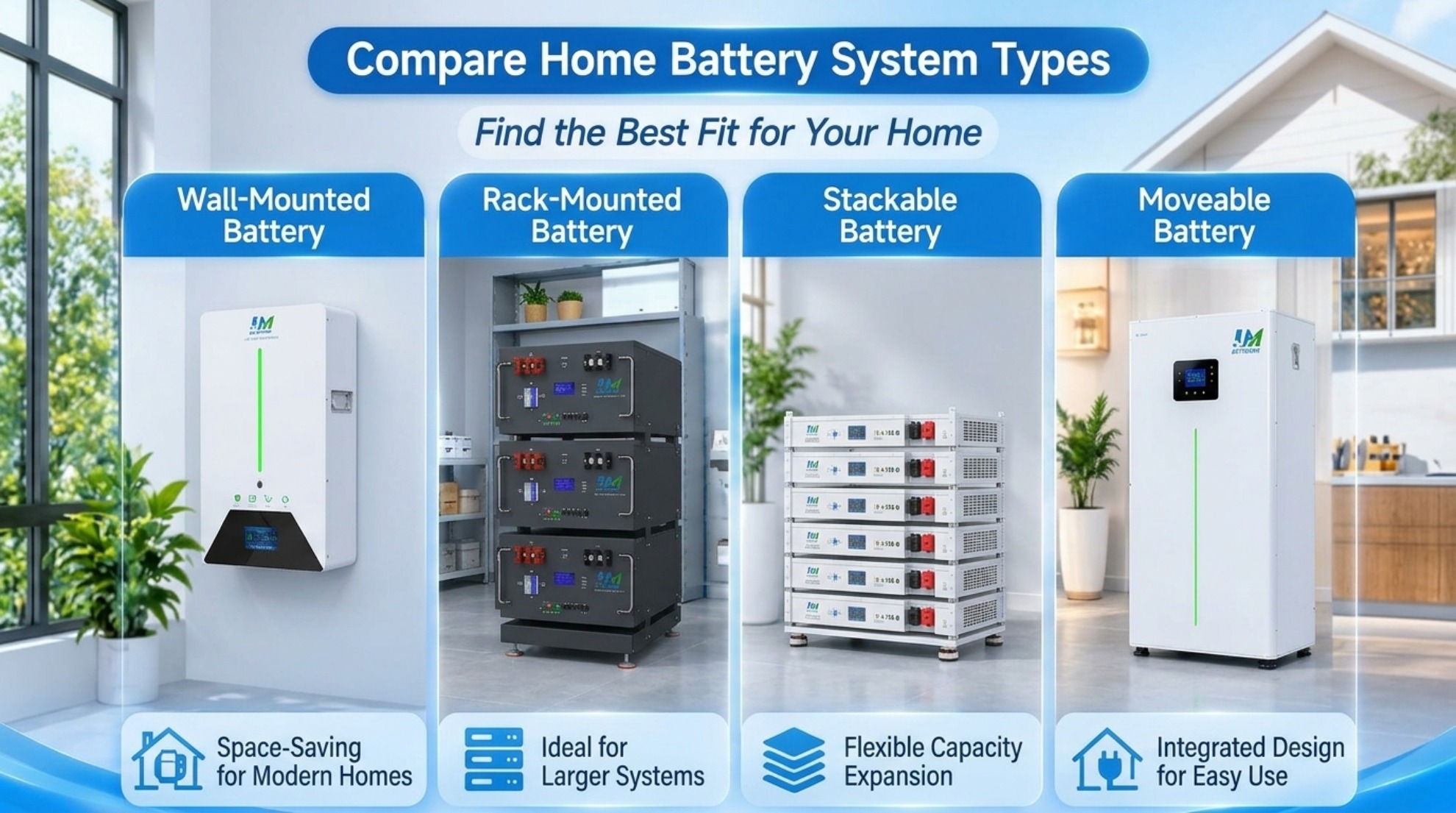
Battery form factor influences installation space, maintenance access, system expansion, and the overall appearance of a residential installation. The main formats include wall-mounted batteries, rack-mounted batteries, stackable systems, and all-in-one systems.
Wall-Mounted Batteries
Wall-mounted batteries are designed to be installed on a suitable wall or mounting structure. They are often selected for homes where floor space is limited and a clean installation appearance is preferred.
Before installation, check the wall's load-bearing capacity, mounting requirements, clearance, ventilation recommendations, and access for maintenance. The installation location must also comply with local electrical and fire-safety requirements.
Rack-Mounted Batteries
Rack-mounted batteries are designed for installation in compatible battery cabinets or equipment racks. They can be useful for installers and distributors who need standardized modules and a more organized system layout.
Rack systems require attention to rack dimensions, weight distribution, cable routing, ventilation, electrical protection, and communication connections.
Stackable Battery Systems
Stackable systems use modular battery units that can be combined to increase storage capacity. Their main benefit is configuration flexibility. A system may begin with a smaller capacity and expand later if the manufacturer supports the proposed arrangement.
Expansion should never be assumed to be unrestricted. Confirm supported module counts, battery model combinations, firmware requirements, current sharing, and installation instructions before adding modules.
All-in-One Home Energy Storage Systems
An all-in-one system integrates multiple energy storage components into a coordinated product. Depending on the model, this may include a battery, inverter, control electronics, and other system components.
All-in-one systems can simplify product selection and installation planning, but buyers should still verify output power, usable battery capacity, backup functionality, grid requirements, monitoring features, and service access.
| System type | Main advantage | Important selection point |
|---|---|---|
| Wall-mounted | Space-efficient installation | Wall strength and mounting clearance |
| Rack-mounted | Organized modular installation | Rack compatibility and cable layout |
| Stackable | Potential for modular expansion | Approved battery combinations and limits |
| All-in-one | Integrated system architecture | Complete system specifications and serviceability |
6. Check Battery-Inverter Compatibility
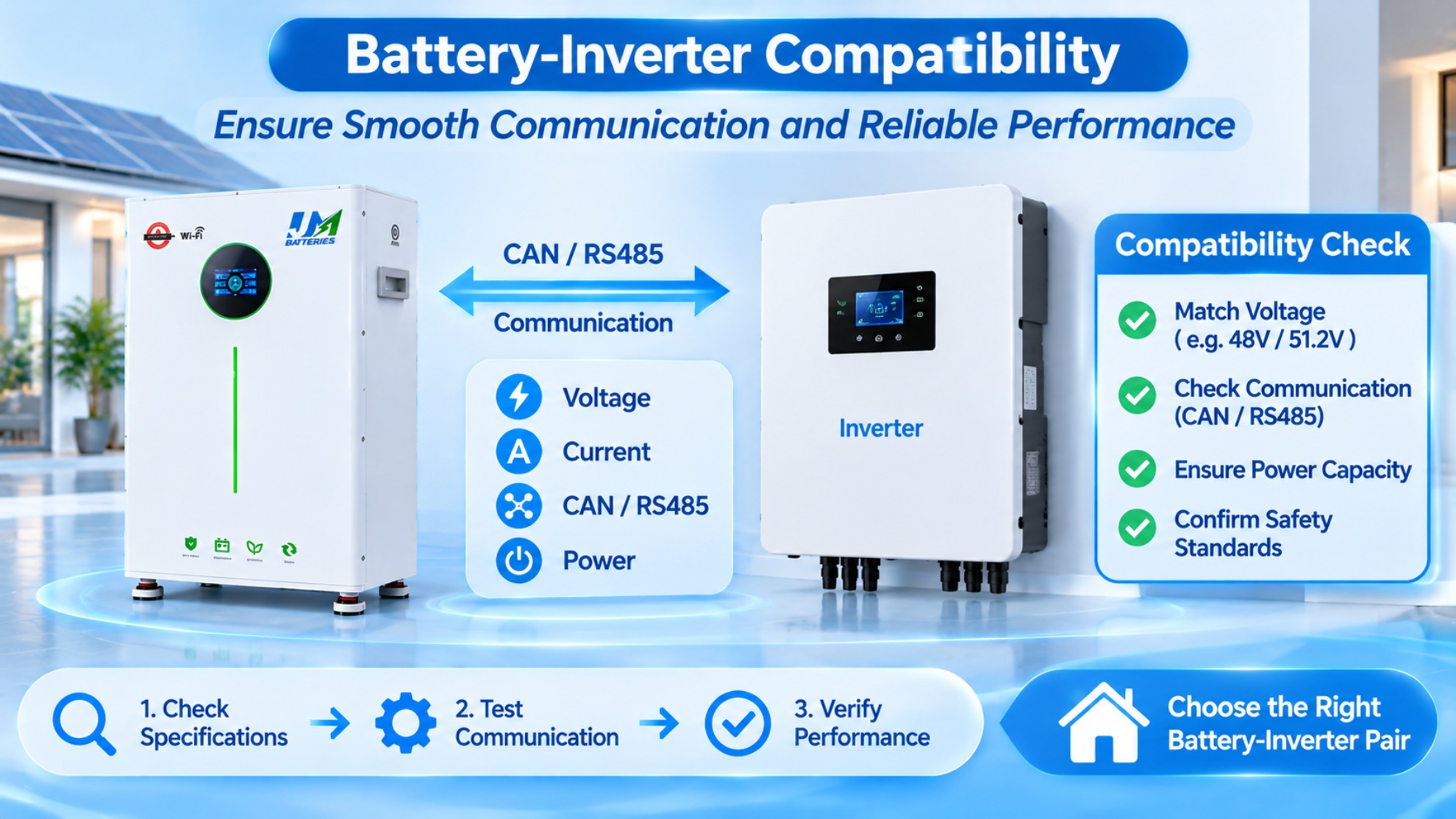
Battery-inverter compatibility is one of the most important checks when selecting a home battery backup system. A battery and inverter may have similar nominal voltage ratings but still fail to operate together correctly.
Check the Voltage Range
Compare the battery's operating voltage range with the inverter's supported battery voltage range. Do not rely only on a product's nominal voltage label. The full charging and discharging voltage ranges must be suitable for the inverter.
Check Charging and Discharging Current
The battery's maximum continuous charge and discharge current must be considered alongside the inverter's requirements. The system should not depend on a current level that exceeds the battery's approved operating limits.
Also check peak current limits and their permitted duration. Short-duration surge requirements may differ from continuous operating requirements.
Check Power Ratings
Compare the inverter's continuous AC output power and surge capability with the loads the household intends to operate. The battery must be able to supply the required DC power within its permitted operating limits.
Verify Communication Protocols
Many modern battery systems communicate with inverters through CAN or RS485. Communication can allow the inverter to receive battery information and adjust charging or discharging behavior.
However, the presence of a CAN or RS485 port does not prove compatibility. The communication protocol, pin assignment, baud rate, firmware, supported message definitions, and inverter model must all be checked.
Check the Approved Compatibility List
Before purchasing, request the manufacturer's compatibility documentation for the exact battery model and inverter model. If the combination is not listed, ask the technical teams of both manufacturers to confirm the proposed configuration.
For a more detailed explanation, read battery and inverter compatibility.
7. Evaluate Safety, BMS, and Certifications
Battery safety depends on cell quality, pack design, electrical protection, thermal management, BMS functionality, manufacturing controls, installation conditions, and correct system operation. A product label alone cannot establish the safety of a complete installation.
What Does a Battery Management System Do?
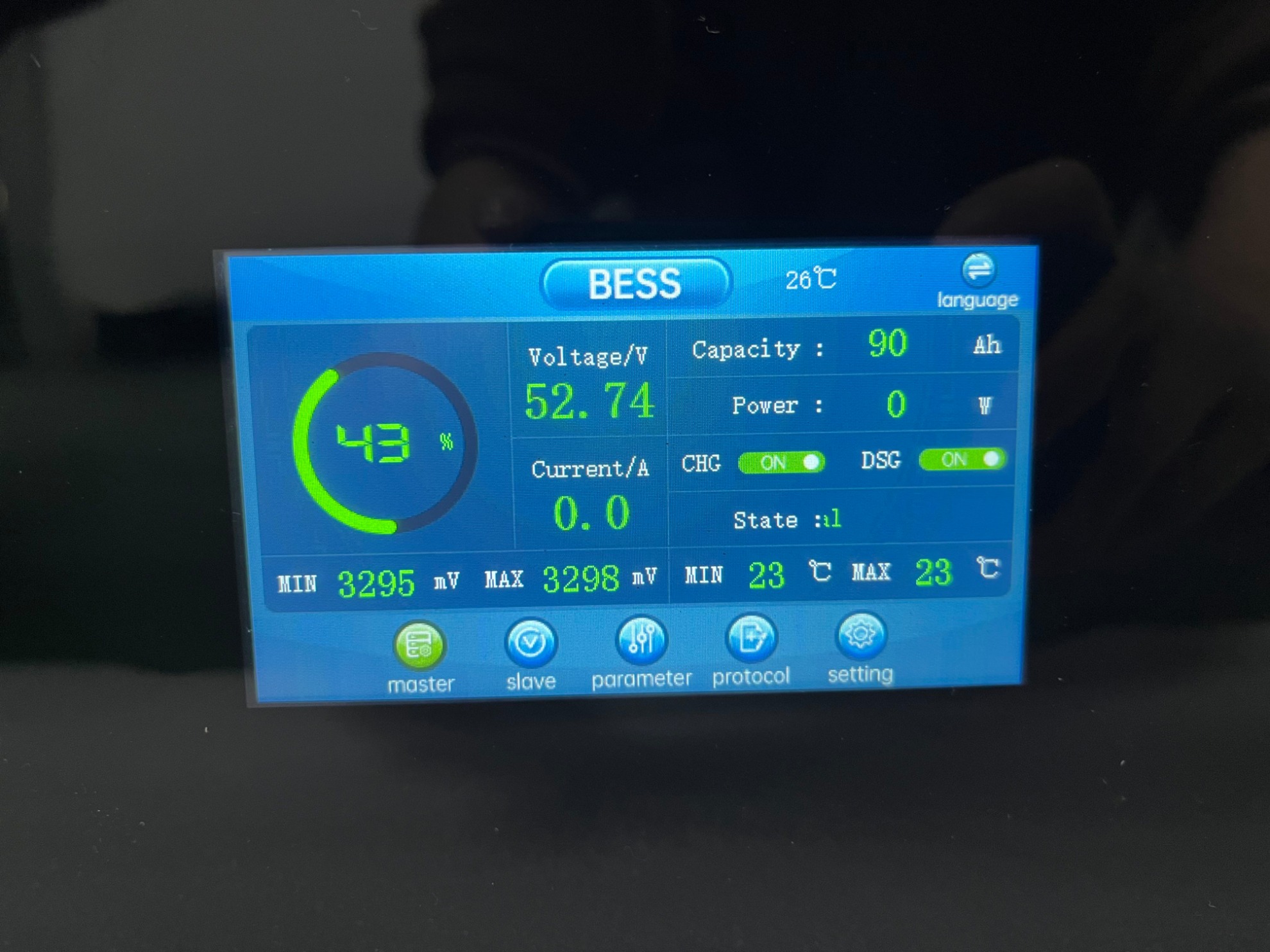
The BMS monitors battery operating conditions and manages protective functions. Depending on the product design, these functions may include:
- Overvoltage protection
- Overdischarge protection
- Short circuit protection
- Overcurrent protection
- Overtemperature protection
- Passive balancing
Not every BMS provides the same protection functions or control capabilities. Buyers should review the actual product specification and technical documentation rather than assuming that all batteries have identical features.
Cell Quality and Manufacturing Consistency
Battery performance depends on the quality and consistency of the cells used in the pack. Procurement teams should ask how cells are sourced, inspected, matched, and traced during production.
Quality-control procedures may include incoming cell inspection, voltage and internal-resistance checks, pack assembly inspection, welding quality checks, BMS verification, and finished-product testing. The specific procedures and acceptance criteria should be documented by the manufacturer.
Understand Relevant Standards and Certifications
Several standards and testing frameworks may be relevant to residential battery products. Their scope is different, so they should not be treated as interchangeable.
| Standard or framework | General scope | What buyers should verify |
|---|---|---|
| IEC 62619 | Safety requirements for secondary lithium cells and batteries used in industrial applications, including certain stationary applications. | Applicable product model and supporting test or certification documents. |
| UL 1973 | Safety standard for batteries used in stationary and other specified applications. | Certification listing and exact model coverage. |
| UL 9540 | Safety standard for energy storage systems and equipment. | Whether the complete system configuration is covered. |
| UL 9540A | Test method for evaluating thermal runaway fire propagation in battery energy storage systems. | Actual test report, tested configuration, and conditions. It is a test method, not a standalone product certification. |
| UN 38.3 | Transport testing requirements for lithium batteries. | Test summary and applicability to the shipped battery type. It is not a general residential installation safety certification. |
| CE marking | Indicates conformity with applicable European Union legislation where CE marking is required. | Applicable legislation, technical documentation, declaration of conformity, and product scope. |
Requirements vary by country, product category, installation type, and market. Buyers should confirm the applicable rules with local authorities, certification bodies, and qualified professionals. A certificate for one battery model or system configuration should not automatically be assumed to cover another.
For additional information, see this guide to home energy storage battery safety.
8. Lifespan, Cycle Life, and Warranty
Battery lifespan is influenced by chemistry, cell quality, depth of discharge, temperature, charging and discharging rates, storage conditions, and usage patterns. Cycle-life ratings are useful for comparing products, but they do not independently determine how many calendar years a battery will operate.
Cycle Life and Depth of Discharge
Cycle life describes the number of charge and discharge cycles a battery can complete under specified test conditions before reaching a defined capacity-retention threshold. The test conditions and end-of-life criteria matter when comparing different products.
For consistency, this guide uses the following reference specification:
- Depth of Discharge: 80% DoD
- Cycle Life: 8,000 cycles at 80% DoD
These figures should be used only where they are supported by the relevant product datasheet and test conditions. Actual service life varies with operating conditions.
A cycle-life rating is not a promise that every installed battery will reach the same number of cycles. Real-world performance can differ because of temperature, charge rate, discharge rate, idle time, cell variation, and system settings.
Temperature and Operating Conditions
Temperature has a significant effect on lithium battery operation. High temperatures can accelerate degradation, while charging at temperatures below the manufacturer's permitted range can damage lithium-ion cells.
Battery systems should use appropriate temperature monitoring and protection. If a battery is installed in a location exposed to extreme heat or cold, the installer should verify the manufacturer's operating and charging limits and determine whether additional environmental control is needed.
Read more about how temperature affects battery performance.
Battery Degradation
Battery capacity gradually decreases as the cells age. This process is affected by both calendar aging and cycling. A battery may lose capacity even when it is not being used heavily, particularly if it is stored or operated under unfavorable conditions.
When evaluating a product, ask the supplier for capacity-retention information, test conditions, and any limitations on the stated cycle-life rating. A useful technical document should explain the conditions under which the rating was established.
For more detail, see the guide to LiFePO4 battery degradation.
9. Understand the Total Cost of a Home Battery Backup System
The battery purchase price is only one part of the total cost of a residential energy storage project. A complete system may also require an inverter, mounting equipment, electrical protection, cabling, installation labor, commissioning, and monitoring equipment.
Battery Cost
Battery prices vary according to chemistry, capacity, cell quality, BMS features, enclosure design, certifications, and manufacturing scale. A lower purchase price does not necessarily indicate better long-term value.
Inverter and Electrical Equipment
The inverter must support the required battery voltage, charging and discharging limits, output power, and operating modes. Additional costs may include breakers, disconnects, protection devices, wiring, distribution equipment, and communication accessories.
Installation and Commissioning
Installation costs depend on system complexity, site conditions, electrical upgrades, local labor rates, and regulatory requirements. Wall-mounted, rack-mounted, and high-voltage systems may involve different mounting and electrical work.
Long-Term Ownership
When comparing quotations, consider the complete installed system, usable energy, inverter performance, warranty conditions, expected maintenance, and after-sales support. A product with a higher initial price may be more suitable if it offers better documentation, reliability, and service support.
Distributors and installers should also consider logistics, packaging, spare parts availability, technical training, and the cost of supporting customers after installation.
10. How to Evaluate a Home Battery Manufacturer
For distributors, wholesalers, and installers, supplier selection is a long-term business decision. Product specifications matter, but production capability, quality control, technical documentation, and after-sales support also influence project delivery and customer satisfaction.
Manufacturing Capability
Review the manufacturer's production facilities, assembly processes, quality-control procedures, and ability to maintain consistent product output. A factory visit, production video, or independent audit can help buyers understand how the manufacturer manages manufacturing quality.
Cell Sourcing and Traceability
Ask how the manufacturer selects and inspects battery cells. Documentation should explain incoming inspection, cell matching, production traceability, and how nonconforming materials are handled.
The term "Grade A" is commonly used in the battery market, but it is not a universal independent certification. Buyers should request meaningful supporting information, such as cell specifications, supplier documentation, inspection records, and relevant test results.
Research and Development
A capable manufacturer should be able to explain its battery design, BMS configuration, thermal considerations, communication functions, and product testing process. Technical questions should be answered by personnel who understand the actual product rather than relying only on sales descriptions.
OEM and ODM Services
OEM and ODM capabilities can be important for distributors building their own product ranges. Buyers should clarify available customization options, including enclosure design, labels, communication functions, monitoring interfaces, packaging, and documentation.
Customization should be supported by engineering review and appropriate validation. A change to the battery pack, BMS, or electrical configuration may affect product testing and certification scope.
Technical and After-Sales Support
Before placing a large order, confirm whether the supplier can provide:
- Detailed product datasheets
- Installation and operation manuals
- Battery-inverter compatibility information
- Communication protocol documentation where applicable
- Warranty terms and claim procedures
- Troubleshooting guidance
- Technical support for installers and distributors
- Consistent spare parts and product supply arrangements
Clear technical support can reduce commissioning problems and help installers resolve issues more efficiently.
11. Three Practical Home Battery Selection Examples
The following examples are hypothetical scenarios designed to illustrate how different households may approach battery selection. They are not actual customer projects or claims about completed installations.
Example 1: A Small Household With Essential Backup Loads
A small household uses approximately 5 kWh of electricity per day for essential appliances. Its main priorities are keeping the refrigerator, lighting, internet router, and a few electronic devices operating during outages.
For this household, the selection process should begin with an appliance list and the expected backup duration. The buyer should avoid sizing the system around total household consumption if some appliances will not be used during an outage.
A compact low-voltage LiFePO4 system may be appropriate if its usable capacity, discharge current, and inverter output meet the actual load requirements. The installation should also allow suitable charging from the available solar or grid source.
Example 2: A Medium Household With Daily Solar Storage Needs
A medium household has approximately 10 kWh of daily essential energy consumption. It wants to use more of its solar generation in the evening and maintain selected household loads during grid interruptions.
In addition to battery capacity, this household should consider the amount of surplus solar energy available during the day. If the solar array cannot regularly recharge the battery, increasing battery capacity alone may not deliver the expected benefit.
The inverter should support the intended operating modes, and the battery should have sufficient continuous discharge capability for the selected appliances. Monitoring functions can help the homeowner understand daily charging and discharging behavior.
Example 3: A Large Household With Higher Power Requirements
A large household uses approximately 20 kWh per day for essential energy needs and expects to operate more appliances during an outage. Air conditioning, pumps, cooking equipment, and other high-power loads may be part of the backup plan.
This application requires careful review of both energy capacity and power output. The installer should assess which loads operate simultaneously, the starting current of motor-driven equipment, and the inverter's continuous and surge ratings.
A modular battery configuration or a higher-voltage system may be considered where supported by the selected inverter and battery manufacturer. The final design should include appropriate protection, wiring, commissioning, and expansion limits.
12. Home Battery Backup System Buying Checklist
Before purchasing a residential battery system, use the following checklist to compare products and suppliers.
Energy and Performance
- Have daily electricity consumption and essential loads been identified?
- Is rated capacity clearly distinguished from usable capacity?
- Are the DoD and cycle-life test conditions documented?
- Are continuous and peak discharge ratings suitable?
- Can the system provide the expected backup duration?
System Compatibility
- Does the battery voltage range match the inverter?
- Are charging and discharging current limits compatible?
- Has the exact inverter model been checked?
- Are communication protocols and firmware supported?
- Is parallel operation explicitly approved where required?
Safety and Compliance
- Are relevant certificates and test reports available?
- Do the documents cover the exact supplied model?
- Does the BMS provide the required protective functions?
- Are installation instructions and safety documentation available?
- Does the proposed installation meet local regulations?
Supplier and Commercial Terms
- Can the manufacturer demonstrate production and quality-control capability?
- Are cell sourcing and traceability procedures documented?
- Are OEM/ODM requirements clearly defined?
- Are warranty conditions transparent?
- Is technical and after-sales support available?
- Are lead times, packaging, logistics, and order terms clear?
13. Why Consider JM Batteries for Home Energy Storage?
For distributors, wholesalers, and installers, choosing a home battery supplier involves more than selecting a battery with the right capacity. Product consistency, manufacturing processes, technical support, customization options, and supply capability all matter when building a residential energy storage business.
JM Batteries focuses on LiFePO4 battery solutions for residential and home energy storage applications. Its product range includes different battery formats and capacities designed for a variety of installation and system requirements.
Residential Energy Storage Product Options
Home storage projects have different space, capacity, and installation requirements. Wall-mounted, rack-mounted, stackable, and integrated battery configurations can help distributors and installers serve different residential applications.
When evaluating a JM Batteries product, buyers should review the exact model's rated voltage, capacity, usable energy, maximum current, BMS functions, communication options, enclosure rating, operating temperature, and warranty documentation.
Manufacturing and Quality Control
JM Batteries operates in Dongguan, China, and provides battery manufacturing and customization services. Buyers evaluating the company should request current company documentation, product specifications, quality-control information, and applicable certification records for the specific products under consideration.
OEM and ODM Support
For distributors and wholesalers, OEM and ODM services can support brand development and product differentiation. Customization requirements should be discussed with the engineering and sales teams so that product configuration, labels, packaging, communication features, and technical documentation are clearly defined before production.
Technical Support and Product Selection
Battery and inverter compatibility should be confirmed at the model level. JM Batteries customers should request the relevant datasheets and compatibility information before finalizing a system design or placing an order.
Looking for a Home Battery Storage Solution?
If you are a solar distributor, wholesaler, installer, or residential energy storage business, contact JM Batteries to discuss LiFePO4 battery options, OEM/ODM requirements, product specifications, and technical support.
Visit JM Batteries to explore home energy storage solutions and request further product information.
14. FAQ
1. What is the best home battery backup system?
The best home battery backup system depends on household energy consumption, backup requirements, inverter compatibility, installation space, and budget. For many residential applications, LiFePO4 batteries are a practical option because of their thermal characteristics and cycle-life potential. The complete system should also include a compatible inverter, a properly configured BMS, and suitable electrical protection.
2. How much battery capacity does a home need?
The required battery capacity depends on daily electricity consumption, the appliances that need backup power, and the expected backup duration. A household using 5 kWh per day for essential loads has different requirements from one using 10 or 20 kWh. When selecting a LiFePO4 battery, consider its usable capacity at 80% DoD rather than assuming the entire rated capacity is available.
3. Is LiFePO4 the best battery for home backup?
LiFePO4 is a popular choice for residential energy storage because it offers good thermal stability, long cycle-life potential, and suitability for repeated charging and discharging. Compared with lead-acid batteries, it generally provides a longer service life in applications involving regular cycling. The final choice should also consider system cost, installation requirements, operating temperature, and inverter compatibility.
4. How long does a home battery backup system last?
The service life of a home battery backup system depends on battery chemistry, operating temperature, depth of discharge, charging and discharging rates, and usage patterns. A LiFePO4 battery specified for 8,000 cycles at 80% DoD has a cycle-life rating based on those stated conditions. Actual service life may differ, so buyers should also review capacity-retention guarantees and warranty terms.
5. Can a home battery backup system work without solar panels?
Yes. A home battery backup system can operate without solar panels if it is connected to a compatible grid-charging source or another suitable charging system. It can store electricity from the grid and provide backup power during an outage. The charging configuration and operating modes depend on the inverter and local electrical requirements.
6. Is a 48V battery suitable for home energy storage?
Yes. Low-voltage batteries in the 48V class, including 51.2V nominal LiFePO4 batteries, are widely used in residential energy storage systems. They are suitable for many small and medium-sized home storage applications. For higher power requirements, system designers should evaluate current limits, cable sizing, inverter ratings, and whether a high-voltage architecture is more appropriate.
7. How do I choose a compatible battery and inverter?
Check the battery and inverter's operating voltage ranges, charging and discharging current limits, continuous and peak power ratings, communication protocols, and supported operating modes. A CAN or RS485 port alone does not guarantee compatibility. Confirm the exact battery model, inverter model, communication protocol, and firmware requirements with the manufacturers before installation.
8. Can multiple home batteries be connected in parallel?
Some home battery systems support parallel connection to increase total storage capacity. However, the batteries must be approved for parallel operation and configured according to the manufacturer's instructions. Check voltage consistency, battery model compatibility, BMS communication, current sharing, cable arrangement, and the maximum number of supported units before expanding a system.
9. What certifications should I check when buying a home battery backup system?
Relevant standards and regulatory requirements may include IEC 62619, UL 1973, UL 9540, UL 9540A, UN 38.3, and applicable CE requirements. Their scope differs: some address battery safety, some apply to complete energy storage systems, and others cover transport testing or specific test methods. Buyers should verify the actual certificates, reports, product models, and target-market requirements rather than relying on standard names alone.
10. What should I look for in a home battery manufacturer?
Evaluate the manufacturer's production capability, cell sourcing, quality-control procedures, BMS engineering, product testing, inverter compatibility documentation, warranty conditions, and after-sales support. For distributors and installers, OEM/ODM capabilities, technical documentation, supply consistency, and communication support are also important when selecting a long-term supplier.
11. How much does a home battery backup system cost?
The total cost depends on battery capacity, inverter selection, system architecture, installation labor, electrical protection, and any required upgrades. A meaningful comparison should consider the complete installed system rather than the battery price alone. Warranty coverage, usable capacity, expected operating life, and after-sales support also affect long-term value.
15. Conclusion: Choose a System That Fits the Home, Not Just the Battery Specification
Choosing the best home battery backup system requires a complete assessment of household energy use, backup priorities, battery chemistry, usable capacity, inverter compatibility, installation conditions, safety documentation, and long-term ownership costs.
LiFePO4 batteries are a practical option for many residential storage applications, but the battery itself is only one part of the system. A suitable inverter, correctly configured BMS, approved communication arrangement, appropriate electrical protection, and professional installation are equally important.
For homeowners, the priority should be a system that reliably supports the loads that matter. For distributors, wholesalers, and installers, the decision should also include manufacturer capability, product consistency, technical documentation, warranty conditions, and after-sales support.
A well-selected home battery backup system is not necessarily the largest or least expensive option. It is the system whose performance, configuration, and support match the actual requirements of the home.

JM New Energy Technology



Why Does My LiFePO4 Battery Keep Disconnecting