


LiFePO4 Batteries for Solar Energy Storage: Benefits, Applications & How to Choose
LiFePO4 Batteries for Solar Energy Storage: Benefits, Applications & How to Choose
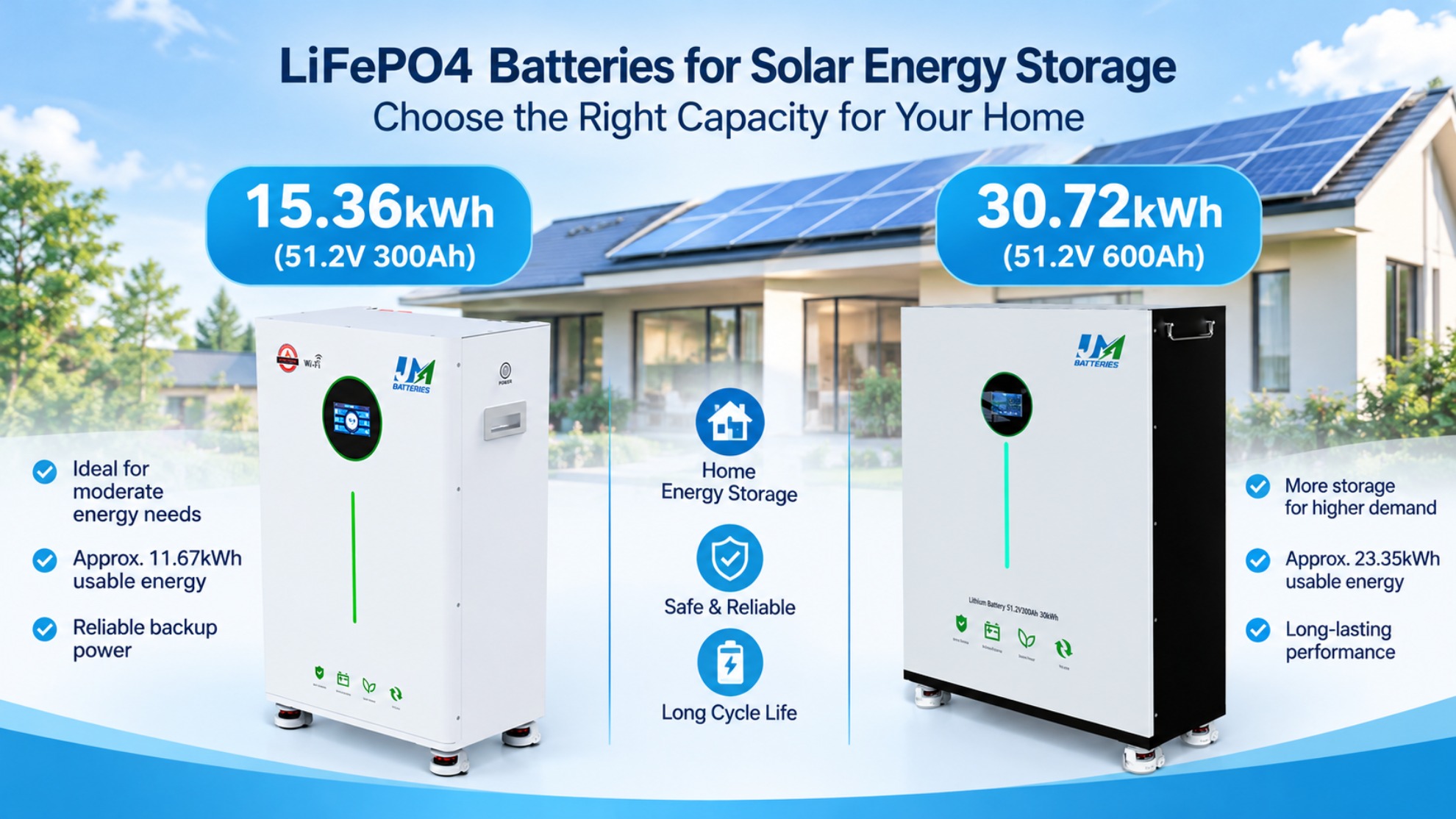
Solar panels can generate electricity during the day, but a home often needs power after sunset or during a grid outage. That is where battery storage becomes important. Among the available options, lithium iron phosphate batteries, commonly called LiFePO4 batteries, are widely used in residential solar energy storage.
They offer a combination of cycle life, thermal stability, usable capacity, and charging performance that makes them suitable for daily energy storage. However, choosing a battery involves more than comparing kWh ratings. Capacity, output power, inverter compatibility, protection functions, and supplier support all affect how well a system performs.
This guide explains how LiFePO4 batteries work in solar systems, compares two common home storage configurations, and outlines what installers, distributors, and buyers should check before purchasing.
1. What Are LiFePO4 Batteries for Solar Energy Storage?
LiFePO4 stands for lithium iron phosphate, the material used in the battery's cathode. Unlike lead-acid batteries, LiFePO4 batteries use lithium-ion chemistry to store and release electrical energy through the movement of lithium ions between the electrodes.
In a residential solar system, the battery stores surplus electricity generated by solar panels. The stored energy can then supply household loads at night, during periods of low solar production, or when the utility grid is unavailable.
For a closer look at the underlying technology, read our guide to how lithium-ion batteries work.
LiFePO4 batteries are commonly available in low-voltage residential configurations, including 48V-class systems with a nominal voltage of 51.2V. They are also used in larger battery systems designed for higher storage capacity.
2. Why Choose LiFePO4 Solar Batteries?
LiFePO4 batteries are popular in home solar storage because several characteristics suit repeated daily charging and discharging.
Long Cycle Life
Solar batteries may charge and discharge almost every day. LiFePO4 chemistry can support many cycles when operated within the manufacturer's recommended voltage, temperature, current, and depth-of-discharge limits.
Cycle-life claims should always be checked against their test conditions. A claim of 6,000 or 8,000 cycles is not meaningful without knowing the depth of discharge, charge and discharge rate, temperature, and remaining-capacity threshold used in the test.
Actual performance also depends on long-term capacity loss. Learn more about LiFePO4 battery degradation and the factors that influence battery lifespan.
Thermal Stability
LiFePO4 chemistry generally offers better thermal stability than some other lithium-ion chemistries, including NMC. This is one reason it is widely used in stationary energy storage. It does not mean the battery is fireproof: correct installation, electrical protection, and a suitable battery management system remain essential.
Usable Energy and Daily Operation
Battery capacity is usually expressed in kilowatt-hours (kWh). The amount of energy available to household loads depends on the permitted depth of discharge and system conversion losses. A battery's nominal capacity should therefore not be treated as the exact amount of AC electricity it can deliver.
You can also explore the advantages of lithium solar batteries to understand how lithium-based storage compares with other battery technologies.
3. How Do LiFePO4 Batteries Work with Solar Panels?
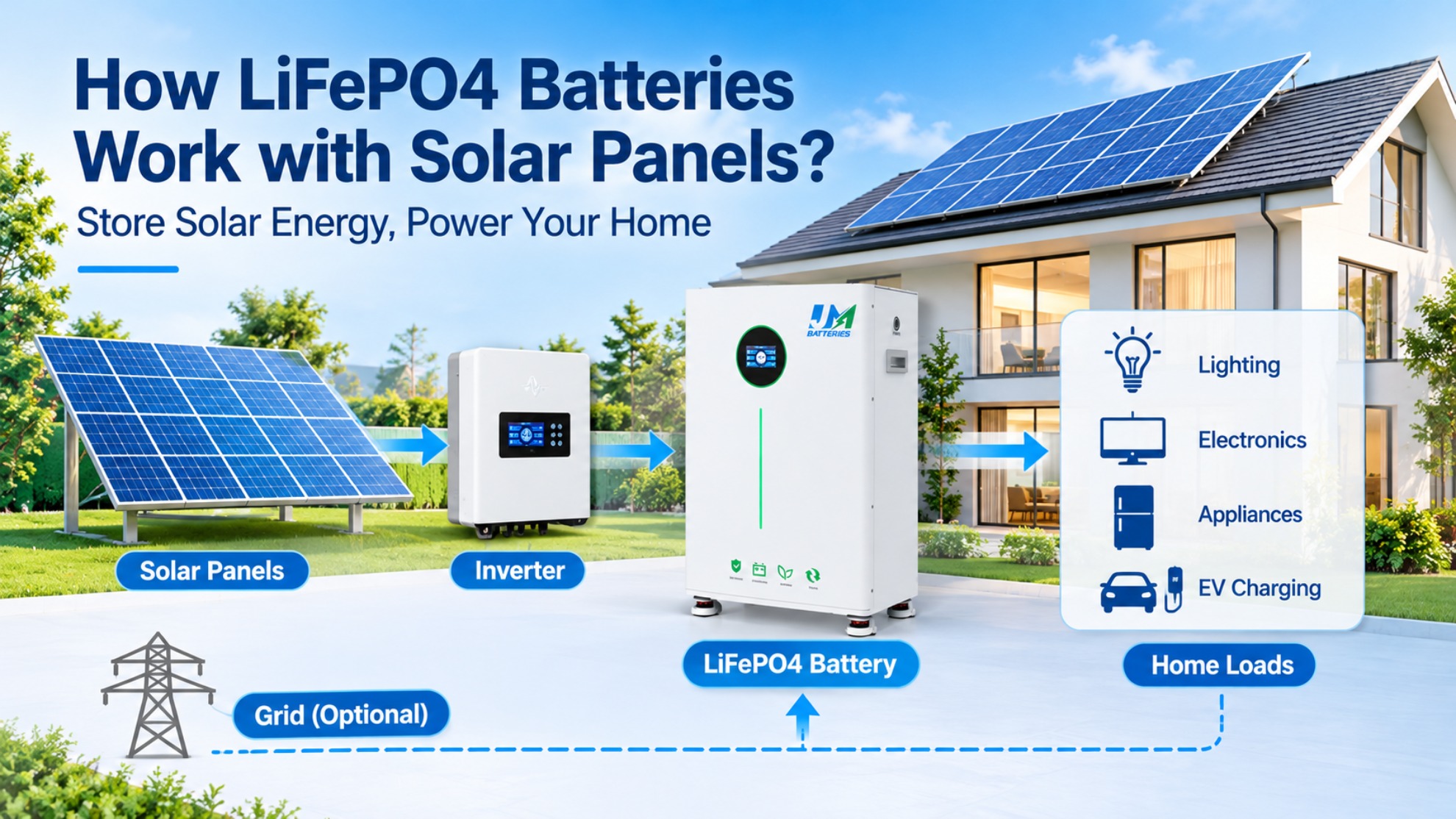
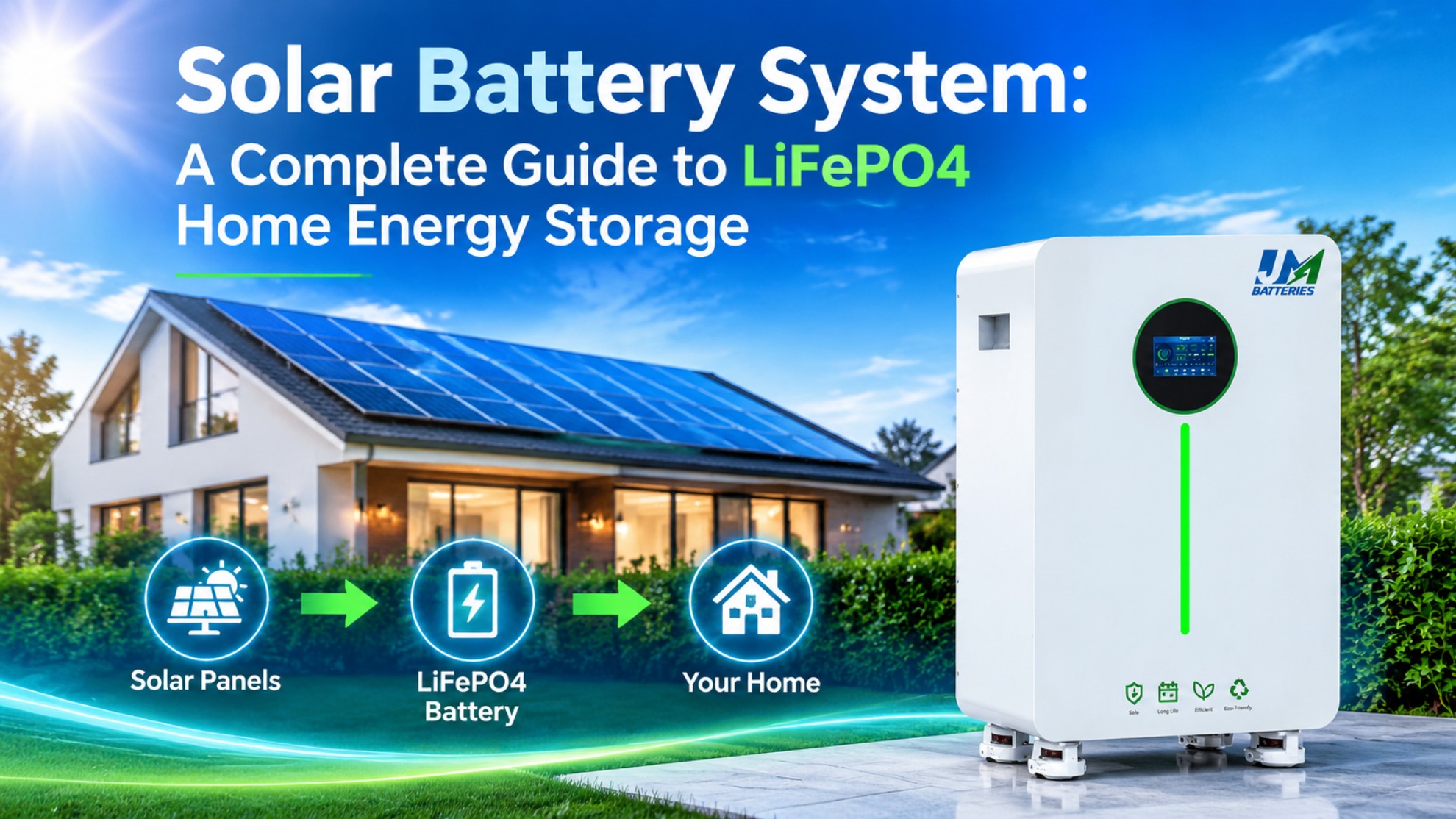
A typical home solar storage system includes solar panels, a solar inverter or hybrid inverter, a battery, a battery management system (BMS), and household electrical loads.
During the day, solar panels generate electricity. The inverter supplies power to active household loads and directs available surplus energy to charge the battery. When solar production falls, the battery can discharge to support the home, depending on the system configuration and operating settings.
In a grid-connected system, the inverter may also use grid electricity to charge the battery if this function is supported and enabled. During a power outage, backup operation depends on whether the inverter supports islanding and has a properly configured backup output.
The battery and inverter must work together as a system. Matching voltage alone is not enough. Communication settings, current limits, charging parameters, and backup functions also matter.
4. How Much Battery Capacity Does a Home Need?
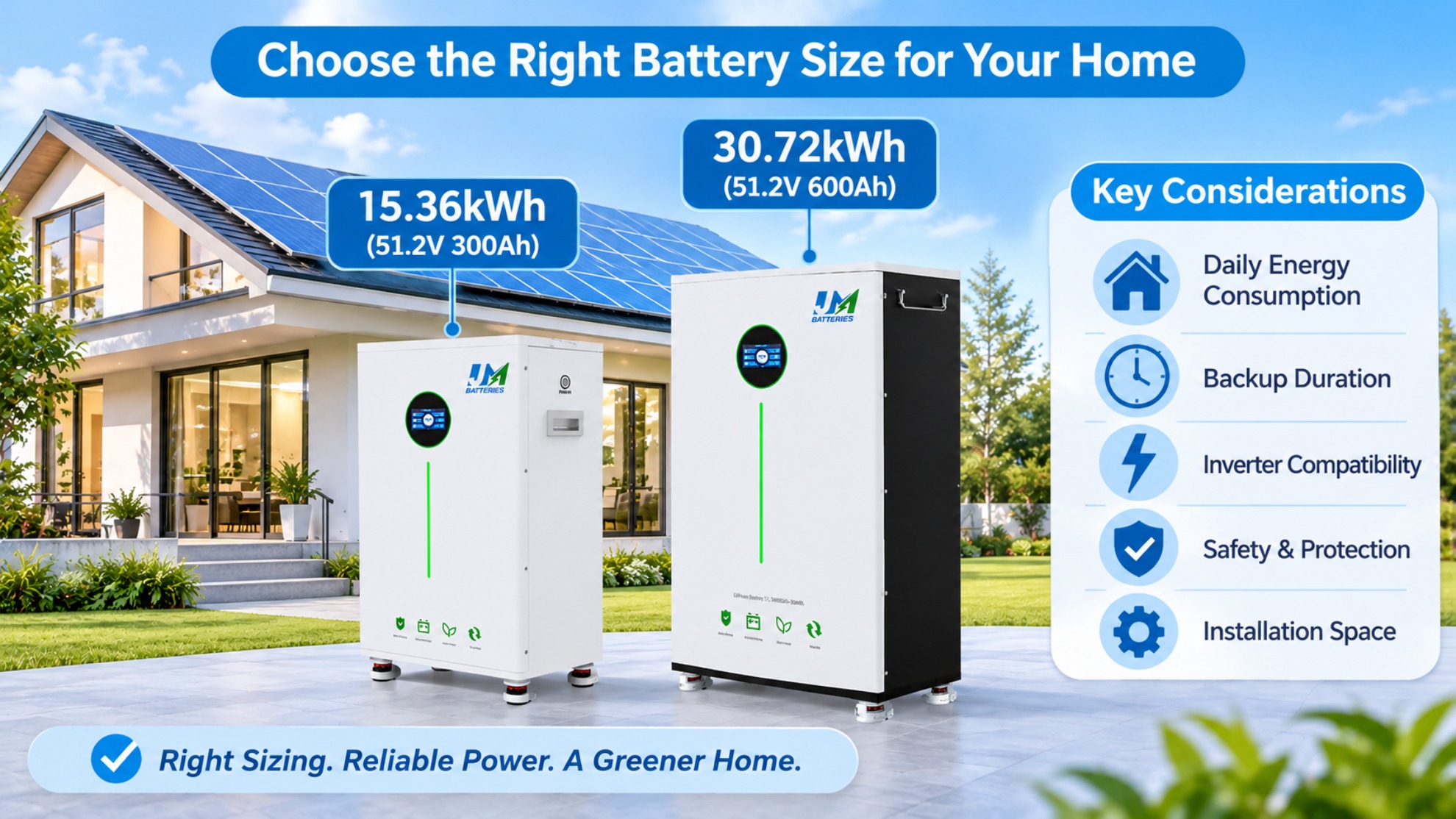
The right battery size depends on how much electricity a household wants to store and how long it needs backup power. Start by identifying the appliances that must remain operational during an outage, then estimate their daily energy consumption.
For example, a household may prioritize refrigerators, lighting, internet equipment, and selected outlets rather than attempting to power every appliance in the home.
Consider Usable Capacity, Not Just Nominal Capacity
A battery's nominal capacity is not the same as the energy that can be delivered to household appliances. The usable amount depends on the permitted depth of discharge, inverter efficiency, reserve settings, and the system's own energy consumption.
For initial planning, consider the household's daily critical-load consumption and the number of hours or days of backup required. Then compare the expected energy demand with the battery's usable capacity under the manufacturer's recommended operating conditions.
Capacity and output power are different specifications. A battery may store enough energy for several hours but still be unable to start a high-power appliance if its continuous or peak discharge rating is insufficient.
5. Comparing 15.36kWh and 30.72kWh Home Batteries
Two common residential storage configurations use 51.2V LiFePO4 batteries with different amp-hour ratings. The following examples show how their nominal capacity translates into estimated AC energy.
| Specification | 15.36kWh Configuration | 30.72kWh Configuration |
|---|---|---|
| Nominal voltage | 51.2V | 51.2V |
| Capacity | 300Ah | 600Ah |
| Nominal energy | 15.36kWh | 30.72kWh |
| Estimated energy at 80% DoD | 12.29kWh | 24.58kWh |
| Estimated AC energy at 95% inverter efficiency | 11.67kWh | 23.35kWh |
15.36kWh: A Practical Residential Storage Size
A 51.2V 300Ah battery has a nominal energy capacity of 15.36kWh. Assuming an 80% depth of discharge and 95% inverter efficiency, it can deliver approximately 11.67kWh of AC energy. At a steady 1kW load, that represents roughly 11.7 hours of operation.
This configuration may suit homes with moderate backup requirements, especially when essential loads are prioritized.
30.72kWh: More Storage for Higher Energy Demand
A 51.2V 600Ah battery has a nominal capacity of 30.72kWh. Under the same assumptions, the estimated AC energy is approximately 23.35kWh. At a steady 1kW load, that is roughly 23.4 hours.
This larger configuration may be more suitable for households with higher daily consumption or longer backup requirements.
These runtime examples assume a constant 1kW load and exclude additional auxiliary consumption. Actual runtime depends on load variation, battery power limits, inverter behavior, and operating conditions.
6. LiFePO4 Battery BMS and Inverter Compatibility
The battery management system is a key part of a LiFePO4 battery. It monitors operating conditions and helps protect the battery from abnormal voltage, current, and temperature conditions.
Depending on the design, a BMS may provide:
- Cell overvoltage and undervoltage protection.
- Charge and discharge overcurrent protection.
- Temperature monitoring and protection.
- Cell balancing.
- Communication with compatible inverters or monitoring systems.
Inverter compatibility should be checked before purchasing or installing a battery. Confirm the nominal voltage, charging voltage range, discharge current, communication protocol, pinout, baud rate, and supported firmware. A CAN or RS485 port by itself does not guarantee compatibility.
Before installation, review our guide to battery and inverter compatibility for a closer look at voltage matching, communication protocols, and system requirements.
Temperature is another important consideration. LiFePO4 batteries generally have different permitted temperature ranges for charging and discharging. Charging below the battery manufacturer's specified minimum temperature can damage the cells unless the system includes an approved low-temperature charging solution.
For more information about installation considerations and protection measures, see our guide to home energy storage battery safety.
Temperature can affect charging performance and battery lifespan. Read more about how temperature affects battery performance.
7. What to Look for in a LiFePO4 Battery Manufacturer
For distributors, wholesalers, and solar installers, choosing a battery supplier involves more than comparing the quoted price per kWh. Product consistency and technical support can have a direct impact on installation quality and after-sales costs.
Before placing an order, consider the following points:
- Cell quality: Ask about cell sourcing, grading procedures, and incoming inspection.
- Battery specifications: Review the datasheet for voltage, capacity, continuous current, peak current, and operating temperature.
- BMS configuration: Confirm protection functions, communication protocols, and available monitoring features.
- Testing and documentation: Request applicable test reports, transport documentation, and product compliance records.
- Warranty terms: Check the coverage period, capacity-retention conditions, exclusions, and claim process.
- Technical support: Confirm whether the supplier can assist with inverter matching, installation questions, and troubleshooting.
- Production capability: Evaluate quality-control procedures, production consistency, lead times, and OEM/ODM capabilities.
Do not evaluate a supplier based on cycle-life figures or certification logos alone. Ask for the documents behind the claims and confirm that they apply to the exact battery model being purchased.
8. JM Energy Tech Residential LiFePO4 Batteries
JM Energy Tech focuses on residential energy storage solutions, including 51.2V LiFePO4 battery configurations for home solar systems.
For projects requiring different storage capacities, two example configurations are a 51.2V 300Ah battery with 15.36kWh nominal energy and a 51.2V 600Ah battery with 30.72kWh nominal energy.
These configurations provide different capacity options for residential backup applications. The appropriate choice depends on the household's energy consumption, required backup duration, inverter specifications, and available installation space.
For distributors and installers, supplier evaluation should also include battery documentation, BMS communication details, product testing, customization options, and after-sales support. These factors are important when selecting products for different residential markets.
Before finalizing a system, confirm the exact model datasheet and inverter compatibility with the supplier. Battery capacity alone does not determine whether a system will meet a project's power and backup requirements.
9. FAQ
1. What is the best LiFePO4 battery for solar energy storage?
The best battery depends on the system voltage, required storage capacity, output power, inverter compatibility, installation environment, warranty, and available technical support. There is no single configuration that suits every home.
2. How many LiFePO4 batteries do I need for a solar system?
First identify the required usable energy, then compare it with the usable capacity of each battery. Also check the inverter's voltage range, supported battery quantity, and parallel connection limits before deciding how many units to install.
3. How long can a 15kWh LiFePO4 solar battery power a home?
Runtime depends on the connected load. As a simplified example, a 15.36kWh battery operating at 80% DoD with a 95% efficient inverter can provide about 11.67kWh of AC energy. At a constant 1kW load, this is approximately 11.7 hours.
4. Is a 51.2V LiFePO4 battery suitable for home solar storage?
Yes. A 51.2V nominal battery is commonly used in 48V-class residential energy storage systems. It must still match the inverter's voltage range, current requirements, and communication settings.
5. Can I connect multiple LiFePO4 batteries in parallel?
Some LiFePO4 batteries support parallel connection, but the manufacturer must explicitly approve the configuration. Check the maximum number of units, battery model compatibility, cable requirements, BMS communication, and inverter limits.
6. What affects the lifespan of a LiFePO4 solar battery?
Battery lifespan is affected by depth of discharge, operating temperature, charging and discharging current, voltage settings, cell quality, and BMS protection. Following the manufacturer's operating recommendations helps reduce unnecessary degradation.
7. Can LiFePO4 batteries be charged directly by solar panels?
Solar panels should normally charge the battery through a compatible charge controller or inverter with battery charging functionality. The charging equipment must regulate voltage and current according to the battery manufacturer's specifications.
8. What should distributors check before buying LiFePO4 solar batteries?
Distributors should review cell quality, datasheets, BMS functions, inverter compatibility, testing documents, warranty conditions, production capacity, lead times, and technical support. They should also confirm that product specifications meet the requirements of their target market.
Conclusion
LiFePO4 batteries are a practical option for residential solar energy storage because they combine long cycle-life potential, thermal stability, and flexible capacity configurations. However, selecting the right battery requires more than comparing nominal kWh ratings.
Start with the household's actual energy requirements, then check usable capacity, output power, inverter compatibility, BMS protection, temperature limits, and supplier documentation. For installers and distributors, these checks help build systems that are better matched to the application and easier to support over time.

JM New Energy Technology



Home Battery Storage: Costs, Benefits & How to Choose a System
Lithium Solar Batteries: Types, Benefits, Lifespan and How to Choose