


BMS SOC Algorithm & SOH Calculation: ESS Battery Health Guide
BMS SOC Algorithm & SOH Calculation: ESS Battery Health Guide

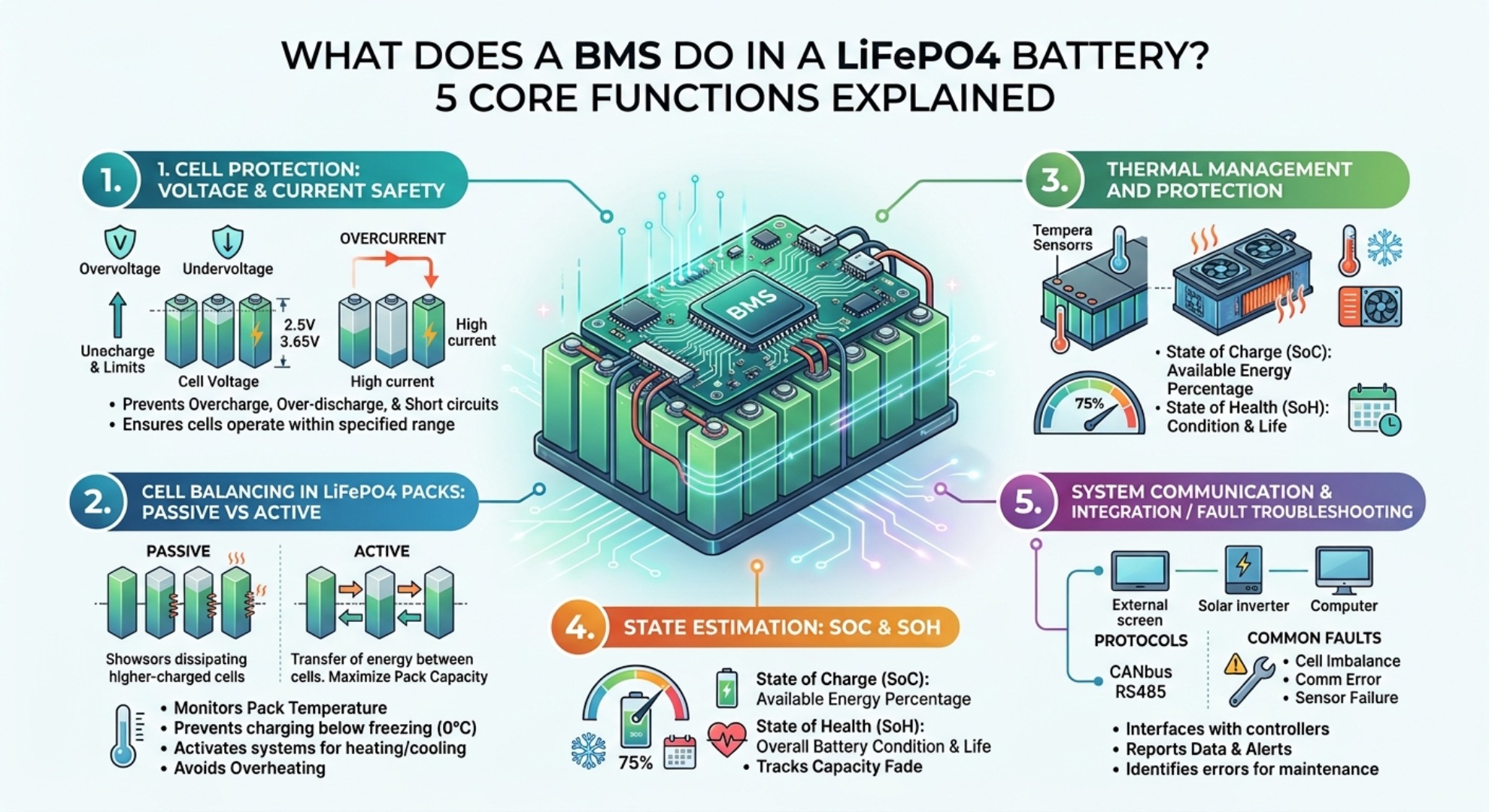
Maintaining energy storage system battery health requires continuous measurement of current, voltage, and temperature during operational cycles. Precise state tracking prevents overcharging, mitigates thermal runaway hazards, and extends pack service life under standards maintained by the U.S. Department of Energy Energy Storage Program. Accurate SOC and SOH readings serve as core inputs for field operation, manual troubleshooting, and site‑level dispatch planning for stationary energy storage deployments.
Battery SOC Estimation: Coulomb Counting, OCV & EKF Methods
Coulomb Counting & OCV Recalibration for LFP SOC

High coulomb counting accuracy relies on integrating measured current over sub‑second sampling intervals. Because sensor offsets cause numerical drift over time, the controller resets accumulated charge values using the open circuit voltage OCV curve when the system reaches complete electrochemical equilibrium. This resting recalibration is critical for lithium iron phosphate SOC estimation, where a flat voltage curve between 20% and 80% charge prevents state calculation from operating voltage alone. Research standards documented on IEEE Xplore demonstrate that pairing current integration with resting lookup tables provides a stable baseline for battery management systems. Regular current‑sensor offset calibration during maintenance can reduce long‑term drift and lower the frequency required for full rest‑state recalibration.

| SOC Estimation Technique | Key Strengths | Known Limitations | Typical Application Scenario |
|---|---|---|---|
| Coulomb Counting | Simple implementation, fast sampling | Sensor drift over runtime, needs periodic reset | Real‑time running ESS under continuous load |
| OCV Look‑up Table | Absolute SOC reference value | Requires long battery rest period | System idle, post‑shutdown recalibration |
| Coulomb+OCV Combined | Balanced accuracy for LFP batteries | Depends on quality of OCV calibration curve | Most commercial stationary BMS deployment |
Extended Kalman Filter & Equivalent Circuit Model
When operational rest periods are infrequent, an extended kalman filter battery routine estimates internal states continuously. The algorithm relies on an equivalent circuit model BMS representation—combining bulk internal resistance with parallel resistor‑capacitor pairs—to compute dynamic polarization and diffusion delays. By calculating the difference between predicted cell voltage and actual measured voltage, the filter corrects internal state vectors on every time step. This real‑time feedback improves state of charge estimation accuracy under sudden load steps and ambient temperature changes. Field technicians must tune model parameters based on real cell sample data; generic circuit‑model values often produce noticeable estimation deviation for aged battery packs.
Battery SOH Calculation: Capacity Fade, DCIR & ICA Diagnostics

Capacity Fade & DCIR Measurement for SOH Calculation
Determining overall pack degradation requires measuring usable capacity loss and internal impedance growth. A standard battery state of health calculation compares current maximum usable charge against original factory ratings, expressing health as a percentage of remaining retention. Alongside capacity drop, controllers evaluate an internal resistance measurement DCIR by measuring instantaneous voltage drops caused by high‑current pulses. Feeding these dynamic voltage‑and‑current response values into a battery degradation modeling framework isolates temporary thermal impedance shifts from permanent structural cell damage. Most stationary storage operators use 80 percent remaining capacity as practical end‑of‑service threshold for major pack refurbishment or module replacement decisions.

| SOH Indicator | Calculation Method | Interpretation for Field Operation |
|---|---|---|
| Remaining Capacity | Actual usable capacity / factory rated capacity ×100% | Direct indicator for available energy storage capability |
| DCIR Direct‑Current Internal Resistance | Voltage drop divided by applied pulse current | Higher value reflects aging; exclude temperature‑caused temporary rise |
| Module Imbalance Deviation | Max‑min cell capacity difference within one module | Large deviation triggers cell balancing or module replacement |
ICA & DVA: Non‑Invasive Battery Aging Diagnostics
Advanced software detects internal chemical changes through incremental capacity analysis ICA, which computes differential capacity relative to incremental voltage steps. Peak shifts in differential capacity profiles identify electrode degradation and active material loss without destructive testing. Complementing this, differential voltage analysis DVA evaluates differential voltage relative to unit capacity changes to quantify cyclable lithium inventory loss. Applied research from the National Renewable Energy Laboratory confirms these non‑destructive techniques expose battery aging mechanisms early, allowing proactive cell balancing before module mismatch occurs. Engineers compare measured ICA‑DVA traces against factory baseline curves to separate normal operational drift from accelerating cell failure risk.
Joint SOC‑SOH Estimation: Cloud‑Hosted BMS & Fleet Operational Analytics

Because battery aging reduces total available storage capacity, using an unadjusted nominal capacity in state‑of‑charge algorithms causes systematic calculation errors over time. Implementing joint SOC SOH estimation ensures the controller updates full‑charge capacity baselines whenever health metrics change. Modern installations forward this operational telemetry to a cloud based battery management system. Site engineers use aggregated fleet‑wide aging trend data to adjust manual dispatch schedules and set operational limits that slow down cell degradation. All adjustments are completed through rule‑based configuration and operational parameter tuning rather than self‑learning model outputs.

| Operational Step | Data Inputs | Practical Site Action |
|---|---|---|
| BMS periodic SOH refresh | Full charge‑discharge cycle data, DCIR readings | Update internal full‑capacity parameter inside BMS firmware |
| Fleet health review | Uploaded telemetry from multiple storage sites | Rank units for maintenance and arrange on‑site service window |
| Dispatch parameter adjustment | Updated SOC‑SOH dataset | Derate charge‑discharge current for heavily degraded battery packs |
Smart BESS Monitoring: Unlocking Hidden Value in Battery Data
Active vs Passive BMS Balancing: Which Is Better for Battery Packs?