


How to Charge a LiFePO4 Battery
How to Charge a LiFePO4 Battery: Safe Charging Guide for 12V–48V

Table of Contents
- LiFePO4 Charging Algorithm: CC/CV Stages Explained
- Safe LiFePO4 Charging: C‑Rate, Voltage & Temperature Limits
- Best Ways to Charge a LiFePO4 Battery: Solar, AC & Alternator
- LiFePO4 BMS Protection & Long‑Term Storage Best Practices
- Common Charging Mistakes & Practical Troubleshooting Tips
- Frequently Asked Questions (FAQ)
Properly replenishing energy in lithium iron phosphate cells requires an understanding of precise voltage thresholds, temperature parameters, and controller profiles. Transitioning from traditional lead‑acid chemistries to lithium iron phosphate chemistry offers significant advantages in cycle life, thermal stability, and energy density. Mastering lithium iron phosphate battery charging techniques ensures maximum efficiency, prevents premature capacity loss, and guarantees operational safety across solar, RV, marine, and off‑grid power systems. Many hobbyists and system builders run into avoidable issues simply by re‑using old lead‑acid charger settings without adjustment, which can slowly degrade LiFePO4 performance over months of use.
LiFePO4 Charging Algorithm: CC/CV Stages Explained

Constant Current (CC) and Constant Voltage (CV) Stages
Unlike legacy deep‑cycle batteries that require complex multi‑stage bulk, absorption, float, and equalization routines, lithium iron phosphate cells rely on a simplified two‑stage protocol. The primary LiFePO4 charging algorithm consists strictly of Constant Current (CC) followed by Constant Voltage (CV). During the Constant Current stage, the power source delivers a uniform amperage while the voltage steadily rises until it reaches the target absorption threshold. This initial bulk phase efficiently restores roughly 80% to 90% of the overall total battery capacity.
During the subsequent Constant Voltage stage, the power supply holds the target setpoint constant while the current acceptance naturally tapers down. Under this constant current constant voltage protocol, charging is complete when current drops to approximately 0.03C to 0.05C. Once the charge termination cutoff threshold is met, current flow must cease or drop to a safe stand‑by level to avoid continuous chemical stress on the internal cathode substrate. Keep in mind that many cheap generic power supplies do not automatically taper current, so they should never be used for unattended LiFePO4 charging.
LiFePO4 Absorption & Float Voltage for 12V, 24V, 48V
Setting correct charging voltages prevents dangerous overvoltage conditions while ensuring 100% state of charge. Individual prismatic or cylindrical cells have a nominal voltage of 3.2V and an upper charge limit of 3.65V. Selecting the correct 12V LiFePO4 charge voltage (4 cells in series) requires setting the absorption limit between 14.2V and 14.6V. For larger multi‑cell pack configurations, these targets scale proportionately to balance energy input against cell longevity. Real‑world environmental conditions can shift readings, so always verify voltage with a calibrated multimeter instead of trusting only charger screen readouts.
| System Nominal Voltage | Series Cells (S) | Absorption / Bulk Target | Recommended Float Target | Disconnecting Cutoff Limit |
|---|---|---|---|---|
| 3.2V (Single Cell) | 1S | 3.55V – 3.65V | 3.35V – 3.40V | 2.50V |
| 12.8V System | 4S | 14.20V – 14.60V | 13.40V – 13.60V | 10.00V |
| 25.6V System | 8S | 28.40V – 29.20V | 26.80V – 27.20V | 20.00V |
| 51.2V System | 16S | 56.80V – 58.40V | 53.60V – 54.40V | 40.00V |
Unlike lead‑acid chemistries, lithium batteries exhibit an extremely low self‑discharge rate (~1% to 3% per month). Consequently, aggressive float voltage settings are neither required nor recommended. Keeping float levels between 13.4V and 13.6V (for 12V systems) allows the charger to power active DC loads directly without subjecting the internal cell chemistry to continuous parasitic trickle charging. If you do not have permanent connected loads, you can even disable float mode entirely after reaching full charge for longer battery service life.
Safe LiFePO4 Charging: C‑Rate, Voltage & Temperature Limits

Recommended Charge Current (C‑Rate) for LiFePO4 Batteries
Selecting an appropriate current rate preserves cell internal resistance and prevents excessive thermal build‑up during energy transfer. The standard recommended C‑rate for lithium iron phosphate ranges from 0.2C to 0.5C. For example, charging a 100Ah battery at 0.2C equates to a 20A charge current, taking approximately 5 hours for a full replenishment, whereas a 0.5C rate delivers 50A for a 2‑hour charge cycle. While many industrial grade cells accept up to a 1C rate (100A for a 100Ah pack), continuous ultra‑fast charging accelerates electrode degradation and shortens cumulative cycle life.
For most off‑grid, RV and marine leisure applications, sticking to 0.2C‑0.3C will deliver the best long‑term cycle count. If your solar or charging hardware outputs higher current than your battery specification allows, you must configure current limiting inside your charge controller rather than letting the battery pull unlimited amps.
LiFePO4 Low‑Temperature Charging Protection & Limits
Charging lithium cells below freezing temperatures poses the single greatest threat to battery health. Attempting to force current into cells below 0°C (32°F) causes irreversible lithium plating cold weather damage, where lithium ions collect on the graphite anode surface as metallic lithium rather than intercalating cleanly into the structure. This metallic accumulation increases internal resistance and creates high‑risk short circuits.
| Operating Environment | Temperature Range (°C) | Temperature Range (°F) | Operational Requirement |
|---|---|---|---|
| Safe Charging Range | 0°C to 45°C | 32°F to 113°F | Full current acceptance permitted. |
| Safe Discharging Range | -20°C to 60°C | -4°F to 140°F | Normal power delivery allowed. |
| Sub‑Zero Cold Zone | Below 0°C | Below 32°F | Halt all charging or activate active heating elements. |
Modern setups rely on integrated hardware sensors to enforce low temperature charge protection cutoffs. When operating in frigid environments, active heating pads powered by external charging sources or insulated battery boxes must elevate internal cell temperatures above 0°C (32°F) before current flow is initiated by the controller. Note that external air temperature is not equal to internal cell temperature; thick battery enclosures can hold cold for hours even after ambient temperatures rise above freezing.
Best Ways to Charge a LiFePO4 Battery: Solar, AC & Alternator
Charging LiFePO4 with Solar Panels via MPPT Controller
Solar power represents one of the most effective and clean methods for maintaining off‑grid battery banks. Utilizing an advanced Maximum Power Point Tracking regulator with a dedicated MPPT solar charge controller lithium profile ensures maximum solar harvest while enforcing strict voltage boundaries. Controllers must be programmed with custom charge parameters (14.4V absorption, 13.5V float, and zero equalization voltage). Equalization modes designed for lead‑acid desulfation apply high‑voltage spikes (often exceeding 15.5V) that trigger immediate protective shutdown or permanent battery damage.
When sizing solar arrays, avoid over‑panel‑ing beyond your battery’s acceptable charge current. Too much solar wattage will push excessive current into the pack on bright sunny mornings, stressing cells and BMS electronics. Always double‑check your MPPT firmware version; older controller firmware may have incomplete LiFePO4 profile support. One off‑grid homesteader reported random BMS disconnect events, and after hours of debugging found his old MPPT firmware still applied lead‑acid equalization pulses even after selecting the lithium preset.
Charging LiFePO4 with AC Shore Power & Bench Chargers
Plugging into grid power or using an onboard generator requires a dedicated multi‑stage AC charging unit. Utilizing a purpose‑built AC smart lithium battery charger guarantees that the charger enters constant voltage mode at the exact preset setpoint and shuts off current flow when absorption is complete. Standard lead‑acid AC chargers often feature trickle‑charge stages or automatic equalization routines that degrade lithium battery chemistry over time.
Generator‑based charging adds another layer of consideration: unstable generator voltage spikes can damage chargers, so adding a simple surge protection device is a worthwhile upgrade for remote locations. For bench testing in workshop environments, always keep batteries on non‑flammable surfaces and never leave charging unattended overnight with unknown second‑hand packs.
Charging LiFePO4 from Alternator with DC‑DC Chargers
Directly connecting a lithium battery bank to an automotive engine alternator is strongly discouraged. Because lithium iron phosphate cells exhibit extremely low internal impedance, they pull maximum current continuously from the alternator, leading to severe alternator overheating, stator burnout, and improper voltage regulation. Installing an isolated DC to DC charger for alternator charging regulates input amperage, boosts low alternator voltage to precise lithium charging thresholds, and prevents starter battery drainage during engine idle.
Many RV builders overlook alternator temperature monitoring. If you run heavy charging while idling for long periods, ensure your vehicle’s cooling system works properly. Isolated DC‑DC units are preferred over non‑isolated models for reducing ground‑loop noise common in mixed vehicle electrical systems.
LiFePO4 BMS Protection & Long‑Term Storage Best Practices

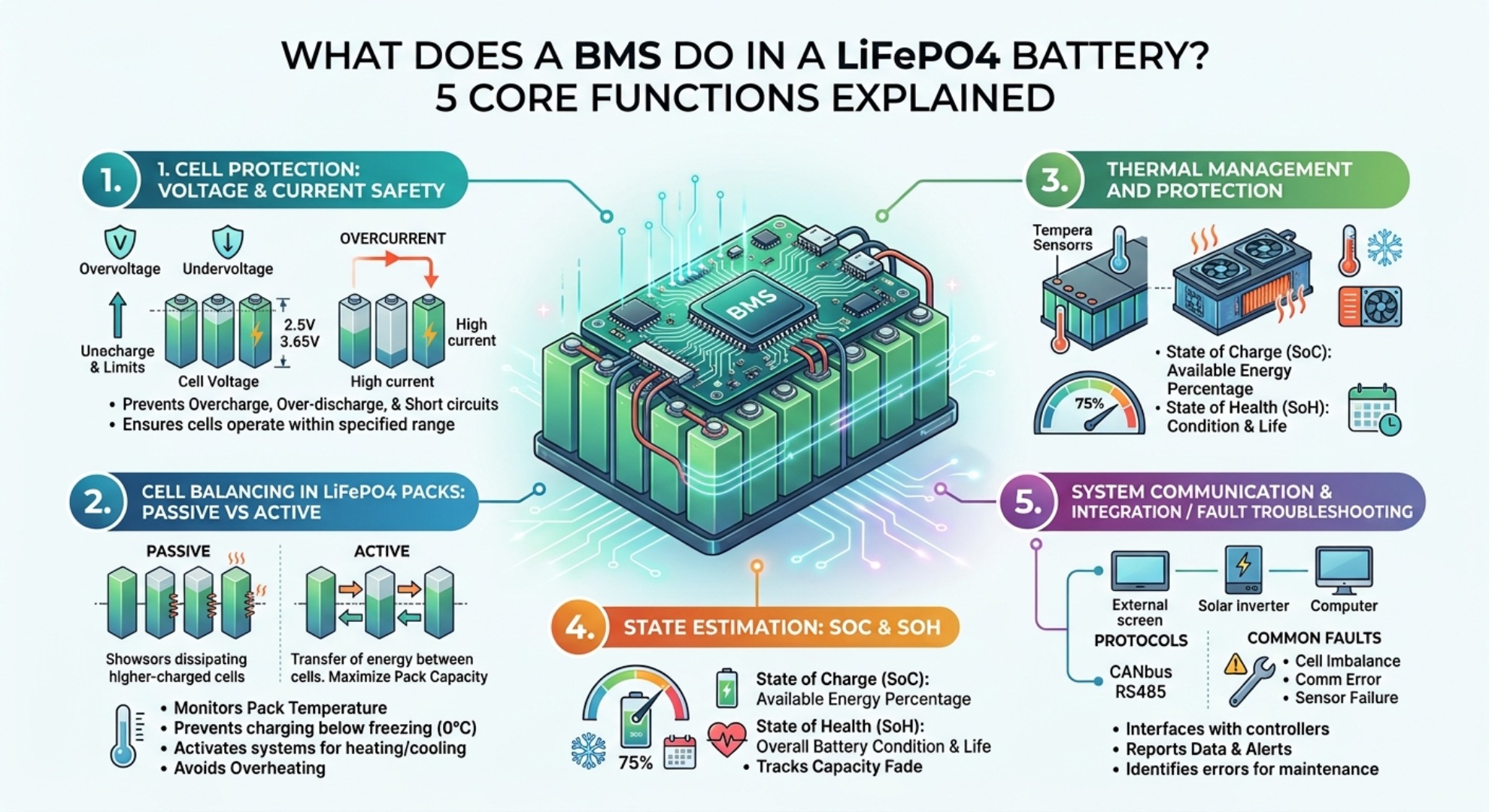
BMS Cell Balancing & Overcharge Cutoff Protection
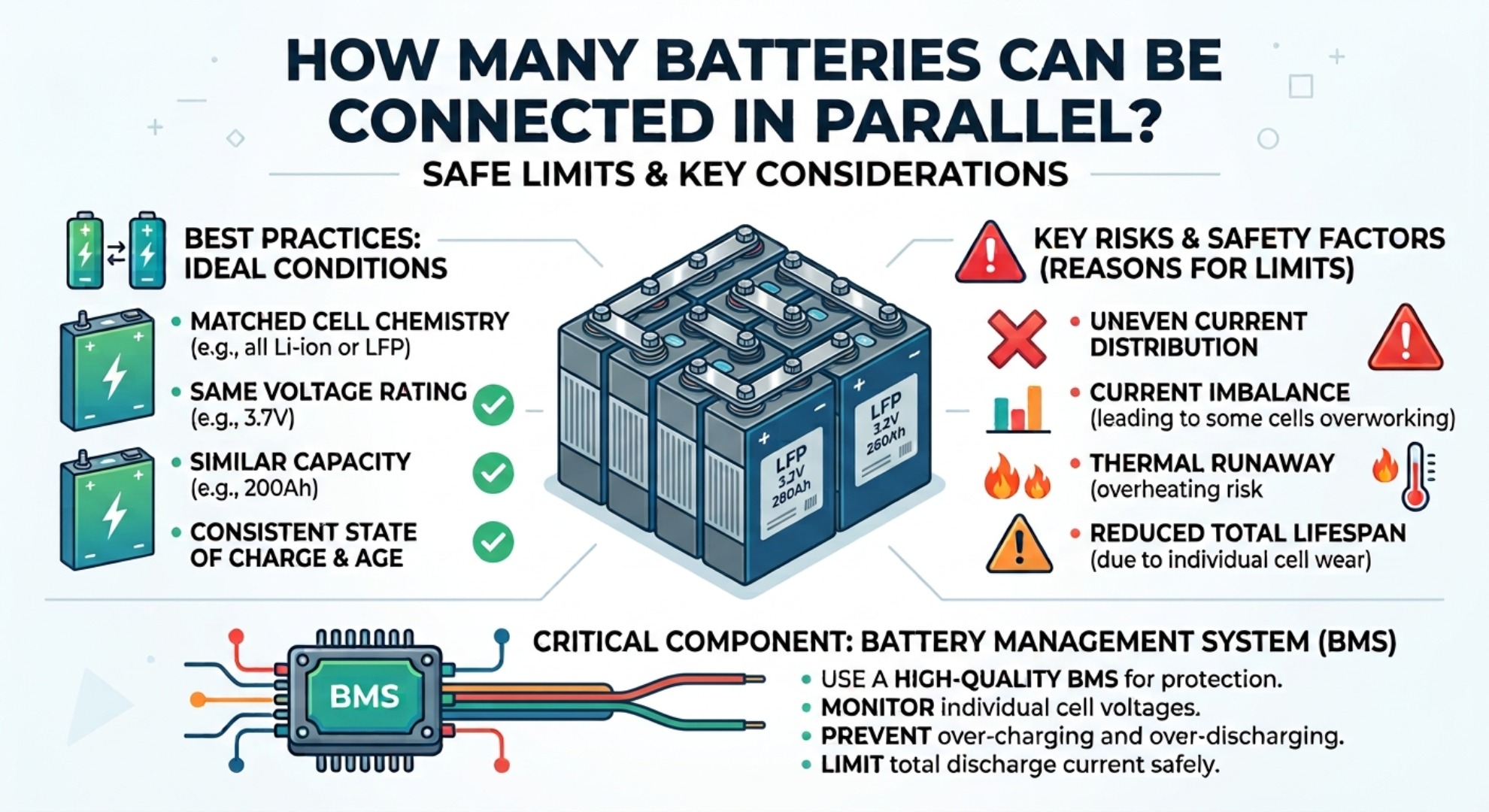
Every high‑performance lithium pack relies on an electronic control circuit acting as the ultimate protective supervisor. An integrated battery management system monitors individual series cell voltages, current rates, and module temperatures. If any single cell exceeds 3.65V, the battery management system overcharge cut‑off disconnects the charge circuit instantly to prevent thermal runaway.
Maintaining high usable capacity over hundreds of cycles requires effective cell balancing. Standard cell balancing passive active mechanisms bleed off excess energy from higher‑voltage individual cells during the final Constant Voltage phase (above 3.45V per cell), bringing all series cells to an equalized state of charge. Passive balancing is adequate for most leisure‑grade systems, while active balancing is recommended for large‑scale off‑grid installations where maximum pack capacity retention is critical. Never run a LiFePO4 pack without a matching, properly‑rated BMS.
Best State of Charge (SOC) for LiFePO4 Winter Storage
Preparing lithium batteries for seasonal storage or extended idle periods requires distinct handling compared to lead‑acid types. Maintaining a 100% full charge during months of storage subjects cathode materials to unnecessary stress, accelerating capacity loss. The optimal LiFePO4 long term storage state of charge is between 50% and 60% (approximately 13.2V for a 12V system) in a dry, temperature‑controlled environment. Disconnect all parasitic loads (such as battery monitors or standby sensors) and perform a periodic check every 3 to 6 months to ensure cell voltage remains well above deep discharge levels.
Storage temperatures ideally sit between 10°C‑25°C. Avoid leaving packs inside unheated sheds or vehicle compartments exposed to extreme summer heat or deep winter frost. If you measure cell voltages drifting too low during storage, perform a partial recharge back to 50‑60% SOC; do not fully top‑up unless you are about to put the system back into active service.
Common Charging Mistakes & Practical Troubleshooting Tips
Even with correct hardware, user error remains one of the top reasons for shortened LiFePO4 service life. Below are real‑world issues frequently reported by DIY builders and system operators.
One very common mistake is re‑using lead‑acid charger profiles without disabling equalization. Equalization pulses push high voltage that can trigger repeated BMS cut‑offs, and over time harm cell health. Another frequent problem is mismatched wiring gauge: too‑thin cables create voltage drop, making the charger read lower pack voltage than actual cell voltage, leading to incomplete charging or false full‑charge readings. Always size wiring for your maximum charge current and keep cable runs as short as practical. One solar hobbyist installed 14‑gauge wire for 45A charging current; large voltage drop meant the battery never actually reached full state‑of‑charge despite charger showing 14.4V output.
If your battery never reaches full charge, first check for voltage drop on heavy wires, confirm your charge controller profile settings, and verify BMS has not temporarily limited current due to high or low temperature. If the BMS keeps cutting off charging, inspect individual cell voltages; large cell‑to‑cell voltage gaps mean balancing needs more time or your BMS balancing capability may be insufficient for your pack.
If you see capacity dropping quickly after only dozens of cycles, review your historical charging habits: repeated 1C fast‑charging, charging below freezing, or regular deep discharge below the manufacturer’s cutoff are typical root causes. When troubleshooting, always start with multimeter voltage measurements before replacing expensive components.
Frequently Asked Questions (FAQ)
Q: Can I use my old lead‑acid charger for LiFePO4 batteries?
A: Not recommended. Most lead‑acid chargers run equalization cycles, high float voltages and trickle charging modes that damage LiFePO4 cells over time. You can only use it if you can fully disable float and equalization and manually lock absorption voltage within 14.2‑14.6V for a 12.8V pack.
Q: What happens if I charge LiFePO4 below 0°C?
A: Charging under freezing can cause lithium plating on anode surfaces. This damage is permanent and cannot be repaired, leading to higher internal resistance, reduced capacity and increased short‑circuit risk. Discharging below zero degrees is generally safe.
Q: Do LiFePO4 batteries need float voltage after full charge?
A: No. LiFePO4 has very low self‑discharge. Float is only required if you have permanent live DC loads connected. If there are no continuous loads, you can turn float mode off completely to extend battery lifespan.
Q: What C‑rate should I choose for my off‑grid solar setup?
A: For most off‑grid home systems, stay within 0.2C‑0.3C. This gives the best balance between charging speed and long‑term cycle life. Industrial‑grade cells may support 0.5C‑1C, but sustained high‑current charging accelerates wear.
Q: Why does my BMS keep cutting off charging during sunny days?
A: Common causes include wrong absorption voltage settings, outdated MPPT firmware, large cell‑to‑cell voltage imbalance, over‑current from oversized solar array, or high/low temperature triggering hardware protection.
Q: What SOC should I set for long‑term seasonal storage?
A: 50‑60% SOC is ideal, around 13.2V open‑circuit voltage for a 12.8V LiFePO4 pack. Avoid full‑charge storage for multiple months, as it puts chemical stress on the battery cathode.
Q: Is cell balancing necessary for LiFePO4?
A: Yes. Without balancing, individual cells will drift apart over cycles. Passive balancing works fine for small DIY off‑grid systems. Large home off‑grid banks benefit more from active balancing hardware.
How to Choose a LiFePO4 Battery: Sizing, BMS & Safety Guide
LiFePO4 vs Sodium-Ion Battery: Which Is Better for Energy Storage?