


LiFePO4 vs Sodium-Ion Battery: Which Is Better for Energy Storage?
LiFePO4 vs Sodium‑Ion Battery: Which Is Better for Energy Storage?
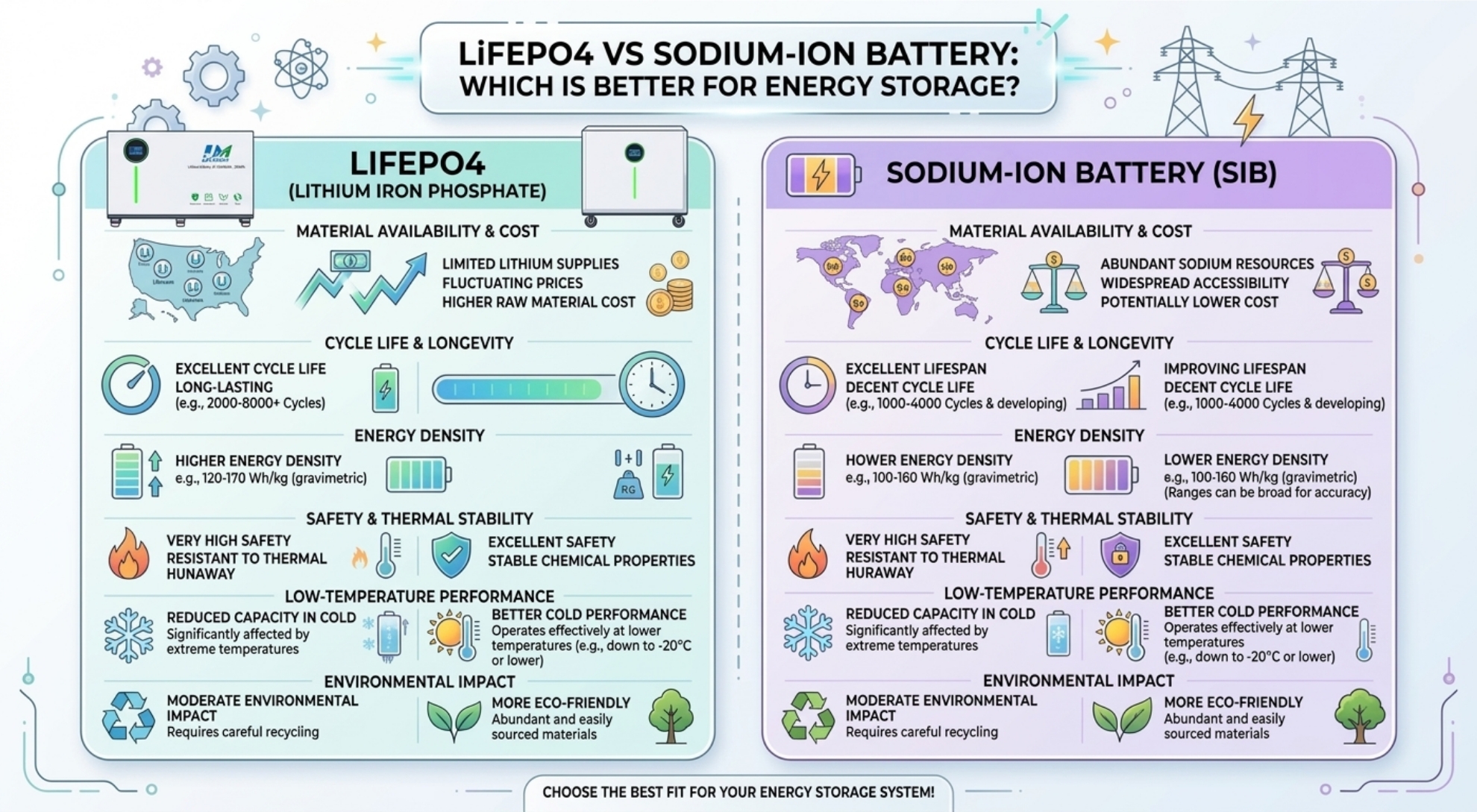
Table of Contents
- LiFePO4 vs Sodium‑Ion Chemistry: Working Principles Explained
- Energy Density: LiFePO4 vs Sodium‑Ion Battery Size and Weight
- Cycle Life: LiFePO4 vs Sodium‑Ion Battery Lifespan Comparison
- Cold Weather Performance: LiFePO4 vs Sodium‑Ion at −20 °C
- Battery Cost and Supply Chain: Sodium‑Ion vs LiFePO4 Raw Materials
- Battery Safety: LiFePO4 vs Sodium‑Ion Thermal Runaway Comparison
- Best Applications: LiFePO4 vs Sodium‑Ion Battery for Energy Storage
- Frequently Asked Questions (FAQ)
LiFePO4 vs Sodium‑Ion Chemistry: Working Principles Explained
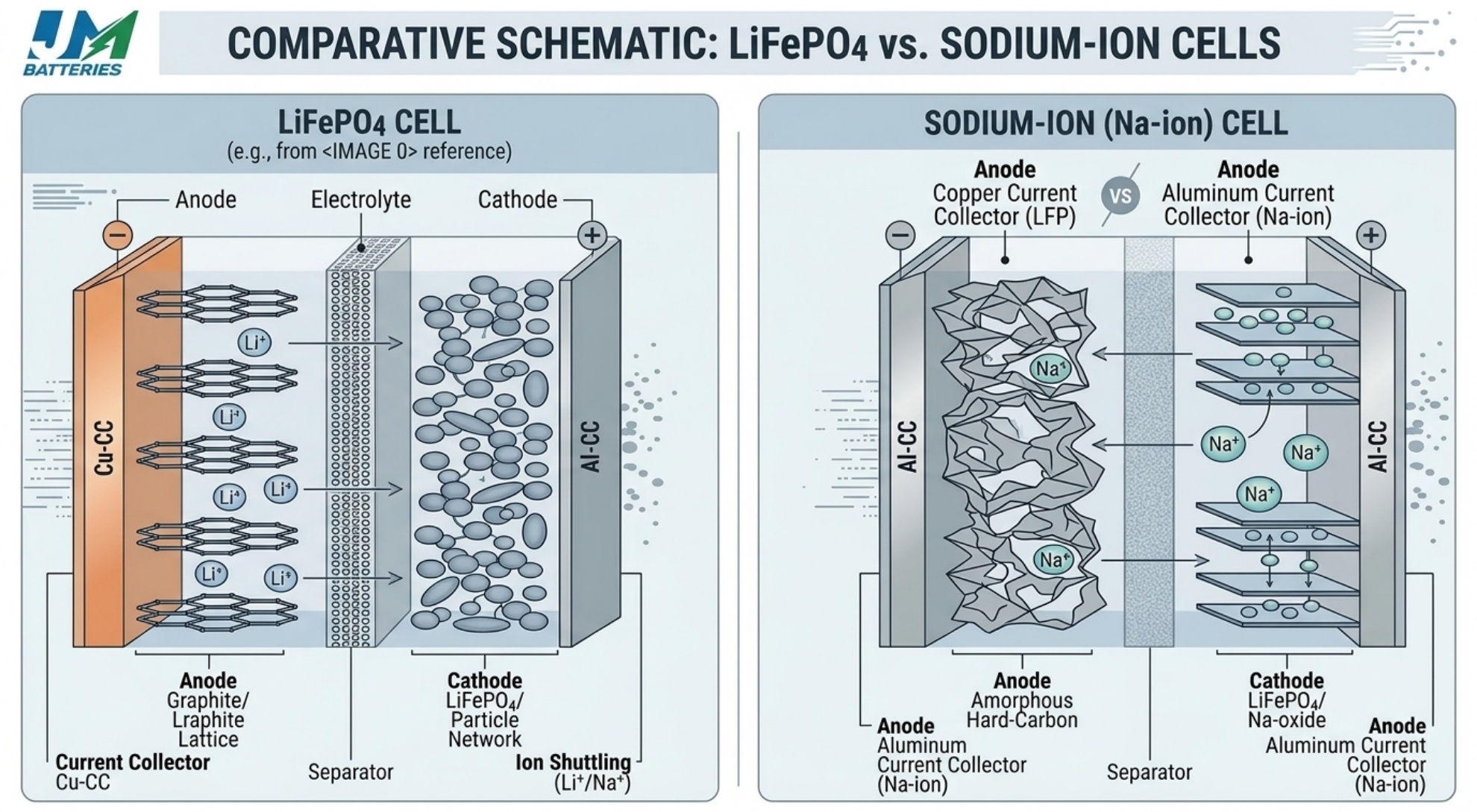
Lithium iron phosphate uses an olivine‑type LiFePO4 crystal structure. This structure delivers good chemical stability through charge‑discharge cycles. Lithium ions travel between an iron‑phosphate cathode and graphite anode, giving a steady cell nominal voltage near 3.2 V. Its rigid three‑dimensional lattice holds up well during fast ion insertion and removal. This mechanical stability forms the basis for its long operating service life.
| Feature / Parameter | LiFePO4 (LFP) | Sodium‑Ion (Na‑ion) |
|---|---|---|
| Charge Carrier | Lithium Ion (Li+) | Sodium Ion (Na+) |
| Anode Material | Graphite | Hard Carbon |
| Current Collectors | Copper & Aluminum | Aluminum (Both Sides) |
| Energy Density | 150 - 210 Wh/kg | 100 - 160 Wh/kg |
| Cycle Life (100% DoD) | 6,000 - 10,000 cycles | 3,000 - 6,000 cycles |
| Retention at -20°C | 45% - 60% | ~85% - 90% |
Sodium‑ion systems work with sodium ions instead of geologically limited lithium. Hard carbon replaces graphite as the anode host material. Sodium ions are physically larger than lithium ions, so electrode structures need open spaces for ion intercalation. One practical manufacturing upside: sodium will not alloy with aluminum at low operating potentials. That means builders can run aluminum foil as current collector on both cathode and anode sides, cutting out costly copper foil.
B‑side buyer note: For project procurement teams, chemistry differences translate directly to BOM risk. Sodium‑ion removes copper from cell bill‑of‑materials, but hard‑carbon anode quality varies widely across manufacturers. B‑side buyers need to audit cell‑level BOM consistency, because inconsistent hard‑carbon batches can create unpredictable field degradation even if datasheet parameters look attractive on paper.
Energy Density: LiFePO4 vs Sodium‑Ion Battery Size and Weight
Gravimetric and volumetric energy density separate these two storage chemistries in real‑world deployments. Commercial LiFePO4 cells commonly hit 150‑210 Wh per kilogram. Higher energy per kilogram lets engineers build compact battery modules with smaller footprints. These properties make LFP suitable for projects where weight or physical space is tight.
Real‑world LFP case example: An urban downtown commercial‑industrial peak‑shaving project installed LiFePO4 battery containers on a constrained building rooftop. Limited load‑bearing capacity and small available floor area ruled out lower‑density alternatives. Compact LFP cabinets delivered 2MWh within permitted weight and spatial boundaries, meeting peak demand reduction targets without costly building reinforcement.
Today’s commercial sodium‑ion cells come in lower on volumetric performance, sitting in the 100‑160 Wh/kg band. For residential storage installations constrained by wall or floor space, reaching equal total capacity means sodium‑ion packs must be physically bigger and heavier. Where land and enclosure space are not limiting factors for large‑scale sites, this extra volume becomes a reasonable trade‑off to accept.
Real‑world sodium‑ion case example: A utility‑level battery farm on open rural land selected sodium‑ion solutions. Site land availability was abundant, so increased cabinet quantity and footprint did not create project barriers. Procurement prioritized supply‑chain stability over minimal cabinet count.
B‑side buyer note: Project developers and EPC contractors must calculate real cabinet footprint, not just cell datasheet values. Lower volumetric density increases container quantity, foundation civil‑works cost, land occupation and shipping weight. In urban substations, rooftop‑mounted or container‑limited projects, larger physical size can kill project feasibility entirely. If land rental or civil engineering is a major CAPEX item, sodium‑ion’s volume penalty must be modelled into your financial business case.
Cycle Life: LiFePO4 vs Sodium‑Ion Battery Lifespan Comparison
Long‑term durability directly shapes return‑on‑energy‑storage infrastructure investments. Well‑proven LiFePO4 can complete 6,000 up to 10,000 full depth‑of‑discharge cycles before capacity drops to 80 % of its original rating. Real‑world field data accumulated over decades shows properly managed systems can run reliably on daily duty for 15 years or longer.
Real‑world LFP case example: A remote island microgrid runs daily deep charge‑discharge cycles for 300+ days every year. Deployed LiFePO4 systems have maintained above 82 % capacity after more than 7 years of continuous heavy cycling. The long cycle performance reduced required early‑stage battery replacement budget for the public‑funded microgrid asset.
Sodium‑ion has made meaningful technical progress in recent years. Commercial cells now reach 3,000‑6,000 full deep cycles. This cycle count works fine for many commercial use‑cases. Even so, multi‑year long‑term field performance datasets are still being built out. If your project needs maximum total energy throughput across a 20‑year design window, the established lithium‑iron‑phosphate chemistry still holds an advantage in verified long‑term durability.
Real‑world sodium‑ion case example: A mid‑size commercial facility uses sodium‑ion for partial peak‑shaving with moderate daily cycling. The project’s design lifetime was set to 10‑12 years, matching current sodium‑ion field expectations. The contract reserved budget for potential mid‑life module swap if degradation runs faster than lab datasheet predictions.
B‑side buyer note: Datasheet cycle numbers are generated under ideal lab conditions. Real‑site temperature swings, partial cycling, irregular maintenance and BMS calibration drift will shorten real service life. Many sodium‑ion suppliers offer limited field‑proven long‑term warranties. For 15‑20‑year PPP or offtake‑backed projects, verify supplier warranty coverage, failure‑rate historical data, and whether cycle‑life guarantees transfer to project asset owners. Avoid relying purely on lab‑reported cycle figures for financial model inputs.
Cold Weather Performance: LiFePO4 vs Sodium‑Ion at −20 °C
Sub‑zero conditions create one of the clearest practical gaps between these two battery types. Standard LiFePO4 packs lose large portions of usable capacity at −20 °C, sometimes 40‑55 %. Rising electrolyte viscosity and higher internal resistance drive this performance drop. To avoid permanent cell damage, freezing‑environment LFP systems often require integrated heating before allowing charging to proceed.
USABLE CAPACITY RETENTION AT SUB‑ZERO TEMPERATURES (-20°C)
Sodium‑ion holds roughly 85‑90 % rated capacity at −20 °C and can keep operating down toward −40 °C. Lower desolvation energy for sodium ions in electrolyte enables smoother ion transport across electrode interfaces in extreme cold. As noted by U.S. Department of Energy technical documents, this cold‑climate strength lowers heating loads for storage hardware deployed in frigid locations.
Real‑world sodium‑ion cold‑climate case example: Unheated remote telecom backup sites in high‑latitude regions deployed sodium‑ion battery systems. Without cabinet heating hardware, batteries still delivered reliable backup power during long winter cold snaps. Site operators removed maintenance tasks related to heater inspection and heater‑part replacement, lowering annual site‑visit frequency.
Real‑world LFP cold‑climate case example: A northern off‑grid mining site used LiFePO4 storage with full active thermal management. Heating subsystems consumed continuous auxiliary power, and maintenance teams had to perform heater component checks every winter season. One winter heater fault caused multi‑day charging restrictions until on‑site repair crews arrived.
B‑side buyer note: For unheated remote telecom sites, off‑grid northern microgrids, mountain or arctic deployments, thermal heating hardware adds CAPEX, continuous auxiliary power consumption and extra maintenance points. Heating system failure can stop LFP systems from charging in winter and create revenue loss for critical‑load assets. Sodium‑ion reduces reliance on heating subsystems, which lowers ongoing OPEX and risk of site downtime. Always model auxiliary heating energy draw into your project LCOE for LFP cold‑climate sites.
Battery Cost and Supply Chain: Sodium‑Ion vs LiFePO4 Raw Materials
Raw‑material availability heavily shapes long‑run market pricing and supply stability. Lithium markets have historically swung wildly, triggered by supply bottlenecks, concentrated mining geography and fast‑growing electric‑vehicle demand. LiFePO4 does eliminate expensive cobalt and nickel, yet its bill‑of‑materials cost still follows global lithium‑carbonate pricing cycles.
RAW MATERIAL ABUNDANCE COMPARISON
Sodium exists at around 1000‑fold higher crustal abundance compared to lithium; raw feedstock may come from sea salt or soda‑ash sources. As worldwide manufacturing volumes scale up, sodium‑ion batteries are expected to gain structural cost benefits, thanks to cheaper starting minerals plus aluminum‑only current collectors. This improved supply resilience gives capital‑heavy energy‑storage projects better long‑term cost predictability.
Real‑world supply‑chain case example: During periods of lithium‑carbonate price surge, several large‑scale tender projects faced revised quotations and budget pressure for LFP‑based storage. Some project teams opened dual‑sourcing evaluations for sodium‑ion alternatives to hedge against further lithium price volatility, even though per‑kWh cell pricing was not yet fully competitive.
B‑side buyer note: Today’s sodium‑ion pricing advantage is still partially theoretical and volume‑dependent. While sodium raw material is cheap, scaled hard‑carbon production capacity remains constrained. Lithium price spikes can push LFP project budgets over bid estimates. Buyers should evaluate multi‑year supply agreements, dual‑sourcing strategies, and price‑escalation clauses in contracts. For large tender projects, confirm supplier’s actual manufacturing capacity lead‑times to mitigate delivery‑delay risks that push project completion dates.
Battery Safety: LiFePO4 vs Sodium‑Ion Thermal Runaway Comparison
Safety cannot be overlooked when selecting stationary energy‑storage hardware. Both chemistries resist thermal runaway far better than older NMC lithium‑ion cells, thanks to robust internal chemical bonding. Research cited by International Energy Agency shows these strong chemical bonds greatly limit oxygen release when cells see thermal abuse conditions.
| Parameter | LiFePO4 (LFP) | Sodium‑Ion (Na‑ion) |
|---|---|---|
| Thermal Runaway Onset | High (~270°C) | Extremely High |
| Shipping State of Charge | Must remain ~30% SOC | Safe at 0 Volts (0V) |
| Short Circuit Risk | Higher transport risk | Zero voltage risk |
One logistical plus for sodium‑ion: full discharge down to zero volts will not harm internal cell components or trigger copper dissolution. By contrast, lithium‑based battery packs must hold partial charge through storage and shipment to protect internal chemistry. Shipping sodium‑ion cells fully discharged lowers transit hazards, simplifies compliance work and can bring down insurance and handling expenses.
Real‑world logistics case example: A phased‑construction utility‑storage project ordered sodium‑ion modules in advance of site readiness. Batteries were stored fully discharged in a local warehouse for several months without cell degradation risk. For a comparable LFP phased‑project, the logistics team would need ongoing SOC monitoring and periodic top‑up charging during long‑term intermediate warehousing.
B‑side buyer note: Logistics compliance, transport insurance and on‑site intermediate storage represent hidden project costs. LFP shipments require controlled state‑of‑charge management throughout factory‑to‑site supply chain. Improper SOC control can trigger shipping regulatory holds, site‑receiving rework or insurance‑claim disputes. Sodium‑ion zero‑volt shipping simplifies cross‑border transport and on‑site stock‑piling for phased‑construction projects. Confirm local transport regulation acceptance for sodium‑ion before final procurement decisions.
Best Applications: LiFePO4 vs Sodium‑Ion Battery for Energy Storage
The better battery chemistry depends heavily on site operating conditions and physical constraints. Indoor home storage, weight‑sensitive hardware and space‑limited urban microgrid setups generally favour LiFePO4. It delivers good energy density plus many years of accumulated real‑world operating records.
| LiFePO4 Ideal Applications | Sodium‑Ion Ideal Applications |
|---|---|
|
|
Utility‑scale grid storage, remote telecom sites in cold zones and budget‑focused commercial‑industrial projects with ample available land make strong use‑cases for sodium‑ion technology. Its wide operating‑temperature window, zero‑volt shipping safety and favourable raw‑material outlook position sodium‑ion as a valuable complement to well‑established lithium‑based storage within the global clean‑energy transition.
Mixed‑chemistry hybrid project case example: One regional energy developer deployed a hybrid storage park: LiFePO4 blocks handle high‑cycle daily arbitrage inside space‑limited building structures, while sodium‑ion blocks serve outdoor cold‑reserve backup. The mixed‑chemistry layout matched each technology’s strength against distinct functional requirements of the same overall site.
B‑side buyer final checklist: Before awarding contracts, map these key project dimensions: available land or cabinet footprint, minimum required asset lifetime, local climate extremes, warranty terms, supplier field‑operation track‑record, supply‑chain lead‑time, logistics regulation, and whether financial models account for auxiliary heating, civil‑works and replacement risk. Neither technology universally outperforms the other; correct chemistry selection comes from matching cell strengths and weaknesses to your specific project risk profile.
Frequently Asked Questions (FAQ)

Q1: Can sodium‑ion batteries completely replace LiFePO4 for stationary energy‑storage projects?
A: Not at present. Sodium‑ion brings advantages in cold‑temperature performance and logistics safety, but lower energy density and shorter proven cycle‑life restrict its full replacement. It works best as a complementary technology. Many developers adopt hybrid‑chemistry designs to leverage strengths from both battery types.
Q2: Should I use datasheet cycle‑life numbers directly in my financial model?
A: No. Lab datasheet cycles are achieved under controlled temperature, clean BMS conditions and ideal charge‑discharge profiles. Real‑world site conditions degrade batteries faster. Adjust figures downward, reference supplier field failure data and read warranty fine‑print before building LCOE models.
Q3: Are sodium‑ion batteries always cheaper than LiFePO4?
A: Not today. Although sodium raw materials are abundant, hard‑carbon manufacturing capacity remains limited. System‑level total cost must consider cabinet quantity, civil‑works, OPEX and expected module replacement frequency, not only cell per‑kWh price.
Q4: Can sodium‑ion batteries be mixed with LiFePO4 inside one BMS battery bank?
A: Direct parallel mixing of different chemistries within the same battery bank is not recommended. Different nominal voltage curves and internal resistance will cause unbalanced charging‑discharging. Hybrid projects typically run separate BMS systems for each battery chemistry, managed at higher‑level controller.
Q5: What risks should I focus on for sodium‑ion tender evaluation?
A: Key risk points: hard‑carbon batch consistency, real‑project field operating hours, transferable warranty for asset owners, local transport regulatory approval, actual production lead‑times, and degradation assumptions for financial modelling.
Q6: Do LiFePO4 batteries always require heating in cold‑climate sites?
A: Discharge can proceed without heating, but charging at sub‑zero temperatures risks permanent cell damage. Most project specifications enforce heating hardware to enable safe winter charging, which adds CAPEX and ongoing auxiliary energy consumption.
Q7: Is zero‑volt shipping for sodium‑ion accepted across all countries?
A: Not universally. Although sodium‑ion can safely sit at 0V, local dangerous‑goods transport regulations are still updating. EPC and procurement teams must verify local logistics rules before final procurement and shipping planning.

JM New Energy Technology



How to Charge a LiFePO4 Battery
Smart BESS Monitoring: Unlocking Hidden Value in Battery Data