


LiFePO4 Battery Cold Weather Charging: Safe Solutions
LiFePO4 Battery Cold Weather Charging: Risks & Safe Solutions

Table of Contents
Understanding LiFePO4 cold weather charging requires examining how temperature impacts chemical reaction rates inside lithium iron phosphate cells. While these batteries offer stable voltage, long cycle life, superior thermal safety compared to NCM ternary lithium cells, exposure to sub-zero environments severely restricts their ability to accept electrical current without risking permanent internal degradation. Many off-grid users, RV campers, marine vessel operators and solar installers ignore low-temperature charging limits in winter, leading to irreversible lithium plating, gradual capacity loss and hidden safety hazards. To fully grasp all root aging factors accelerating LFP degradation including low-temperature damage, read our complete technical guide: LiFePO4 Battery Degradation: Key Factors & Extension Guide. Unlike ternary lithium that has partial reversible recovery for mild low-temperature damage, LFP metal lithium precipitation is permanent and cannot be repaired by routine maintenance.
Why LiFePO4 Batteries Struggle When Charging Below Freezing
Most cell manufacturers uniformly mark a strict charging temperature threshold of 0°C (32°F) in official specifications. When ambient temperatures drop below freezing point, the organic liquid electrolyte becomes far more viscous, ion migration resistance rises exponentially. This drastically slows lithium-ion mobility between cathode and anode during charging. Even minor temperature drops near freezing cut ion migration speed by half, creating an imbalance where charging input outpaces graphite absorption capacity — the core trigger of lithium plating failure. LFP cathode material has lower lithium ion diffusion coefficients than NMC, making it more sensitive to cold charging stress.
The Science of Lithium Plating at Low Temperatures

Forcing constant charging current into frozen LFP cells causes lithium plating. Lithium ions cannot intercalate into layered graphite fast enough, separating out as pure metallic lithium on electrode surfaces. This permanently consumes sealed-cell active lithium inventory; warming, equalization or float charging cannot reverse this chemical damage. Plated lithium continuously shrinks the cell’s effective reaction area and lays groundwork for dendrite growth and long-term capacity fade.
How Cold Causes Permanent Battery Degradation
Repeated cold charging triggers cumulative irreversible capacity loss. Lab field tests confirm cells charged between -5°C and 0°C lose 20%–40% usable capacity within only 100 winter charge cycles, alongside a 30%–60% spike in internal resistance. For deeper sub-zero charging below -10°C, visible cell swelling and severe voltage imbalance emerge after 30–50 cycles, cutting the rated service life to one-third or less. To distinguish usage-based cycle aging from passive time-based calendar aging that worsens in cold storage environments, review our dedicated comparison resource: LiFePO4 Cycle Life vs Calendar Life: Battery Lifespan Guide.
Discharging vs. Charging: Cold Weather Comparison

A vital operational difference exists between sub-zero discharge and sub-zero charging: cold discharge generates internal impedance heat and carries no permanent damage risk, while cold charging creates irreversible plating. LFP can safely discharge down to -20°C with only temporary capacity reduction that recovers after warming, while any charging below 0°C creates lasting chemical harm.
- Discharge at -20°C: Temporary 30%–50% capacity drop, fully recoverable after temperature rebound, no permanent cell harm
- Charge at -10°C to 0°C: Moderate plating risk under standard 0.2C–0.5C charge rates; only ultra-slow 0.05C–0.1C charging reduces hazards slightly
- Charge below -10°C: Severe dendrite growth risk, rapid permanent degradation and internal short-circuit risks
Key Risks of Charging LiFePO4 in Cold Temperatures
Continuous lithium plating builds needle-shaped dendrites that may pierce the separator film between cathode and anode, triggering internal short circuits, heat buildup, cell swelling, electrolyte leakage and thermal runaway. Maintenance records for RV and off-grid storage show dendrite faults account for nearly all winter LFP safety incidents. Swollen cells damage wiring terminals and waterproof enclosures, creating secondary contact overheating risks. In multi-series battery banks, uneven plating widens single-cell voltage deviation, limiting full pack charge capacity and lowering overall energy utilization efficiency.
Safe Cold Weather Charging Solutions for LiFePO4
Eliminating cold plating damage requires paired intelligent BMS protection and stable thermal management hardware, suitable for home solar storage, RV power packs and marine energy systems. Three mature industry solutions fully mitigate winter charging risks without daily manual supervision.
BMS Low-Temperature Cutoff Protection
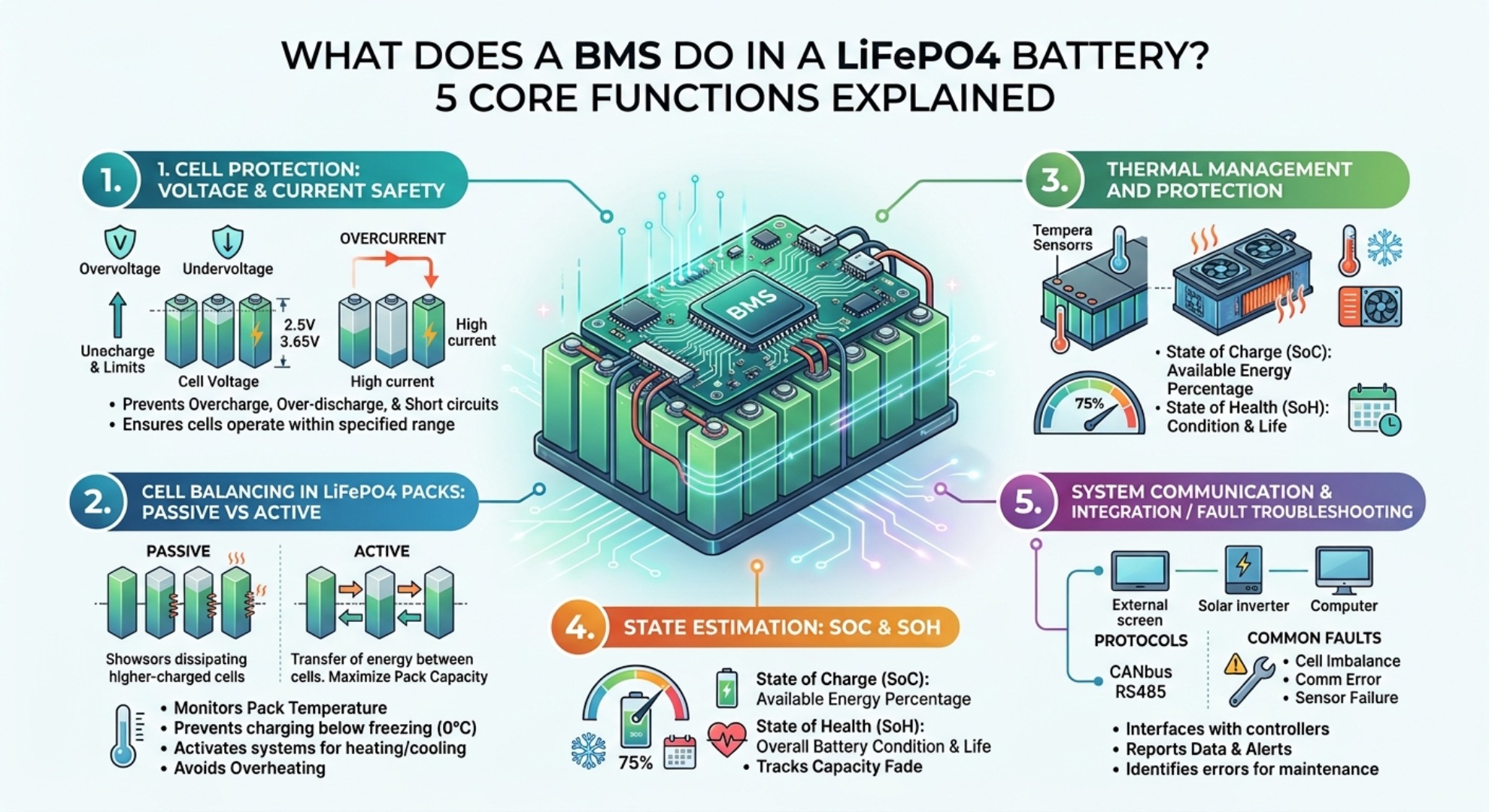
Industrial-grade LFP BMS with dual cell temperature probes automatically disconnect all charging input once cell temperature hits ≤0°C, while keeping discharge circuits active for critical loads. Low-cost consumer BMS often omit cell surface temperature detection and cold charge cutoff, relying only on cabinet air readings that produce inaccurate delayed protection in frigid installations.
Self-Heating Technology & Internal Heating Pads
Factory winterized LFP modules integrate embedded flexible heating films controlled by BMS logic. When charging power is detected under freezing conditions, power diverts to heating elements first until cells warm above 5°C before normal charging resumes. Warm-up energy consumption is minimal: a 12V 200Ah pack uses less than 1% total capacity to rise from -20°C to safe charging temperature, making this the top choice for mobile vehicle energy storage.
Insulated Enclosures & External Heating Options
Retrofit silicone heating pads paired with digital thermostats offer a budget cold-climate upgrade for existing battery banks without factory self-heating. Closed-cell foam insulated boxes reduce heat loss by over 70%; thermostats should activate heating at 2°C and cut power at 6°C to maintain a stable safe temperature window year-round.
Sub-Zero Operating Parameters Comparison

| Temperature Range | Charging Status | Electrochemical Risk | Recommended Solution |
|---|---|---|---|
| Above 0°C (32°F) | Standard Full-Speed Charge | Minimal risk; standard intercalation | Normal BMS operation, regular 0.2C–0.5C charging rate |
| -10°C to 0°C (14°F to 32°F) | Restricted Rate (0.05C–0.1C) | Moderate lithium plating risk if current is high | Reduce charge current drastically or pre-heat cells above 5°C before charging |
| Below -10°C (14°F) | Prohibited (0 Amps) | High risk of dendrite formation & permanent loss | Active low-temp BMS charge cutoff; mandatory pre-heat above 5°C before any charging |
Winter Solar & Off-Grid Charging Best Practices
Standardized winter operation rules extend LFP service life and guarantee consistent off-grid power supply through cold seasons. Install battery banks inside heated indoor utility spaces instead of exterior metal frames or uninsulated outdoor cabinets that rapidly drain internal heat overnight.
For RV, caravan and marine mobile storage, match alternator power output with temperature-sensing DC-DC chargers that block charging below freezing and coordinate logic with solar MPPT controllers. Remote off-grid cabins without grid backup require small auxiliary heating paired with fully insulated battery boxes to sustain stable cell temperatures through extended cold stretches. To access seven actionable maintenance strategies that double LFP solar battery lifespan and avoid cold-related degradation, review our practical guide: 7 Pro Tips to Double LiFePO4 Solar Battery Life.
- Schedule solar charging exclusively during midday warm hours when cell temperatures naturally rise
- Ban bulk fast charging immediately after overnight deep-freeze heavy discharge; activate preheating first
- Inspect and insulate all charging wiring, terminals and controller ports to eliminate cold-induced voltage drop
- Run quarterly capacity testing and single-cell voltage balancing through winter to spot early plating degradation
- Clear snow and frost from battery box outer surfaces each morning to cut external cold conduction loss
- Enable temperature delay charging mode on compatible MPPT solar controllers
Long-term winter maintenance checklist: Verify heating pad thermostat functionality weekly, inspect cells for swelling monthly, record inter-cell voltage deviation every two weeks, and replace aging temperature probes and heating films before winter arrives each autumn. Strict adherence to these standardized winter protocols can more than double the real-world usable lifespan of off-grid LiFePO4 storage banks compared to unregulated cold charging operation.

JM New Energy Technology



LiFePO4 Battery Heater vs. Insulation
7 Pro Tips to Double LiFePO4 Solar Battery Life