


Home Battery Without Solar Panels: Is It Worth It?
Home Battery Without Solar Panels: Is It Worth It?
Standalone battery storage · TOU arbitrage · VPP earnings · Full lifecycle ROI analysis
Contents

When you think of home energy storage, solar panels probably come to mind first. Solar panels with a battery have become the gold standard for home energy independence, and for good reason—research published in Applied Energy suggests that without battery storage, a solar installation is just not worth it, as those with standalone solar only used around 30–40% of the energy they generated.
But what if solar panels aren’t an option for your home? Perhaps your roof isn’t right for solar, you rent your home, or the upfront cost of a full solar-plus-battery system is simply out of reach right now. Here’s the little-known fact that many homeowners don’t realize: you don’t need solar panels to benefit from a home battery system.
A home battery without solar can still cut your electricity bills, protect you from power outages, and even generate extra income through grid service programs. The question isn’t whether it works—it’s whether it makes financial sense for you.
Let’s break down exactly how standalone battery storage works, how much you can save, and how to decide if it’s worth the investment.
How a Home Battery Works Without Solar Panels
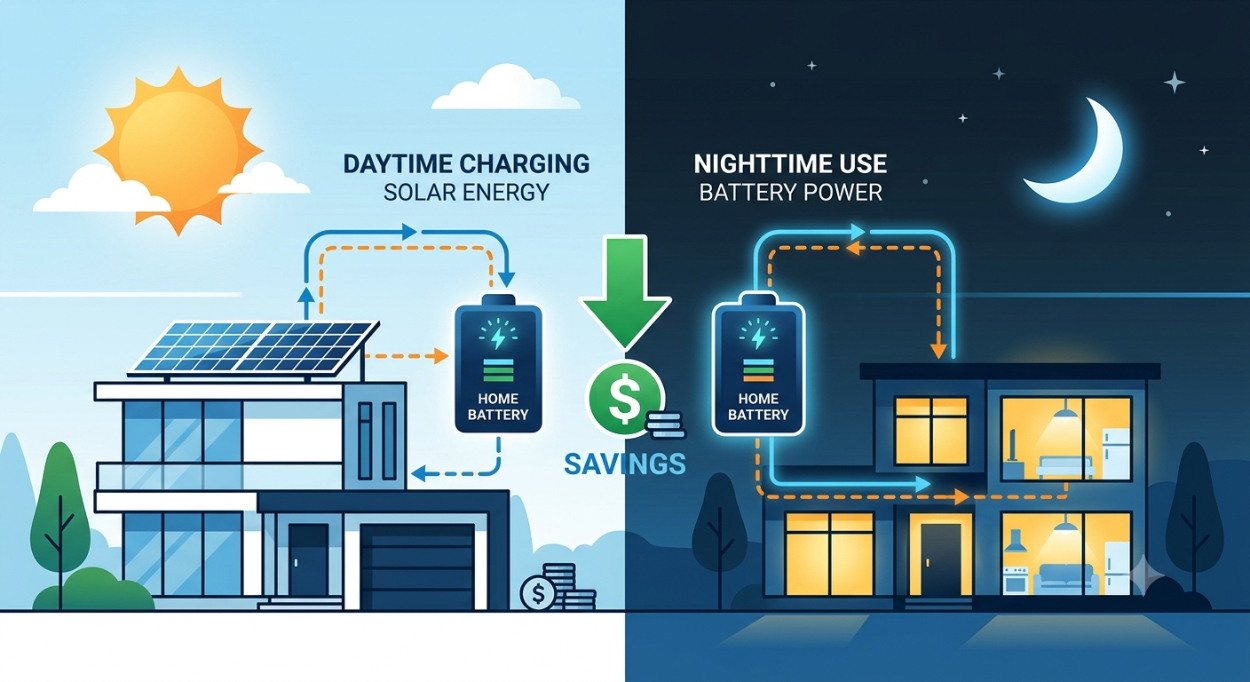
A home battery system without solar works through a simple yet powerful concept called time-of-use arbitrage. While a solar-coupled battery stores surplus solar energy generated during the day, a standalone battery stores electricity drawn from the grid when it’s cheapest and greenest—typically overnight when demand is low—and discharges it during peak hours when electricity prices spike. (A home battery system without solar is precisely defined as a behind-the-meter storage asset that charges from the grid and then discharges into the home’s electrical system when it is most valuable.)
Here’s how it works in practice. You sign up for a time-of-use (TOU) electricity tariff from your utility, which offers different electricity prices depending on the time of day. Off-peak hours (usually late at night, between 11 PM and 8 AM) have the lowest prices, while peak hours (typically daytime and early evening) have the highest prices. Your battery automatically charges during those cheap off-peak hours, then powers your home during expensive peak hours. You’re not generating your own energy—you’re just buying it at the right time and using it at the right time.
Why this actually works comes down to how extreme the price difference can be. In many regions with TOU pricing, the spread between off-peak and peak rates can be $0.20–$0.35 per kWh or even more. That difference is where your savings come from. The battery becomes the central asset in the stack, and its usable capacity, cycle life, and round-trip efficiency determine what the whole system can reliably deliver.

How Much Money Can You Save?
Let’s get to the number everyone wants to know. The savings from a standalone battery depend on several variables—your local electricity rates, your daily energy usage, the size of your battery, and the TOU tariff you choose.
Using a real-world example, a household that charges a 10kWh battery overnight at 8p per kWh and offsets usage during a 35p per kWh peak window saves roughly 27p per unit (minus system losses). Over a full year, that can add up to £900–£1,000 in ideal conditions. In the U.S., a California homeowner with a peak rate of $0.42/kWh and an off-peak rate of $0.18/kWh could save around $700 per year from a 10kWh battery cycling daily.
A 2026 analysis found that home battery systems typically achieve payback within 7–12 years, and households in areas with steep TOU differentials ($0.35–$0.50/kWh peak vs. $0.15/kWh off-peak) recover costs 2–3 years faster. But that’s just from bill savings. When you factor in other revenue streams and incentives, the math gets even better.
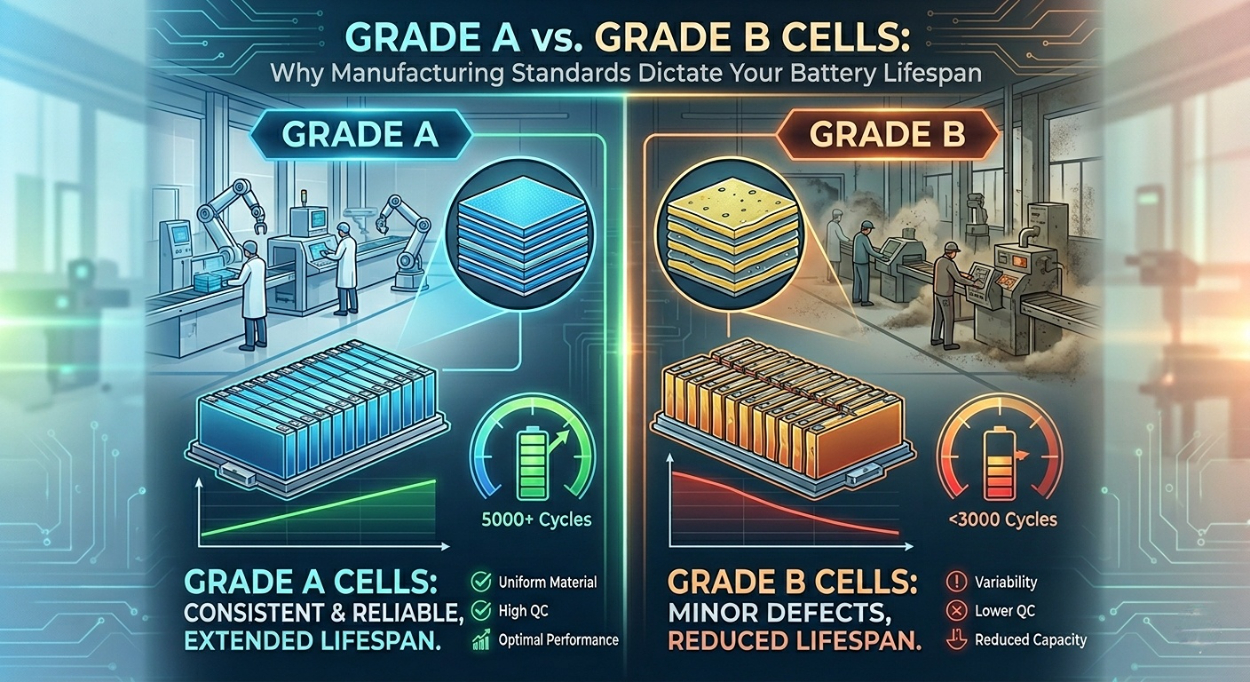
The battery’s lifespan is critical here. If your battery only lasts 5–6 years, a 7–12 year payback period doesn’t work. But LiFePO₄ (LFP) batteries last 4,000 to 10,000+ cycles, or 10–20 calendar years. That’s what makes the investment viable. Understanding how lifespan affects ROI is essential before making any purchase decision. (For more insight into why LFP chemistry is the superior choice for home energy storage, our detailed comparison of LFP vs NMC for home battery backup explains the differences in cycle life, safety, and long-term cost.)
Beyond Bill Savings: Additional Revenue Streams
Here’s where standalone batteries really start to shine. Beyond basic bill savings, your battery can actually earn you money by participating in Virtual Power Plant (VPP) programs.
A VPP is essentially a network of home batteries that utilities can tap into during periods of high grid demand. When you enroll your battery in a VPP, the utility pays you for permission to draw a small amount of power from your battery to help stabilize the grid during peak times—think of it as getting paid for lending your battery to the grid when it needs help most. According to the U.S. Department of Energy, VPPs are a key strategy to modernize electric grids.
📊 VPP earnings snapshot: SolarEdge now has more than 500 MWh of residential battery storage enrolled in VPP programs across 16 U.S. states and Puerto Rico, and over 40% of SolarEdge battery sites in the U.S. participate in these incentive programs. Participants can earn meaningful amounts: In Arizona, homeowners receive $110 per kW based on their battery’s average output during events; in Tucson, they can earn up to $120 per kW, with payments issued twice annually. South Carolina’s VPP program offers up to $624 per year in ongoing incentives, and New York State programs complement NYSERDA’s Expanded Storage Incentive offering up to $6,250 per system.

Here’s the key point: VPP participation doesn’t take away your backup power during outages. The utility only draws from your battery when the grid is stable—if a blackout occurs, your battery reserves are preserved for your home. It’s a genuine win-win: you get paid, the grid gets more stable, and everyone benefits.
Protection When You Need It Most: Backup Power
There’s also a value that’s harder to put a price tag on: backup power.

For homeowners in areas prone to grid outages—whether from storms, wildfires, or aging infrastructure—a battery is a form of insurance. When the grid goes down, a properly configured battery keeps your refrigerator running, your lights on, your internet working, and your medical devices powered. For a home office, lost productivity during an outage can cost $500 per day or more; for a small retail business, $2,500–$10,000 per day.
In regions where outages are frequent, the backup value alone can justify the entire investment. And unlike a gas generator, a home battery requires no fuel storage, emits no fumes, operates silently, and provides instant power the moment the grid fails.
Federal & State Tax Credits: A Critical Piece of the Puzzle
Until very recently, the federal Investment Tax Credit (ITC) offered a 30% credit on home battery installations—but only for batteries that were paired with solar panels. For standalone batteries (those without solar), the federal ITC historically did not apply.
However, the landscape is changing. Many states now offer their own rebates and incentives for standalone battery storage. California’s SGIP program provides up to $250/kWh for residential storage, with income-qualified households eligible for up to $850/kWh. New York’s ConEd offers $300–$400/kWh for demand management, and Massachusetts’ SMART program provides $200–$700/kWh depending on location. We highly recommend checking the DSIRE database for real-time incentives in your area.
The key takeaway: always check your local utility and state energy office for current incentives before making a purchase decision. Your installer should also be up to date on what’s available in your area.
When Does a Standalone Battery Make Financial Sense?
Based on the data, a standalone home battery is most likely to be worth it if:
- Your utility offers a steep TOU rate differential. The wider the gap between off-peak and peak rates, the faster your payback. If the spread is less than $0.15/kWh, it’s probably not worth it.
- You have high evening energy usage. A battery works best when you can shift a significant portion of your daily consumption from peak to off-peak hours. If you’re out of the house all day and barely home during peak hours, your savings will be limited.
- Your area has VPP programs available. The extra income from grid services can dramatically improve your ROI and shorten the payback period by several years.
- You value backup power. If blackouts are a real concern in your area, a battery provides peace of mind that no dollar figure can fully capture—and in many cases, the backup value alone justifies the investment.
A standalone battery is less likely to make sense if your utility’s rate structure is flat (no peak/off-peak difference), your home’s energy usage is consistently low, or you’re in an area with no VPP programs and very reliable grid service.
Of course, the daily decisions you make also matter. Your daily usage habits have a direct impact on how long your battery lasts—and understanding how ambient conditions like garage temperatures affect lifespan is equally important. For those looking to maximize their investment, learning how to save money with a home battery through smart charging strategies can make a real difference.
Choosing the Right Battery for Standalone Use
If you decide a standalone battery is right for your home, choosing the right battery chemistry is just as important as sizing the system correctly.
LiFePO₄ (LFP) is the clear winner for home storage applications. LFP batteries deliver 4,000 to 10,000+ cycles compared to NMC’s 1,000–5,000 cycles, and they offer calendar lives of 10–20 years versus NMC’s 6–10 years. For a home battery that gets cycled daily for TOU arbitrage, LFP’s superior cycle life means you’ll buy one battery instead of two or three over the same period. LFP also has a much higher thermal runaway threshold (around 500°F) compared to NMC (around 300°F), making it the safer choice for home installation (UL 9540 safety standard).
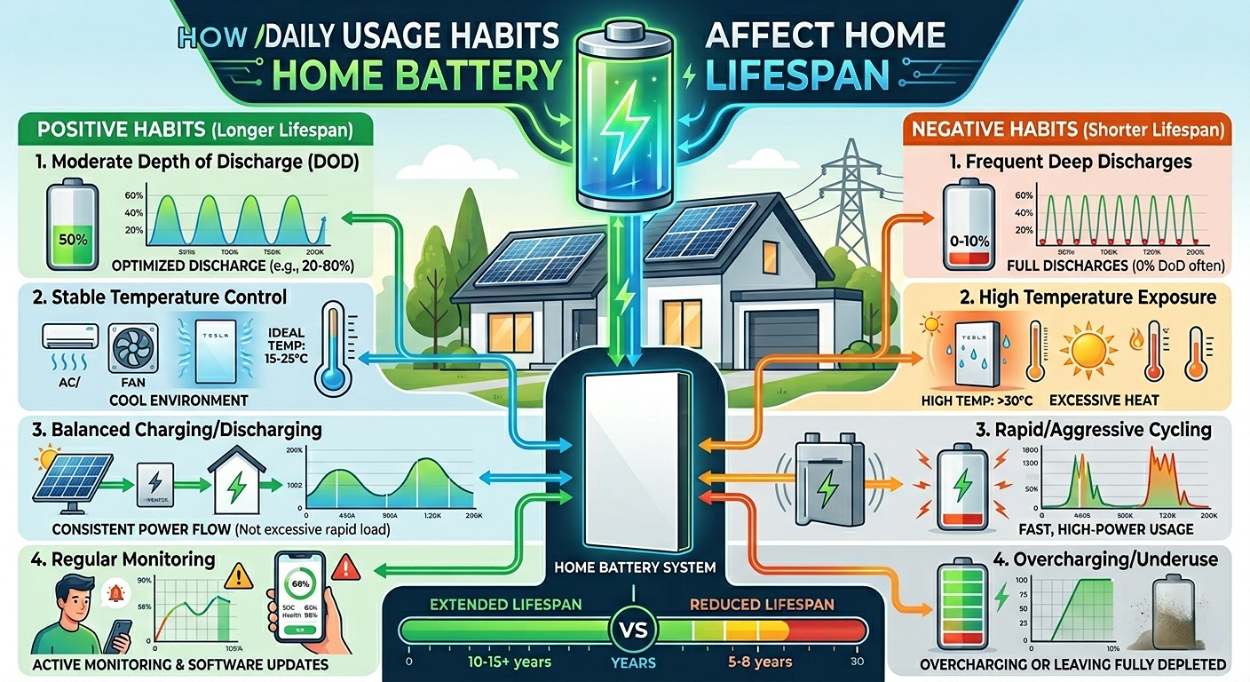
Another critical factor for standalone battery users is charging behavior. Because you’ll be cycling your battery daily for TOU arbitrage (charging overnight, discharging during peak hours), understanding why depth of discharge is the key to battery longevity is essential. Keeping your daily DoD within 80–90% rather than pushing to 100% every day can significantly extend your battery’s life. And the answer to does partial charging extend home battery life is a definitive yes—the 80% rule, which means charging to 80% for daily use rather than 100%, reduces internal stress and can extend battery lifespan by 2–3 times.
For homeowners without solar, the ability to preserve battery life through smart daily management is particularly important since your battery will be cycling every single day.
Making Your Decision: A Practical Checklist
✅ Before you invest in a standalone home battery, run through this checklist:
- Review your utility bill. What’s the difference between your off-peak and peak rates? Is there a meaningful spread? Look up your utility’s TOU tariff details online.
- Check for state and local incentives. Visit your state energy office website or the DSIRE database to see what rebates are available for standalone storage.
- Look up VPP programs in your area. Search for “virtual power plant [your utility name]” or ask local installers about grid service programs.
- Assess your backup power needs. How often does your power go out? How critical is continuous power for your household (medical equipment, home office, food storage)?
- Size your system properly. Work with a reputable installer to determine the right capacity for your home based on your daily energy usage.
- Consider the long-term value. While a standalone battery may take 7–12 years to pay back from bill savings alone, factoring in VPP earnings, backup protection, and potential home value increases can make the investment worthwhile much sooner.
Final Verdict: Is It Worth It?
The honest answer is: it depends on your situation, but for many homeowners, a standalone home battery is increasingly worth the investment.
The economics are improving every year. Battery costs continue to fall, VPP programs are expanding across more states and utilities, and utilities are implementing increasingly aggressive TOU rate structures that favor energy shifting. If you live in an area with a strong TOU spread and available VPP programs, a standalone battery can provide a solid financial return while delivering backup protection that no dollar figure can fully capture.
The bottom line: You don’t need solar panels to start saving with home battery storage. It’s a flexible, accessible solution for homeowners who want to take control of their energy costs and protect their homes—roof or no roof.
Ready to explore whether a standalone battery is right for your home? Contact JM Energy Tech to discuss your energy needs and get personalized recommendations based on your local utility rates and usage patterns.
🔋 Visit JM Energy Tech →
How Daily Usage Habits Affect Home Battery Lifespan