


What Can a 40kWh Battery Power
What Can a 40kWh Battery Power? Home Backup Guide
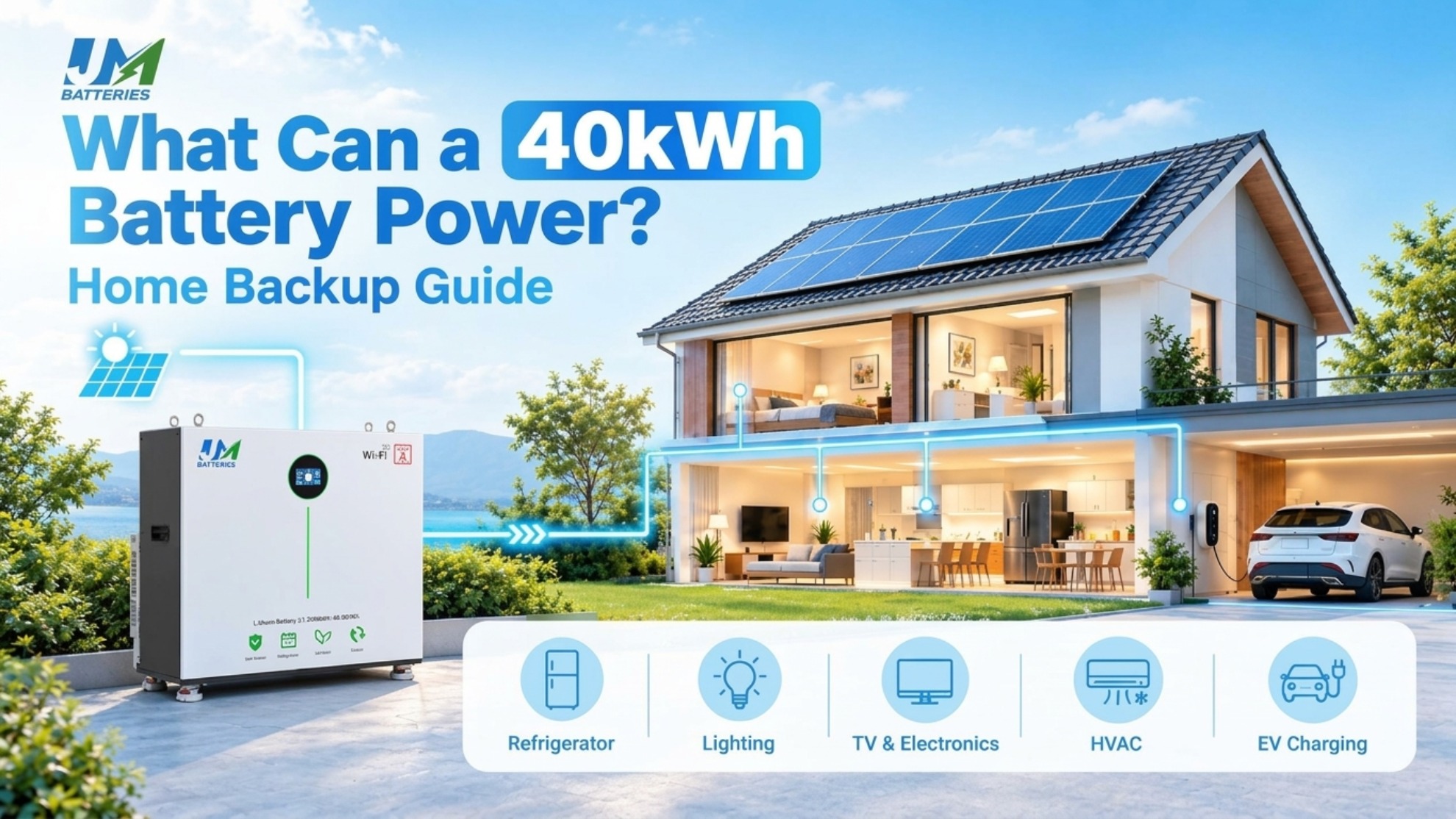
Table of Contents
Understanding 40kWh Energy Storage Capacity for Modern Homes
A 40 kilowatt‑hour residential energy storage system represents a substantial capacity threshold designed for modern residential applications, small businesses, and hybrid solar installations. Because the average household consumes roughly 25 to 30 kilowatt‑hours of electricity daily, a fully charged unit of this scale can theoretically sustain an entire home for well over a day under standard operating conditions. When deployed alongside photovoltaic arrays, this storage size bridges the gap between intermittent renewable generation and continuous domestic electricity demands, enhancing overall grid independence.
What a 40kWh Battery Powers in a Typical Home
How Long Does a 40kWh Battery Last Under Daily Load?
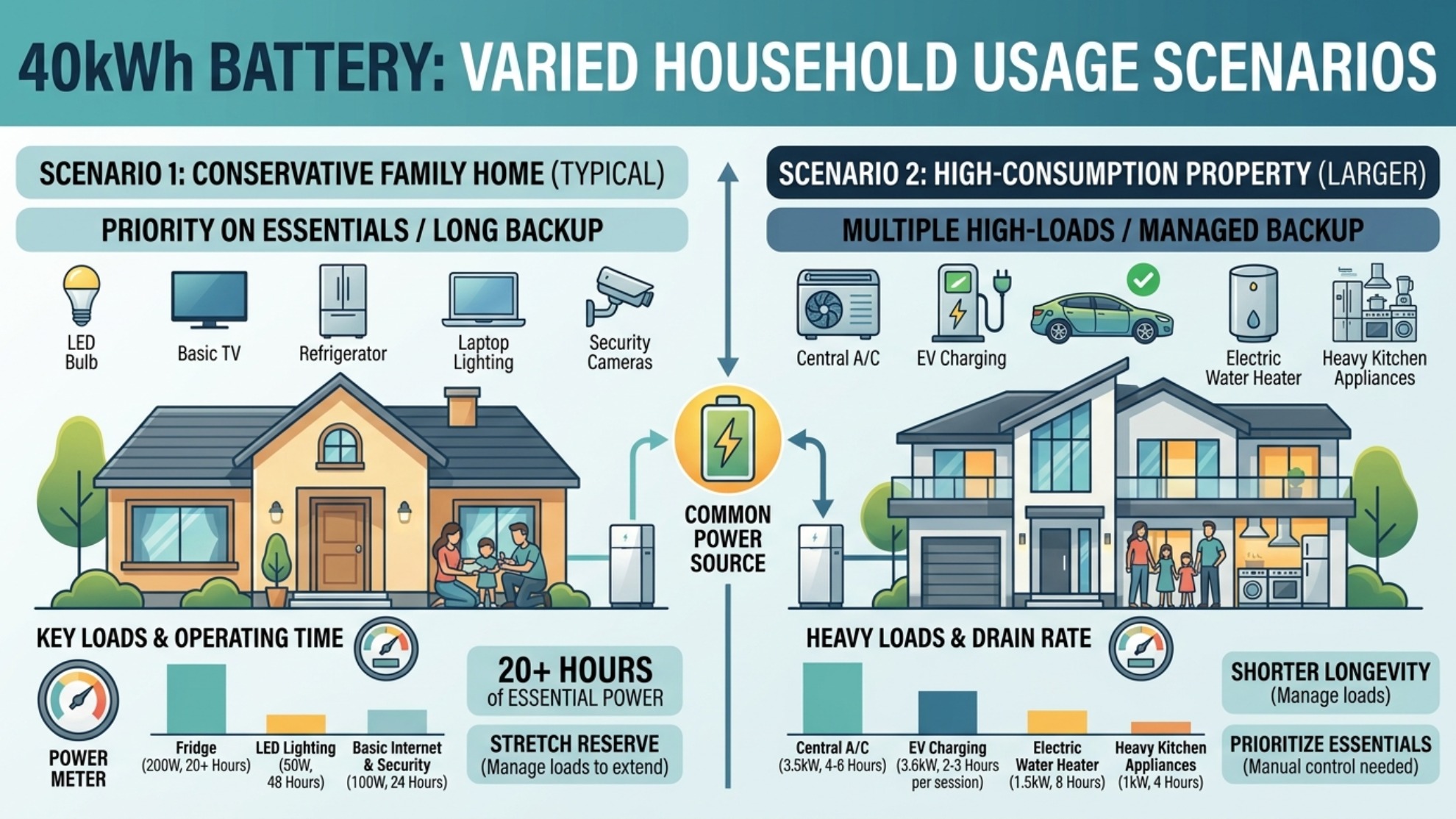
Evaluating runtime requires examining real‑world variables like inverter efficiency, depth of discharge limits, and concurrent home battery capacity usage. If a property operates on a conservative energy profile—powering critical items like refrigerators, internet routers, and LED lighting—the hourly drain is exceptionally low, allowing the reserve to stretch up to 20 hours or more. Conversely, running multiple energy‑intensive devices simultaneously accelerates depletion, reducing total operational longevity to a shorter timeframe while still maintaining critical emergency protection during unexpected grid failures.
Which Household Appliances a 40kWh Battery Runs
The true versatility of a large‑scale power bank becomes evident when analyzing how individual household appliances perform during extended outages or off‑grid scenarios. Essential electronics such as refrigerators, televisions, and LED lighting draw minimal wattage, meaning they can run continuously for hundreds of hours combined without draining the primary reservoir. This reliability makes a robust backup power system indispensable for regions prone to severe weather events, rolling blackouts, or unstable local electrical infrastructure.
Can a 40kWh Battery Power HVAC and EV Chargers?
Integrating high‑demand equipment introduces unique load dynamics that test the limits of continuous power output and surge currents within any household power consumption framework. Central air conditioning units and electric water heaters demand high starting wattage, which a well‑engineered 40kWh configuration can support comfortably for several hours. Furthermore, charging an electric vehicle using a standard setup is entirely feasible, though managing multi‑kilowatt draws requires careful load balancing to prioritize essential domestic necessities.
How Solar and Peak Shaving Boost a 40kWh Battery
Beyond emergency readiness, deploying a large‑capacity storage unit offers profound financial and environmental benefits through advanced solar self‑consumption optimization and time‑of‑use rate arbitrage. Homeowners can store excess clean energy generated during peak daylight hours and discharge it during evening periods when utility rates peak. This intelligent energy management minimizes reliance on fossil fuels, lowers monthly electricity bills significantly, and ensures a resilient, sustainable power ecosystem for decades of reliable operation.
Real‑World 40kWh Battery Case Studies
Case Study 1: Australian Semi‑Rural Family Home — Multi‑Day Blackout Resilience
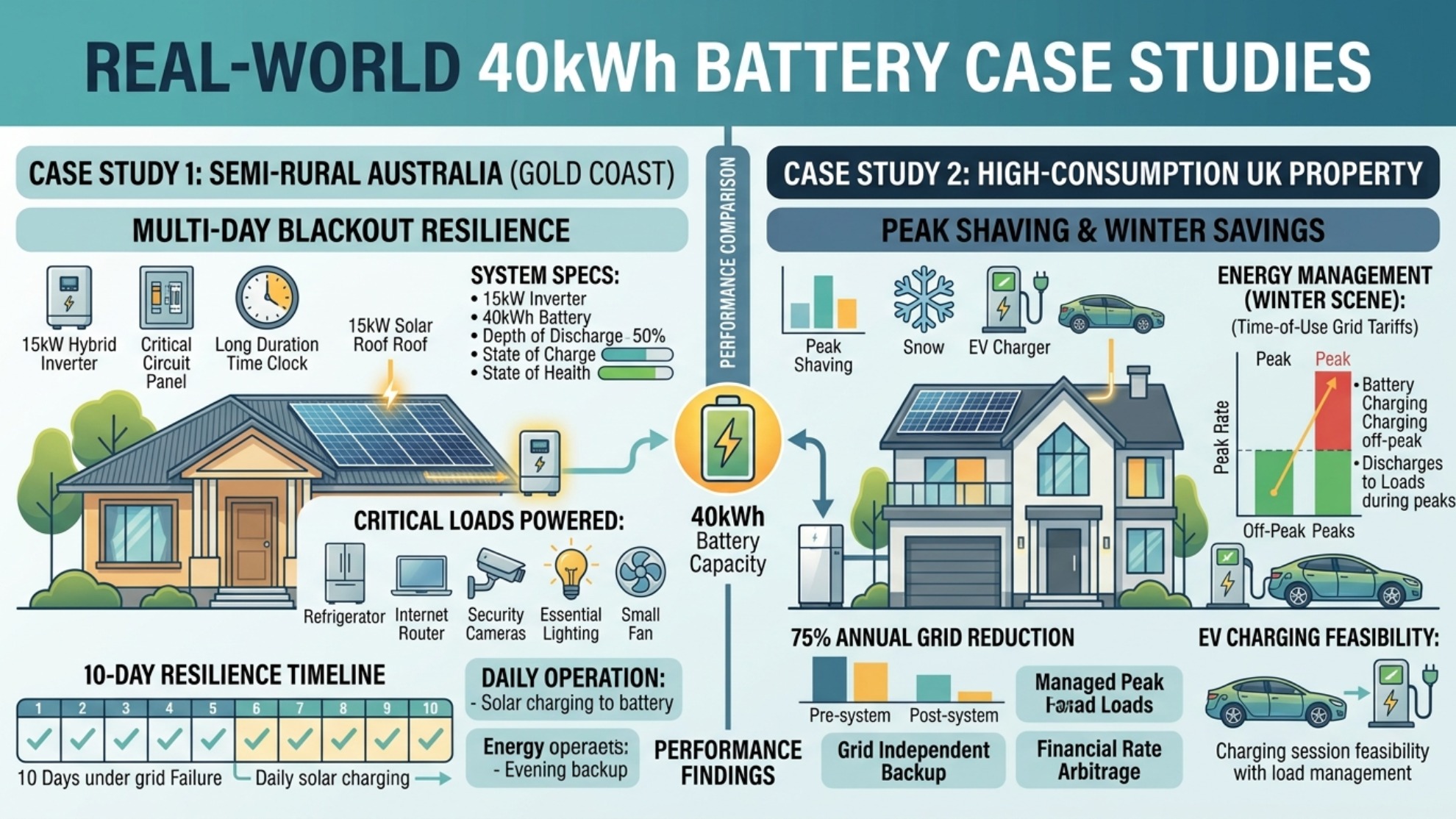
A semi‑rural family home on Australia’s Gold Coast installed a 15kW hybrid inverter paired with a full 40kWh battery system to solve frequent extended grid blackouts. Local outages sometimes lasted 10 days or longer, threatening refrigeration, home internet, security cameras, and essential household lighting. With the fully‑charged 40kWh battery, the household maintained critical home circuits during multi‑day grid failures without a generator. Under normal grid‑connected operation, the system stores rooftop solar power for evening use and reduces monthly grid‑energy purchases. This installation demonstrates how a 40kWh battery delivers both daily solar self‑consumption and long‑duration emergency backup for outage‑prone residential locations, with careful monitoring of battery state of charge (SoC) and state of health (SoH) preserving long‑term battery performance.
Case Study 2: UK High‑Consumption Family Property — Peak Shaving and Winter Energy Savings
A high‑usage residential property in the United Kingdom fitted a 13.8kW rooftop solar array alongside a 40kWh battery storage system, targeting electricity‑bill reduction plus limited backup capability. The home’s annual power consumption was well above average. In summer, surplus daytime solar fills the battery for evening household loads. During shorter winter daylight hours, the system combines low‑cost overnight grid‑tariff charging and limited solar harvest to avoid expensive peak‑rate electricity. The project achieved approximately 75% annual reduction in grid‑imported electricity, proving 40kWh storage works effectively for both peak‑shaving financial goals and emergency preparedness for higher‑energy‑use households.
Frequently Asked Questions
Can a 40kWh battery run an entire house all day?
Yes, under low‑to‑moderate household consumption. Average homes use 25‑30kWh per day. Heavy simultaneous loads like full‑time air‑conditioning will shorten runtime significantly.
How many solar panels do I need to charge a 40kWh battery?
It depends on local sun hours. Typically a 8‑12kW solar array can fully recharge a 40kWh battery over one sunny day.
What is depth of discharge for a 40kWh home battery?
Most lithium‑ion home batteries restrict usable capacity to 80‑90% of the rated 40kWh to preserve battery lifespan. Learn more about SoC, DoD and battery operating ranges.
Is 40kWh enough for off‑grid living?
40kWh works for basic off‑grid needs, but you will need load management and sufficient solar generation for long‑term full off‑grid operation. Regularly checking battery SoH helps you anticipate capacity loss over many cycles.
10kWh vs 15kWh Battery: Which Home Storage Size Is Better?