


What Is DOD in a LiFePO4 Battery?
What Is DOD in a LiFePO4 Battery? Depth of Discharge Explained

Table of Contents
- What Is Depth of Discharge (DOD) in a Battery?
- DOD vs SOC: Understanding the Key Difference
- How DOD Affects LiFePO4 Battery Lifespan & Cycle Life
- 80% DOD vs 100% DOD: Cycle Life Comparison
- Recommended DOD for LiFePO4 Batteries (Best Range)
- Setting BMS Low‑Voltage Cutoff & DOD Limits
- Real‑World DOD Application Case Studies
- Case Study 1: Off‑Grid Mountain Cabin Residential Solar
- Case Study 2: Remote Telecom Standby Power Site
- How to Calculate Usable Battery Capacity from DOD
- Frequently Asked Questions (FAQ)
Depth of Discharge (DOD) represents one of the most fundamental parameters in battery management, directly governing how much stored power you can safely extract before recharging. In a lithium iron phosphate battery (LiFePO4), understanding the precise depth of discharge definition allows system integrators and energy storage owners to balance daily usable capacity with long‑term system durability. Expressed as a percentage, DOD quantifies the portion of a fully charged battery that has been drained during operation.
Calculating this metric in practice is straightforward: simply divide the energy removed from the battery by its total nameplate rating and multiply by one hundred. For instance, if a 10 kilowatt‑hour energy storage module releases 8 kilowatt‑hours of electrical power, its current discharge depth sits at 80 percent. Determining this value helps prevent over‑discharge, ensuring the usable battery capacity matches the operational demands of home backup or off‑grid solar installations without incurring structural damage to internal cathode or anode materials. Further technical details on electrochemical energy metrics are available via standard battery discharge definitions.
What Is Depth of Discharge (DOD) in a Battery?
DOD vs. SOC: Understanding the Key Difference
Evaluating battery status requires clarifying the relationship between state of charge vs depth of discharge. While DOD measures the percentage of energy withdrawn, State of Charge (SOC) measures the remaining available energy. They act as exact inverses that always add up to one hundred percent.
When monitoring a battery fuel gauge, SOC acts like a traditional fuel meter showing full to empty, whereas DOD reflects how far down the tank has been drained. If an SOC meter reads 25 percent, the battery is operating at a 75 percent DOD. Maintaining precise tracking of both metrics prevents unexpected voltage drop‑offs during peak power cycles.
How DOD Affects LiFePO4 Battery Lifespan & Cycle Life
80% DOD vs 100% DOD: Cycle Life Comparison

The relationship between DOD and battery cycle life is strictly non‑linear. While LiFePO4 chemistry is far more resilient than conventional lead‑acid or nickel‑based alternatives, exposing cells to complete deep cycles induces cumulative chemical stress degradation. Every full charge‑discharge cycle causes subtle microscopic expansion and contraction within the olivine crystal lattice of the cathode.
An overview of cell voltage levels across varying states of charge highlights how flat the voltage curve remains before plunging sharply at high DOD levels:
Comparing 80% vs 100% DOD illustrates why limiting cycle depth delivers massive gains in longevity. At a 100 percent DOD, a standard Grade‑A LiFePO4 cell typically yields between 2,000 and 3,000 complete cycles before losing 20 percent of its original capacity. By contrast, restricting the discharge depth to 80 percent DOD lowers the battery degradation rate, boosting total throughput to 4,000–6,000 cycles. Shallow cycling down to 50 percent DOD can push total service life beyond 8,000 to 10,000 cycles.
Deep discharges push the negative graphite electrode to extreme electrochemical potentials, accelerating the growth of the solid electrolyte interphase (SEI) layer. Over thousands of deep cycles, SEI layer thickening consumes active lithium ions and elevates internal cell impedance. Mitigating excessive internal resistance prevents unwanted heat accumulation during heavy discharge currents and preserves round‑trip energy efficiency over multi‑year operation.
Recommended DOD for LiFePO4 Batteries (Best Range)

| Discharge Depth (DOD) | Typical Cycle Life (to 80% Capacity) | Primary Application |
|---|---|---|
| 100% DOD | 2,000 – 3,000 cycles | Portable equipment, maximum emergency backup |
| 80% - 90% DOD | 4,000 – 6,000 cycles | Daily residential solar storage, commercial systems |
| 50% DOD | 8,000 – 10,000+ cycles | High‑reliability telecom, uninterrupted power supplies |
Setting BMS Low‑Voltage Cutoff & DOD Limits
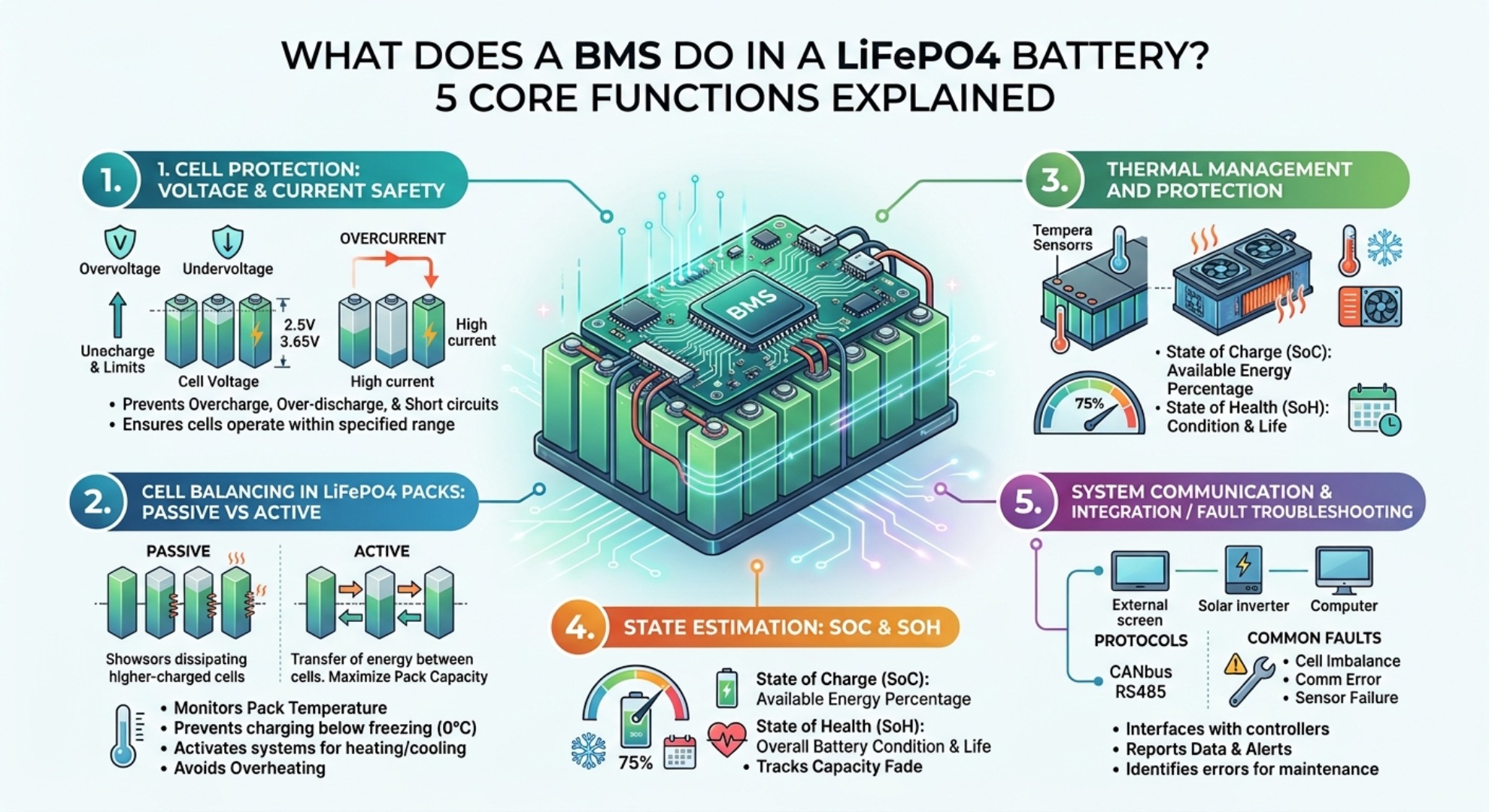
To enforce the recommended depth of discharge, modern battery packs rely on programmed safety thresholds managed by microcontrollers. For daily cycling in a solar battery storage system, setting the operating limits between 80 and 90 percent DOD strikes the ideal balance between initial equipment cost and long‑term cost per kilowatt‑hour.
Fine‑tuning your battery management system cutoff parameters ensures cells never enter the dangerous over‑discharge zone where copper dissolution occurs. Rather than allowing individual cell voltages to fall to the absolute chemical limit of 2.50 volts, setting a conservative low voltage protection limit at 2.80 to 3.00 volts per cell (or 48.0 volts for a standard nominal 51.2‑volt rack) automatically reserves a 10 percent energy buffer. More information on energy storage standards can be explored through international technical frameworks published by the International Electrotechnical Commission.
LiFePO4 Discharge Curve & Safety Zones:
[===================== Safe Operating Range (0% - 80% DOD) =====================] [-- Reserve Zone (80%-90%) --] [!! Danger Zone (90%-100%) !!]
3.40V/cell                                                                     3.20V/cell                     2.80V/cell                    2.50V/cell
Real‑World DOD Application Case Studies
Case Study 1: Off‑Grid Mountain Cabin Residential Solar

A remote off‑grid mountain cabin installed a 10 kWh LiFePO4 battery bank paired with rooftop solar panels. Initially, the BMS low‑voltage cutoff was configured to the absolute minimum cell voltage of 2.50 V, allowing regular 100 % DOD cycles during extended cloudy weather. After roughly two years of daily deep cycling, field testing showed the battery retained only about 73 % of its original rated capacity, far below expected performance. Technicians re‑programmed the BMS to enforce maximum 80 % DOD by raising per‑cell low‑voltage cutoff to 2.85 V, accepting a small reduction of usable daily energy in exchange for slower degradation. After this adjustment, capacity fade slowed significantly. Based on observed degradation rates, the projected service life of the same battery bank increased from approximately 6‑7 years to more than 11 years of daily operation, demonstrating tangible real‑world benefits from limiting daily DOD for residential off‑grid systems.
Case Study 2: Remote Telecom Standby Power Site

A cellular tower site located in an isolated rural area deployed rack‑mount LiFePO4 battery banks for grid‑outage backup power. In normal operation, utility power remains available most of the time, and batteries only cycle partially during brief grid dips. System engineers configured the BMS and site controller to keep average operating DOD limited near 50 %, matching the high‑reliability telecom application profile in the reference table. The battery bank rarely goes beyond 50 % depth of discharge even during power interruptions. After over six years of continuous service, periodic capacity audits measured 87 % remaining original capacity. This field result aligns with lab cycle‑life data showing 8,000‑10,000+ expected cycles for LiFePO4 operating at 50 % DOD. For standby‑critical infrastructure, shallow DOD cycling reduces replacement frequency and lowers long‑term operational expense.
How to Calculate Usable Battery Capacity from DOD
Executing an accurate usable capacity calculation prevents under‑sizing an energy bank during system design. To isolate true usable energy without relying on complex equations, simply multiply the total nameplate rating by your target discharge percentage expressed as a decimal factor.
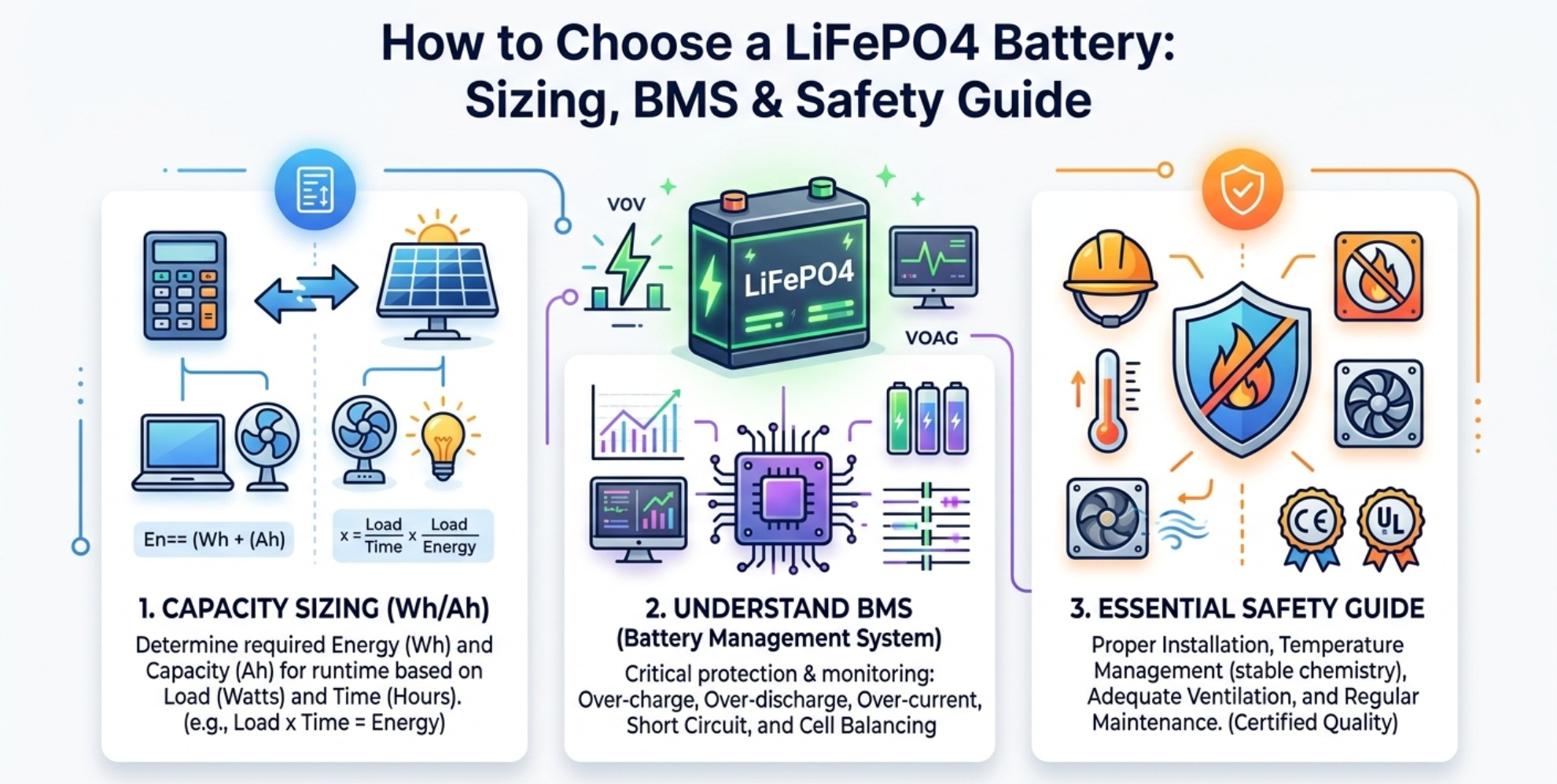
For instance, a solar system requiring 16 kilowatt‑hours of daily night‑time consumption should not be paired with a simple 16 kilowatt‑hour nominal pack running at full depth. Factoring in an 80 percent operational ceiling for proper off‑grid battery sizing means dividing the daily power requirement by 0.80, indicating a 20 kilowatt‑hour total storage capacity is required. When shopping for new storage hardware, review our practical LiFePO4 battery buying guide to compare cell grades, BMS options and certification requirements.
Implementing proactive battery health optimization practices—such as maintaining moderate ambient operating temperatures (15°C to 25°C) alongside capped discharge depths—ensures a residential or commercial energy storage system lifespan comfortably exceeds 10 to 15 years of continuous daily operation.
Frequently Asked Questions (FAQ)

Can I run my LiFePO4 battery at 100% DOD every day?
You can technically discharge to 100% DOD, but daily full discharge accelerates chemical aging and cuts cycle life significantly. 100% DOD is best reserved for emergency situations, not normal daily cycling. For regular home or solar use, stick to 80‑90% maximum DOD.
What is the difference between DOD and SOC for LiFePO4?
SOC shows remaining battery charge, DOD shows how much energy has been taken out. Their sum always equals 100%. For example, 30% SOC equals 70% DOD.
Do I need to adjust BMS settings to limit DOD?
Yes. DOD is controlled by the BMS low‑voltage cutoff voltage. Raising the cutoff voltage per cell reduces maximum DOD. Most residential solar systems use 2.80V‑3.00V per cell to cap DOD near 80‑90%.
Is 50% DOD suitable for home solar battery systems?
50% DOD delivers maximum cycle life, but you will waste large portions of your battery’s rated capacity. This setting works well for telecom and UPS standby power, yet it is generally cost‑ineffective for typical residential solar storage.
Will occasional 100% DOD permanently damage a LiFePO4 battery?
One‑off deep discharge in emergency conditions will not cause immediate permanent damage. Repeated, regular full depth‑of‑discharge cycles cause cumulative degradation over time.
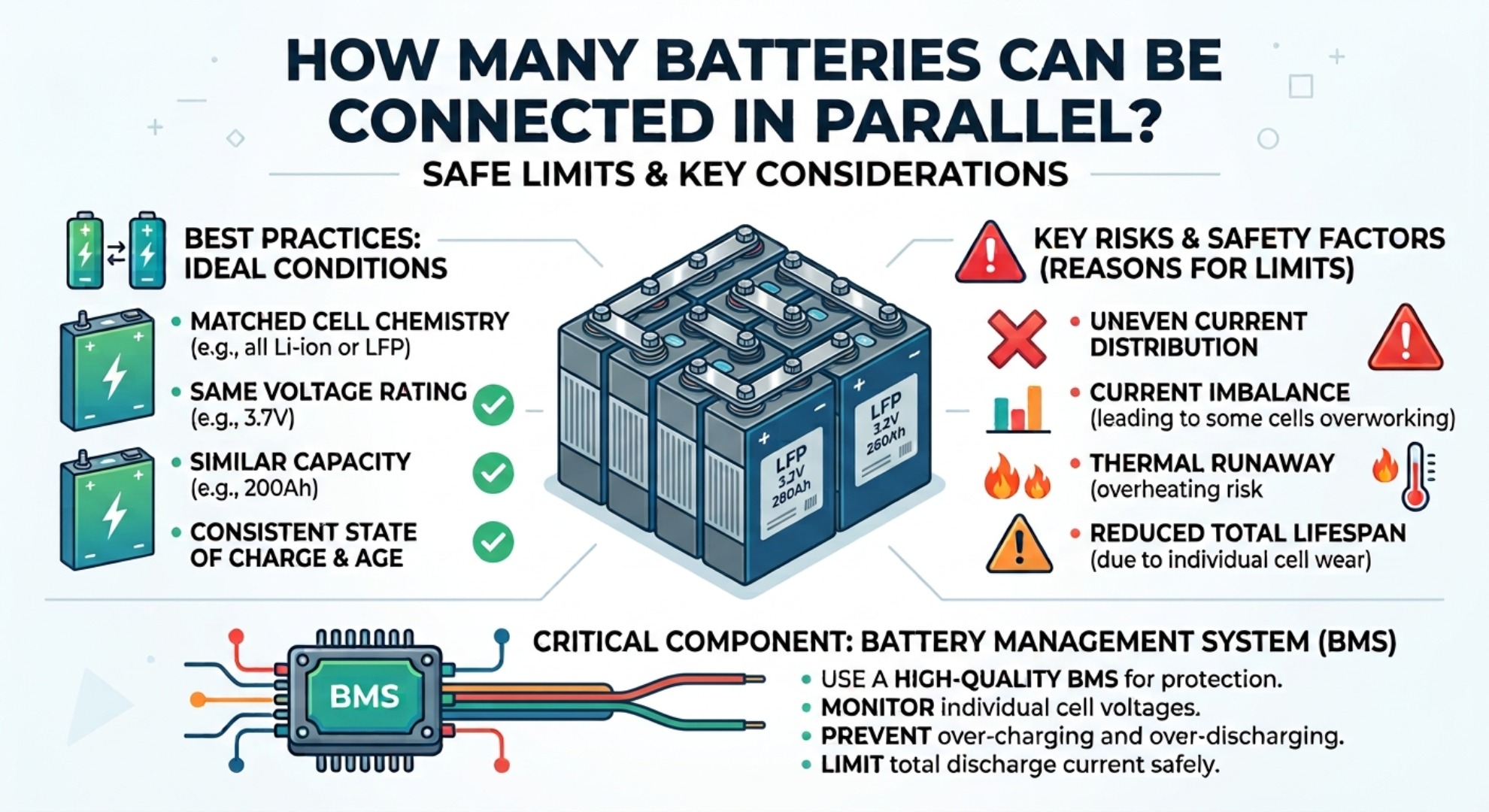
How Many Batteries Can Be Connected in Parallel?
What Does a BMS Do in a LiFePO4 Battery?