


How to Size a Home Battery Storage System
How to Size a Home Battery Storage System: Complete Residential Solar Battery Sizing Buyer’s Guide

Table of Contents
- Why Correct Home Battery Storage Sizing Matters For Solar & Blackout Backup
- How Residential Solar Home Battery Storage Systems Function
- Step 1: Calculate Daily Household Electricity Consumption For Battery Sizing
- Step 2: Identify Essential & Whole-Home Appliance Loads For Battery Backup
- Step 3: Calculate Required Blackout Backup Duration For Home Batteries
- Step 4: Differentiate Battery kWh Capacity vs kW Power Output
- Step 5: Use Depth Of Discharge (DoD) To Calculate Real Usable Battery Energy
- Step 6: Factor Battery Round-Trip Efficiency & BMS Into Sizing Calculations
- Recommended Home Battery Storage Sizes By Household Type & Energy Use
- Real-World Home Solar Battery Sizing Calculation Examples For All Home Types
- Most Common Home Battery Sizing Mistakes Homeowners Need To Avoid
- LiFePO4 vs Lead-Acid Batteries: Full Comparison For Residential Energy Storage
- Frequently Asked Questions About Sizing Home Solar Battery Storage Systems
- Final Recommendations For Selecting A Scalable Home Battery Storage System
Quick Answer
Choosing the right home battery size depends on four key factors: your daily electricity consumption, the appliances you want to power, how long you need backup power, and whether your battery works with a solar energy system.
For most homeowners:
| Daily Electricity Usage | Recommended Battery Capacity |
|---|---|
| 5–8 kWh | 5–10 kWh |
| 8–15 kWh | 10–15 kWh |
| 15–25 kWh | 15–20 kWh |
| 25–40 kWh | 20–30 kWh |
Modern LiFePO₄ batteries allow homeowners to use up to 90–100% of their available capacity while delivering more than 6,000 charge cycles. Choosing the correct battery size helps reduce electricity bills, maximize solar self-consumption, and ensure reliable backup power during outages.
Key Takeaways
- Battery capacity is measured in kilowatt-hours (kWh), not amp-hours (Ah).
- Daily electricity consumption is the most important factor when sizing a home battery.
- Backup duration and appliance power requirements directly affect battery size.
- LiFePO₄ batteries provide higher usable capacity and longer service life than traditional lead-acid batteries.
- A Battery Management System (BMS) helps protect battery performance and extend lifespan.
- Most residential solar systems require between 5 kWh and 20 kWh of battery storage.
- Modular battery systems allow future expansion without replacing the entire system.
Why Correct Home Battery Storage Sizing Matters For Solar & Blackout Backup
Risks Of Undersized & Oversized Residential Battery Systems
Selecting the correct battery capacity is one of the most important decisions when investing in a home energy storage system. A battery that is too small may not provide enough backup power during outages, while an oversized battery can increase installation costs without delivering proportional benefits.
Proper battery sizing helps homeowners:
- Reduce electricity costs by storing excess solar energy.
- Improve energy independence during grid outages.
- Maximize the return on investment (ROI) of a solar power system.
- Extend battery lifespan by avoiding unnecessary deep cycling.
- Prepare for future increases in electricity demand, such as electric vehicles (EVs) or heat pumps.
Many homeowners assume that purchasing the largest available battery is the safest option. In reality, the best battery size is one that closely matches your actual energy consumption and backup requirements. A well-designed system provides enough stored energy for essential loads while minimizing unnecessary costs.
Scalable Modular LiFePO4 Battery Benefits For Future Energy Demand
Another important consideration is system scalability. Many modern LiFePO₄ battery systems are modular, allowing homeowners to add additional battery modules as their energy needs grow. This approach reduces upfront investment while preserving future flexibility.
How Residential Solar Home Battery Storage Systems Function

4 Core Components Of A Grid-Tied Home Energy Storage Setup
Before calculating battery capacity, it's important to understand how a home battery storage system operates.
A residential battery stores electricity either from rooftop solar panels or directly from the utility grid during off-peak hours. When electricity demand increases or a power outage occurs, the battery automatically supplies stored energy to your home through an inverter.
A typical home battery system consists of four main components:
- Solar panels (optional)
- Hybrid or battery inverter
- Lithium battery storage
- Battery Management System (BMS)
During the day, excess solar energy charges the battery instead of being exported to the grid. At night or during a blackout, the stored energy powers household appliances, reducing reliance on utility electricity.
If you're new to residential energy storage, read our guide "How Does Home Energy Storage Work?" before continuing:
Understanding how energy flows through the system makes it much easier to determine the correct battery size and estimate backup duration.
No single battery capacity is suitable for every household. The ideal system depends on several interconnected factors that influence how much stored energy your home requires.
The most important factors include:
- Daily electricity consumption
- Peak appliance power demand
- Desired backup duration
- Solar panel generation
- Battery chemistry
- Depth of Discharge (DoD)
- State of Charge (SoC)
- Battery efficiency
- Future electricity demand
In the following sections, we'll examine each of these factors in detail and demonstrate how to calculate the ideal battery size for your home.
Step 1: Calculate Daily Household Electricity Consumption For Battery Sizing
How To Read Utility Bills To Get Average Daily kWh Usage
The first step in sizing a home battery storage system is determining how much electricity your household consumes each day. Battery capacity should always be based on actual energy usage rather than the physical size of your home.
Most utility bills display monthly electricity consumption in kilowatt-hours (kWh). To estimate your average daily usage, divide the monthly total by the number of days in the billing cycle.
Example
If your monthly electricity consumption is 900 kWh, your average daily usage is:
900 ÷ 30 = 30 kWh per day
This figure provides a useful starting point for calculating the appropriate battery capacity.
If you have a smart energy meter, you can also review hourly electricity usage. This helps identify when your household consumes the most power and whether a battery can shift energy usage to lower-cost periods.
For homeowners with rooftop solar systems, daily battery capacity does not necessarily need to match total daily electricity consumption. Instead, the battery should be sized according to the amount of excess solar energy available for storage.
If you're unfamiliar with battery capacity measurements such as amp-hours (Ah) and how they relate to usable energy, read our guide:What Does Ah Mean on a Battery?
Understanding the relationship between Ah and kWh makes it easier to compare different battery models and select the right capacity.
Standard Daily Power Consumption Benchmarks By Home Type
| Home Type | Typical Daily Usage | Recommended Battery |
|---|---|---|
| Apartment | 5–8 kWh | 5–10 kWh |
| Small Home | 8–15 kWh | 10 kWh |
| Medium Home | 15–25 kWh | 15–20 kWh |
| Large Home | 25–40 kWh | 20–30 kWh |
| Luxury Home | 40+ kWh | 30 kWh or more |
These values are estimates only. Actual consumption depends on climate, family size, appliance efficiency, and lifestyle.
Step 2: Identify Essential & Whole-Home Appliance Loads For Battery Backup
Common Critical Household Appliances For Emergency Battery Power
Not every homeowner needs to power the entire house during an outage. In many cases, keeping only essential appliances running is sufficient and can significantly reduce the required battery size.
Ask yourself:
- Do you want whole-home backup?
- Or do you only need emergency power for critical loads?
The answer has a major impact on battery capacity and system cost.
Many homeowners choose to power only the most important appliances during outages, including:
- Refrigerator
- Wi-Fi router
- LED lighting
- Television
- Laptop computers
- Mobile phone chargers
- Security systems
- Medical equipment
A battery between 5 kWh and 10 kWh is often enough to support these essential loads for several hours.
Full House Backup Power Load Requirements & Typical kWh Needs
If you want the battery to power everything in your home—including air conditioners, electric ovens, washing machines, and water heaters—you will need significantly more storage capacity.
Whole-home backup generally requires:
- 15–30 kWh for average homes
- 30–50 kWh or more for large properties
Many modern systems achieve this using modular LiFePO₄ batteries that can be expanded over time.
Average Wattage & Daily Energy Draw Of Standard Home Appliances

| Appliance | Average Power | Usage Time | Daily Energy |
|---|---|---|---|
| Refrigerator | 150 W | 24 h | 1.2–2 kWh |
| LED Lighting | 100 W | 6 h | 0.6 kWh |
| Wi-Fi Router | 15 W | 24 h | 0.36 kWh |
| Television | 120 W | 4 h | 0.48 kWh |
| Laptop | 60 W | 6 h | 0.36 kWh |
| Microwave | 1200 W | 20 min | 0.4 kWh |
| Washing Machine | 500 W | 1 h | 0.5 kWh |
| Air Conditioner | 1500–3000 W | 6 h | 9–18 kWh |
As shown above, air conditioners consume far more electricity than most household appliances. If you plan to run HVAC systems during outages, your battery capacity should be increased accordingly.
Step 3: Calculate Required Blackout Backup Duration For Home Batteries
Standard Backup Time Targets For Different Residential Scenarios
The next question is simple:
How long do you want your battery to power your home when the grid is unavailable?
Backup time varies widely depending on location, weather conditions, and personal preferences.
Some homeowners only need protection against short outages lasting one or two hours, while others require enough stored energy to remain self-sufficient for an entire day.
| Backup Duration | Typical Application |
|---|---|
| 2–4 Hours | Peak electricity pricing |
| 6–12 Hours | Evening and overnight use |
| 12–24 Hours | Typical grid outages |
| 24–48 Hours | Storms and emergency backup |
| Multiple Days | Off-grid homes |
Longer backup times require proportionally larger battery banks.
Core Formula To Compute Minimum Required Battery kWh Capacity
A simple way to estimate battery capacity is:
Battery Capacity (kWh) = Daily Energy Consumption × Backup Days ÷ Usable Capacity
For example:
- Daily electricity use: 20 kWh
- Desired backup: 1 day
- Battery usable capacity: 90%
Required battery capacity:
20 ÷ 0.9 ≈ 22 kWh
In practice, a modular system using two or more LiFePO₄ battery units would provide an appropriate solution.
Account For Future EV, Heat Pump & High Power Device Load Growth
When sizing a battery, don't focus only on your current electricity usage.
Ask yourself whether you plan to add:
- An electric vehicle (EV)
- A heat pump
- Additional air conditioning
- A swimming pool
- More solar panels
- Home office equipment
Each of these additions can significantly increase daily electricity consumption.
Because many LiFePO₄ systems are expandable, homeowners often begin with a 10–15 kWh battery and add more modules as their energy needs grow. This approach reduces initial costs while providing flexibility for future expansion.
Step 4: Differentiate Battery kWh Capacity vs kW Power Output

Standard Rated Capacity Ranges For Residential LiFePO4 Storage Batteries
One of the most common mistakes homeowners make is confusing battery capacity (kWh) with battery power (kW). Although these terms are related, they describe different aspects of battery performance.
- kWh (kilowatt-hours) measures how much energy a battery can store.
- kW (kilowatts) measures how much power the battery can deliver at one time.
Think of a battery as a water tank:
- kWh is the size of the tank.
- kW is the size of the pipe delivering the water.
A larger battery capacity means your home can operate for a longer period before the battery needs to be recharged.
| Battery Capacity | Suitable Applications |
|---|---|
| 5 kWh | Apartments, cabins, essential backup |
| 10 kWh | Small homes with moderate electricity use |
| 15 kWh | Average family homes with solar |
| 20 kWh | Large homes or frequent power outages |
| 30 kWh+ | Villas, off-grid systems, high electricity demand |
Although battery capacity is important, usable capacity is even more important.
For example, a 10 kWh battery may not always provide the full 10 kWh of usable energy. The actual available energy depends on the battery's State of Charge (SoC) and operating conditions.
How Battery State Of Charge (SoC) Impacts Usable Energy Storage
To better understand how SoC affects available battery capacity, read our detailed guide:What Is Battery SoC?
Knowing how SoC works will help you estimate real-world backup time more accurately and avoid overestimating battery performance.
Step 5: Use Depth Of Discharge (DoD) To Calculate Real Usable Battery Energy

DoD Comparison: LiFePO4 vs Lead-Acid, AGM & Gel Home Batteries
Another critical factor when sizing a home battery is Depth of Discharge (DoD).
DoD refers to the percentage of stored energy that can be safely used before the battery is recharged.
For example:
- A 10 kWh battery with a 100% DoD can deliver approximately 10 kWh of usable energy.
- A 10 kWh battery with a 90% DoD provides about 9 kWh of usable energy.
- A lead-acid battery with a recommended 50% DoD provides only about 5 kWh of usable energy.
This is one of the main reasons why LiFePO₄ batteries have become the preferred choice for residential energy storage.
| Battery Type | Typical DoD | Usable Capacity |
|---|---|---|
| Lead-Acid | 50% | Low |
| AGM | 50–60% | Moderate |
| Gel | 60–70% | Moderate |
| LiFePO₄ | 90–100% | High |
A higher DoD allows homeowners to make better use of the battery they purchase, reducing the overall cost per usable kilowatt-hour.
For a more detailed explanation of how DoD affects battery life and performance, read:What Is Depth of Discharge (DoD)?
Step 6: Factor Battery Round-Trip Efficiency & BMS Into Sizing Calculations
Round-Trip Efficiency Ratings For All Common Home Battery Chemistries
Battery capacity alone does not determine system performance.
The efficiency of the battery and the quality of its Battery Management System (BMS) play equally important roles.
Round-trip efficiency measures how much stored energy can actually be recovered after charging and discharging.
| Battery Type | Round-Trip Efficiency |
|---|---|
| Lead-Acid | 75–85% |
| Lithium-ion | 90–95% |
| LiFePO₄ | 95–98% |
Higher efficiency means less energy is lost during charging and discharging, improving overall system performance.
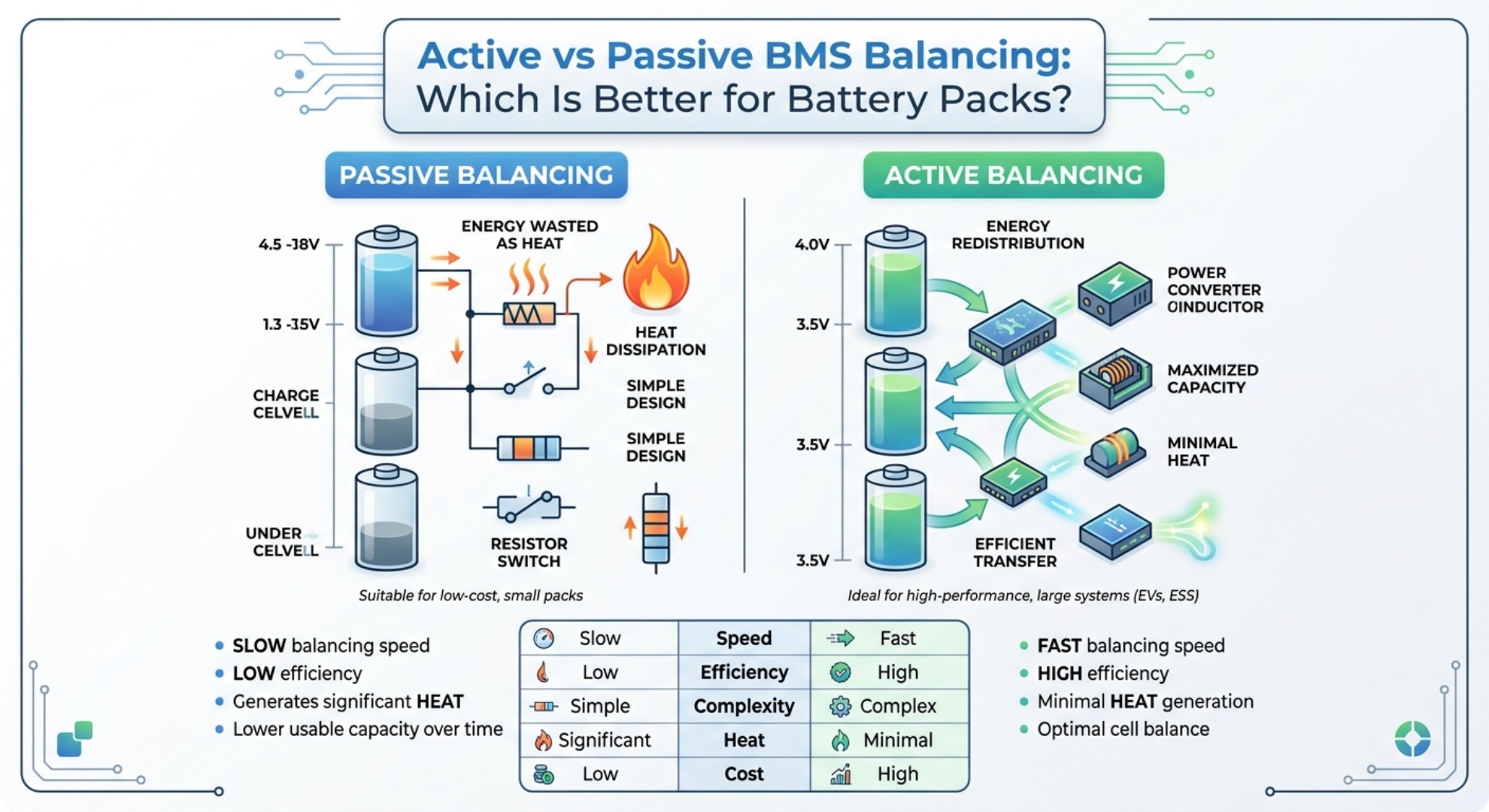
Core Functions Of BMS To Protect Lithium Home Storage Batteries
Every modern lithium home battery includes a Battery Management System (BMS).
The BMS continuously monitors:
- Cell voltage
- Current
- Temperature
- Cell balancing
- Overcharge protection
- Over-discharge protection
- Short-circuit protection
- Communication with the inverter
Without an advanced BMS, even high-quality battery cells cannot achieve optimal safety or long service life.
To learn more about how a BMS protects lithium batteries, read:How BMS Protects Your LFP Battery?
How Battery State Of Health (SoH) Reduces Capacity Over Years
Battery capacity naturally decreases over time.
Instead of focusing only on State of Charge (SoC), homeowners should also understand State of Health (SoH).
While SoC indicates the battery's current charge level, SoH measures how much of the original battery capacity remains after years of use.
| Battery Age | Typical SoH |
|---|---|
| New Battery | 100% |
| After 5 Years | 90–95% |
| After 10 Years | 80–90% |
A battery with an SoH of 85% can no longer deliver its original rated capacity, which is important to consider when estimating long-term backup performance.
For a detailed explanation, read:What Is Battery State of Health (SoH)?
Recommended Home Battery Storage Sizes By Household Type & Energy Use
Choosing the right battery capacity depends on your household's electricity usage, the number of occupants, and your backup requirements.
The table below provides general recommendations for typical residential applications.
| Home Type | Daily Consumption | Recommended Battery | Typical Application |
|---|---|---|---|
| Apartment | 5–8 kWh | 5–10 kWh | Essential backup |
| Small Home | 8–15 kWh | 10 kWh | Evening energy shifting |
| Family Home | 15–25 kWh | 15–20 kWh | Whole-home backup |
| Large Home | 25–40 kWh | 20–30 kWh | High electricity demand |
| Off-Grid Home | 40+ kWh | 30–60 kWh | Full energy independence |
For homeowners using rooftop solar systems, modular LiFePO₄ batteries offer the greatest flexibility. Starting with a 10–15 kWh system and expanding later is often more cost-effective than purchasing excessive capacity upfront.
JM Energy Tech's stackable battery systems are designed for this purpose, allowing additional battery modules to be installed as electricity demand grows.
Breakdown: 5kWh /10kWh /15kWh /20kWh /30kWh+ Battery Use Cases
5 kWh Battery
Best for:
- Apartments
- Vacation homes
- Emergency backup
- Essential household loads
10 kWh Battery
Best for:
- Small families
- Homes with moderate electricity use
- Solar self-consumption
- Evening peak shaving
15 kWh Battery
Best for:
- Average family homes
- Homes with rooftop solar
- Overnight backup
- Increased energy independence
20 kWh Battery
Best for:
- Large households
- Frequent power outages
- Homes with air conditioning
- Hybrid solar systems
30 kWh and Above
Best for:
- Off-grid properties
- Luxury homes
- Electric vehicle charging
- High daily electricity consumption
- Commercial or agricultural applications
Selecting the correct battery size today—and choosing a system that can expand in the future—helps maximize your investment while ensuring reliable backup power for years to come.
Real-World Home Solar Battery Sizing Calculation Examples For All Home Types
Understanding battery sizing becomes much easier when you apply it to real-life scenarios. The following examples demonstrate how to estimate battery capacity for different types of homes and energy needs.

Example 1: Small Apartment Essential Emergency Backup Battery Setup
Household Profile
- 2 occupants
- Daily electricity consumption: 6 kWh
- Backup requirement: Refrigerator, lights, Wi-Fi, TV, and phone charging
- Solar system: 3 kW rooftop solar
Recommended Battery
A 5–10 kWh LiFePO₄ battery is sufficient for this home.
The battery can store excess solar energy during the day and provide enough electricity for essential appliances throughout the evening or during short power outages.
Example 2: Medium Family Home Full Overnight Solar Battery Backup
Household Profile
- 4 occupants
- Daily electricity consumption: 18 kWh
- Backup requirement: Whole-home backup overnight
- Solar system: 8 kW
Recommended Battery
A 15–20 kWh battery system provides an excellent balance between backup performance and cost.
With sufficient daytime solar production, the battery can power the home throughout the evening while reducing electricity purchased from the utility grid.
Example 3: Large EV Home High-Demand Modular LiFePO4 Storage System
Household Profile
- 5 occupants
- Daily electricity consumption: 35 kWh
- Electric vehicle charging
- Two air conditioners
- Heat pump
- 12 kW solar system
Recommended Battery
A 30 kWh or larger modular battery system is recommended.
Because EV charging significantly increases electricity demand, homeowners should also consider future battery expansion.
Choosing an expandable LiFePO₄ battery system allows additional storage capacity to be installed without replacing the original battery.
Simple Formula To Estimate Exact Battery Blackout Runtime Hours
Battery runtime depends on both battery capacity and household power consumption.
The following examples provide approximate backup durations.
| Battery Capacity | Average Household Load | Estimated Backup Time |
|---|---|---|
| 5 kWh | 500 W | Approximately 10 hours |
| 10 kWh | 1 kW | Approximately 10 hours |
| 15 kWh | 1.5 kW | Approximately 10 hours |
| 20 kWh | 2 kW | Approximately 10 hours |
| 30 kWh | 3 kW | Approximately 10 hours |
Actual runtime varies depending on inverter efficiency, battery State of Charge (SoC), battery age, and appliance usage patterns.
If you'd like to learn how long a lithium battery can power your appliances, read:How Long Will a 100Ah LiFePO₄ Battery Last?
Most Common Home Battery Sizing Mistakes Homeowners Need To Avoid
Even experienced homeowners sometimes make mistakes when choosing battery capacity.
Avoiding these common errors can improve system performance while reducing unnecessary costs.
1. Choosing the Lowest-Cost Battery
A smaller battery may save money initially but often cannot provide sufficient backup during outages.
Selecting the right capacity based on actual electricity usage offers much better long-term value.
2. Ignoring Future Electricity Demand
Many households eventually install:
- Electric vehicles
- Heat pumps
- Additional air conditioners
- Swimming pools
- Larger solar arrays
Planning for future expansion today can prevent costly system upgrades later.
3. Confusing kW with kWh
Power (kW) and energy (kWh) are not interchangeable.
A battery may have enough energy capacity but still be unable to power multiple high-wattage appliances simultaneously if its power output is insufficient.
4. Ignoring Depth of Discharge
Comparing battery capacities without considering usable energy often leads to incorrect purchasing decisions.
Always compare usable capacity rather than advertised capacity.
5. Overlooking Battery Quality
Not all lithium batteries are built to the same standard.
Factors such as cell quality, manufacturing consistency, and Battery Management System (BMS) design significantly affect safety and service life.
To learn how battery cell quality influences long-term performance, read:
Battery Cell Quality Grades Explained
6. Prioritizing Capacity Over Safety
Safety should always be considered alongside capacity.
Modern LiFePO₄ batteries offer excellent thermal stability and significantly lower fire risk compared with many other lithium chemistries.
For more information, read:Home Energy Storage Battery Safety Guide
LiFePO4 vs Lead-Acid Batteries: Full Comparison For Residential Energy Storage

While several battery technologies are available, LiFePO₄ has become the preferred choice for residential energy storage.
| Feature | LiFePO₄ | Lead-Acid |
|---|---|---|
| Cycle Life | 6,000+ cycles | 500–1,500 cycles |
| Depth of Discharge | 90–100% | Around 50% |
| Maintenance | Maintenance-free | Regular maintenance |
| Charging Speed | Fast | Slow |
| Energy Density | High | Low |
| Round-Trip Efficiency | 95–98% | 75–85% |
| Weight | Lightweight | Heavy |
| Expected Lifespan | 10–15 years | 3–5 years |
Although LiFePO₄ batteries generally require a higher initial investment, their longer lifespan, greater usable capacity, and lower maintenance requirements usually result in a lower total cost of ownership.
For a more detailed comparison, read:
LiFePO₄ vs Lead Acid: Which Is Better for Solar Power?
Frequently Asked Questions About Sizing Home Solar Battery Storage Systems
What size home battery do I need?
Most homes require between 5 kWh and 20 kWh, depending on electricity usage, backup requirements, and whether the battery supports the entire home or only essential appliances.
Is a 10 kWh battery enough for a house?
For many small and medium-sized homes, a 10 kWh battery provides sufficient energy for evening use and essential backup during short outages.
Can one battery power my entire home?
Yes, if the battery is properly sized. Larger homes may require multiple battery modules connected together to achieve sufficient capacity.
Should I buy a larger battery than I currently need?
If you expect to purchase an electric vehicle, install additional solar panels, or increase electricity usage, choosing an expandable battery system is often the most cost-effective solution.
Does battery capacity decrease over time?
Yes. As batteries age, their State of Health (SoH) gradually declines, reducing available capacity. High-quality LiFePO₄ batteries typically retain around 80% or more of their original capacity after thousands of charge cycles.
Is LiFePO₄ the best battery chemistry for home energy storage?
For most residential applications, yes. LiFePO₄ batteries offer excellent safety, long cycle life, high efficiency, and low maintenance compared with traditional lead-acid batteries.
Can I add more batteries later?
Many modern home battery systems feature modular designs, allowing homeowners to expand storage capacity without replacing the original battery bank.
How long will a home battery last?
A high-quality LiFePO₄ battery typically lasts 10 to 15 years, depending on usage patterns, operating temperature, and maintenance.
Final Recommendations For Selecting A Scalable Home Battery Storage System
Choosing the correct home battery storage system is about much more than selecting the largest available battery. The ideal solution depends on your household's daily electricity consumption, backup expectations, future energy needs, and the quality of the battery system itself.
By carefully evaluating energy usage, appliance loads, backup duration, and battery technology, homeowners can build a storage system that delivers reliable performance while maximizing return on investment.
LiFePO₄ batteries have become the preferred option for modern residential energy storage thanks to their high efficiency, long service life, and excellent safety. Combined with an advanced Battery Management System (BMS) and a modular design, they provide a scalable solution that can grow alongside your household's energy needs.
Whether you're installing your first solar battery or expanding an existing system, investing time in proper battery sizing today will help ensure dependable, cost-effective energy storage for many years to come.
Related Reading
To continue learning about home energy storage, explore these in-depth guides from JM Energy Tech:
- How Does Home Energy Storage Work?
- What Is Battery State of Charge (SoC)?
- What Does Ah Mean on a Battery?
- How Long Will a 100Ah LiFePO₄ Battery Last?
- LiFePO₄ vs Lead Acid: Which Is Better for Solar Power?
- Battery Management System (BMS)
- Depth of Discharge (DoD)
- Battery State of Health (SoH)
- Home Energy Storage Battery Safety Guide
Can You Add a New LiFePO4 to an Existing Battery Bank
Home Energy Storage Battery Safety Guide