


Battery Power kW vs Energy kWh Guide
Battery Power kW vs Energy kWh: Complete Energy Storage Guide

Table of Contents
Battery Power Rating kW vs Energy Capacity kWh Explained
What Is Battery Power Output in Kilowatts (kW)?
In any battery power system, kilowatts (kW) represent the instantaneous rate at which electrical power is delivered or absorbed. Understanding battery power rating kW determines how many heavy electrical loads—such as air conditioners, heat pumps, or electric vehicle chargers—a system can run simultaneously without overloading the electrical inverter.
What Is Usable Energy Storage Capacity in Kilowatt-Hours (kWh)?
Conversely, kilowatt-hours (kWh) measure total usable energy storage capacity over time, defining how long a system can sustain electrical power output. Evaluating battery energy capacity kWh reveals total electrical storage endurance, indicating whether a backup supply can power household loads for six hours or two full days during grid outages.
Plenty of homeowners mix up these two specs when shopping for solar backup systems, and it almost always leads to underwhelming real-world performance. A battery with huge kWh capacity but weak kW output might hold enough energy to last two days, but it won’t be able to run your well pump and air conditioner at the same time without tripping. On the flip side, a high-kW battery with minimal kWh capacity can power half your house at once, but it will die out in just a couple of hours if the grid goes down.
Water Pipe Analogy: kW Power Flow vs kWh Storage Volume

To conceptualize kW vs kWh battery storage, picture a water storage tank connected to a delivery pipe. The width of the pipe reflects the peak electrical power output in kW, controlling how rapidly water flows out at any given moment. Meanwhile, the physical size of the tank represents total battery kilowatt hours, dictating the overall volume of water available before refilling is required.
Here’s how that plays out for a typical home. A 5 kW battery is like a wider pipe that can push out 5 kW of power at any moment — enough to run several large appliances at once. A 10 kWh battery is the tank itself, holding 10 total units of energy. If you’re only pulling 2 kW to keep your lights, fridge, and small devices running, a full 10 kWh battery will last you roughly 5 hours before you need to recharge.
Continuous Power vs Surge Capacity & Battery C-Rate

When evaluating home energy storage systems, consumers must distinguish between continuous power rating and surge power capacity. While continuous kW indicates the steady power output a battery maintains indefinitely under safe thermal conditions, surge capacity represents brief power spikes required to start high-draw motor appliances without tripping system circuit breakers.
Another critical technical metric is the battery C-rate discharge capability, which expresses the ratio between instantaneous power delivery and total stored energy. A high C-rate enables rapid energy discharge for demanding industrial applications, whereas lower C-rate configurations prioritize long-duration energy backup for off-grid power resilience.
Household Load Examples: Continuous vs Surge Power
You can see this gap clearly with everyday household appliances. Your standard full-size fridge only pulls about 150W once it’s running, but its compressor needs a 1,000–1,500W jolt to kick on. A central AC unit might draw 1,500W while cooling steadily, but surge to 4,000–5,000W the second it starts up. If you want reliable whole-home backup, your battery’s surge rating has to cover the biggest simultaneous startup draw from all your motor-driven appliances.
Understanding Battery C-Rate in Practice
Most residential LiFePO4 batteries sit in the 0.5C to 1C discharge range, which strikes a good balance between long cycle life and usable power. For a 10 kWh battery, a 0.5C rating means it can safely put out 5 kW of steady power; bump that to 1C, and it can handle 10 kW nonstop. Industrial and commercial setups sometimes use 2C or higher for fast, heavy discharge, but those batteries tend to lose capacity faster over time — all that high-current flow generates extra heat that wears on the cells.
If you’re sizing a system for a business, warehouse or industrial site, our Commercial & Industrial Battery Storage Sizing Guide breaks down the full workflow for peak shaving, backup power and solar-plus-storage projects.
How to Size kW and kWh for Solar Energy Storage Systems

Accurate energy storage system sizing requires balancing maximum simultaneous power demand against daily household electricity consumption patterns. Designing an efficient solar battery setup ensures that the inverter kW rating satisfies peak appliance surges while the total kWh capacity supplies sufficient overnight energy reserves.
You can work through a simple four-step process to ballpark the right system size for your home:
- Write down every critical appliance you need to run at the same time, add up their steady wattage, then factor in the biggest startup surge load — that’s your minimum kW rating.
- Figure out how many total kWh you use each day during an outage, based on how long you run each essential device.
- Multiply your daily kWh use by how many days of backup you want, then divide by the battery’s usable depth of discharge (usually 80–90% for LiFePO4 models) to get your total required kWh capacity.
- Double-check that your chosen battery’s C-rate can handle your peak kW demand without pushing past its safe operating limits.
For installations in cold climates, safe winter charging practices are critical to avoid permanent cell damage and preserve long-term capacity. We cover all the risks and field-proven fixes in our LiFePO4 Battery Cold Weather Charging: Risks & Safe Solutions guide.
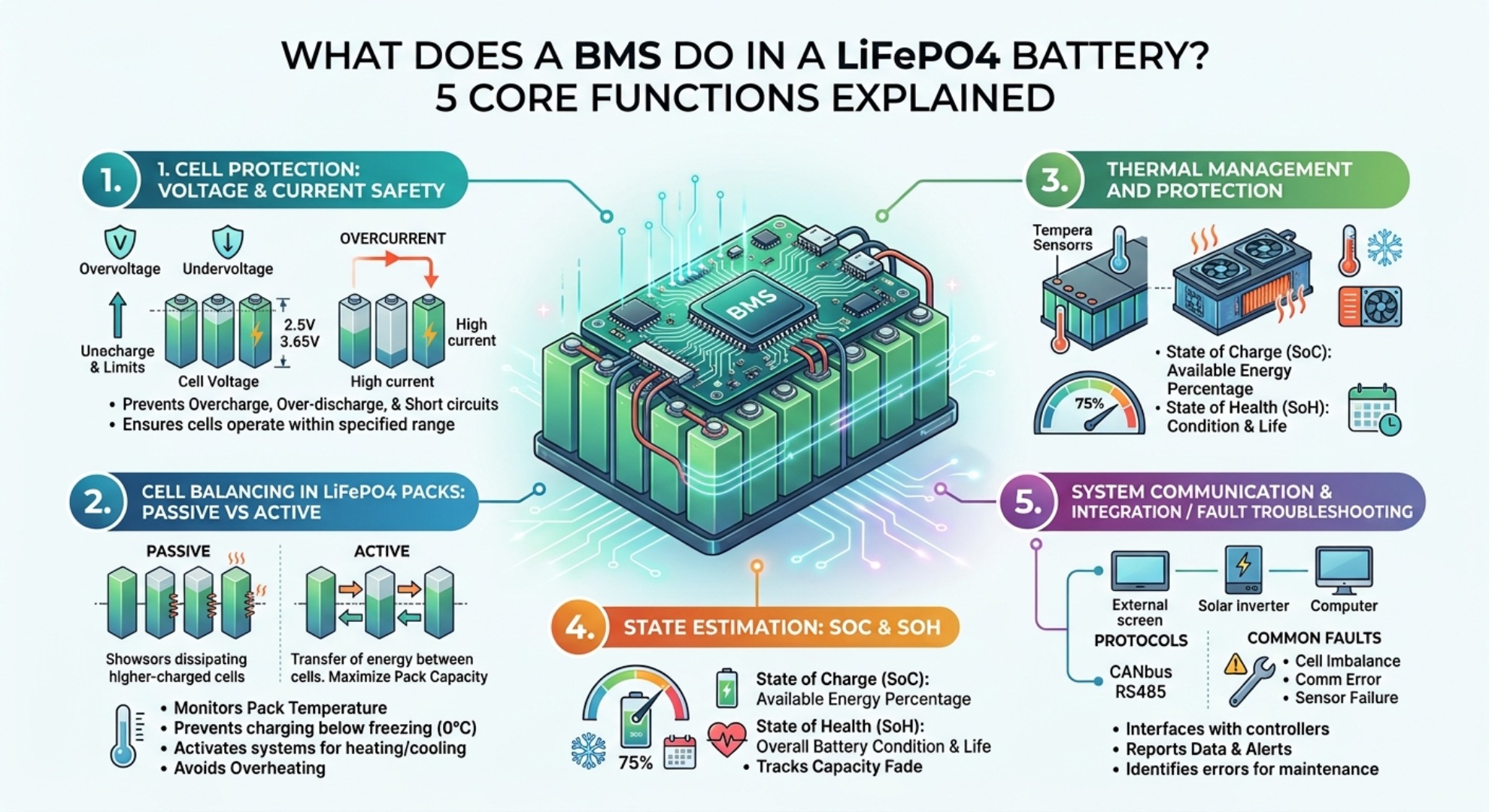
Pairing your battery with a smart, well-calibrated battery management system is also key to mitigating stressors and keeping cells balanced across years of use. You can learn how the two main balancing technologies compare in our Passive vs Active BMS Balancing for LFP Batteries breakdown.
| Storage Parameter | Measurement Unit | Primary Function | Sizing Impact |
|---|---|---|---|
| Power Output | Kilowatts (kW) | Maximum instantaneous load capacity | Dictates appliances run simultaneously |
| Energy Capacity | Kilowatt-hours (kWh) | Total stored energy volume | Determines total hours of backup runtime |
| Discharge Rate | C-Rate (Ratio) | Speed of energy release | Impacts thermal control & cycle life |

Optimizing solar energy storage ROI involves calculating real-world depth of discharge, round-trip efficiency, and battery cycle life expectations. For a complete technical breakdown of how these factors impact long-term battery health, read our LiFePO4 Battery Degradation: Key Factors & Lifespan Extension Guide. Selecting the right combination of kW and kWh prevents undersized systems from shutting down during high demand while avoiding unnecessary capital expenditure on excess energy capacity.
Frequently Asked Questions
kW vs kWh: which one actually matters more for my home?
Short answer: both matter — it just depends on what you’re worried about. If your main frustration is tripping breakers or not being able to run your AC and well pump at the same time, pay closer attention to the kW rating. If you care most about riding out long blackouts without sun, kWh capacity should be your priority. For most homes, you’ll want a good balance of both.
How do I figure out how long my battery will really last?
It’s a pretty straightforward math problem. Take your battery’s usable kWh capacity, divide it by the number of kW you’re drawing at any given time, and you’ll get your estimated runtime in hours. For example, a 10 kWh battery powering 2 kW of essential loads will run for roughly 5 hours. Just keep in mind you’ll lose a little bit to system efficiency along the way.
Is surge power actually that important, or is it just marketing?
It’s absolutely important — skip over it and you’ll be disappointed the first time your fridge kicks on. Any appliance with a motor (fridges, AC units, well pumps, washers) draws 3–5x its normal running power for a split second when it starts up. If your battery’s surge rating can’t handle that spike, it’ll trip even if the continuous kW looks fine on paper.
What’s a normal C-rate for a residential solar battery?
Most home LiFePO4 batteries sit between 0.5C and 1C, and that’s totally fine for everyday use. A 1C battery can put out its full capacity worth of power all at once, which is more than enough for typical household loads. Higher C-rates are out there, but they usually cost more and wear down faster — overkill for most residential setups.
Can I add more kWh later without upgrading my kW output?
With most modular battery systems, yes — you can stack more battery units to increase total storage capacity. But here’s the catch: your inverter (and the battery’s built-in power limits) set the max kW output. Adding more kWh will make your battery last longer, but it won’t let you run more appliances at the same time.
Key Takeaways for kW vs kWh Battery Selection
At the end of the day, kW and kWh answer two very different questions about your battery. kW tells you how many things you can run at once; kWh tells you how long you can run them when the grid goes down or you’re off-grid. Match both numbers to your home’s actual power use and backup needs, and you’ll get a system that performs as expected, avoids unnecessary costs, and delivers reliable power for years to come.
Peak Shaving Battery Storage ROI
Commercial Industrial Battery Storage Sizing Guide