


Can You Add a New LiFePO4 to an Existing Battery Bank
Can You Add a New LiFePO4 to an Existing Battery Bank? Hidden Risks of Voltage Imbalance
Expert lithium battery technical guides from JM Energy Tech: www.jmenergytech.com

Many RV, off-grid solar and residential storage users want to expand their battery capacity by installing a brand-new LiFePO4 battery alongside an old battery pack. This cost-saving idea seems practical at first glance, yet most users overlook hidden chemical and electrical mismatches that shorten battery lifespan and even trigger sudden power failures. This guide breaks down all potential hazards, measurable technical gaps, standardized operation rules and long-term alternative expansion plans for LiFePO4 battery banks.
Table of Contents
- 1. Risks of Mixing Old and New LiFePO4 Batteries
- 2. Internal Resistance & Voltage Imbalance Issues
- 3. Premature BMS Shutdown Risks in Battery Banks
- 4. Safe Ways to Expand Your Existing Battery Bank
- 5. Best Practices for Parallel Battery Connection
- 6. State of Charge (SOC) Balancing Before Wiring
- 7. Long-Term Alternatives for Battery Expansion
1. Risks of Mixing Old and New LiFePO4 Batteries

A large number of RV campers, off-grid cabin owners and solar hobbyists make a widespread critical mistake during battery upgrades: they assume any two lithium iron phosphate batteries can be wired in parallel as long as their nominal voltage matches. This oversimplified logic ignores the core aging characteristics of lithium cells. Every LiFePO4 cell undergoes gradual chemical degradation during repeated charge and discharge cycles, which changes its internal structure, available capacity and electrical performance over time.
A battery that has been in daily use for two years carries completely different electrochemical properties compared to an unopened factory-new battery. When paired together in the same bank, the workload becomes severely unbalanced. The new battery will bear the vast majority of charging current input and discharge load output every single cycle, accelerating its aging speed far beyond its designed service life. Meanwhile, the aged battery will remain underutilized and cannot deliver its full residual capacity, wasting your original investment in the old pack.
If you want to accurately measure the actual degradation level of your aged battery and judge whether it can be matched with new units, check our detailed technical article What is Battery State of Health. This article covers standard testing methods and threshold values for judging usable old batteries.
| Battery Condition | Internal Resistance Level | Typical Completed Charge Cycles | Compatibility for Parallel Connection |
|---|---|---|---|
| Brand New LiFePO4 Battery | Very Low | 0–50 cycles | Only match with other brand-new identical models |
| Used 6–12 Months | Slightly Raised | 50–100 cycles | Theoretically usable under full pre-balancing, high monitoring requirement |
| Used Over 2 Years | High & Unstable | 300+ cycles | Never connect with new batteries; severe imbalance unavoidable |
2. Internal Resistance & Voltage Imbalance Issues
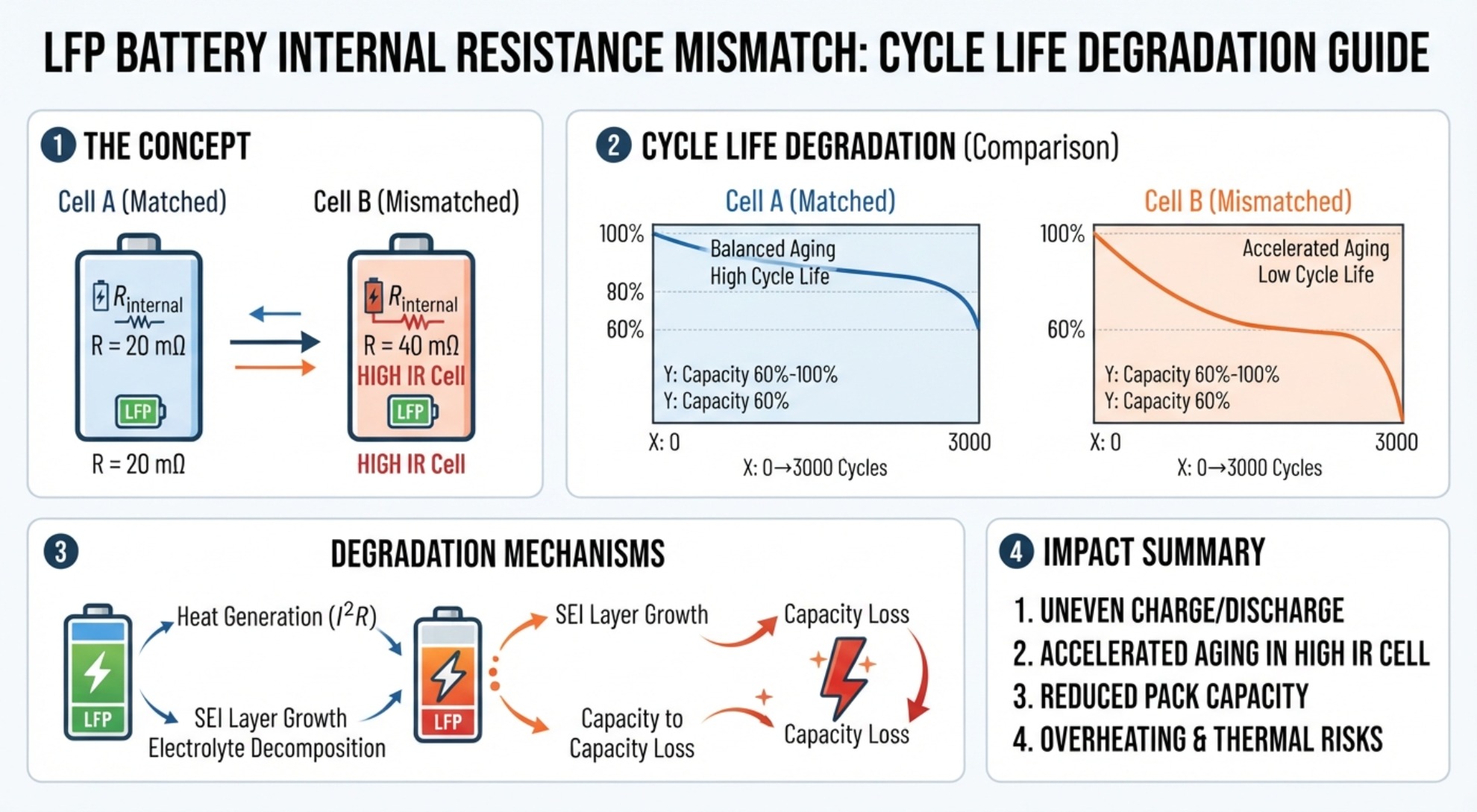
Internal resistance is the core factor that creates uneven power distribution between mixed old and new LiFePO4 batteries. As batteries cycle repeatedly, electrode materials corrode, electrolyte activity declines and tiny conductive layers form inside cells, all of which steadily lift internal resistance. This value directly limits the maximum current each battery can absorb or release efficiently and shortens the overall deep cycle service life of your storage system.
When you wire a low-resistance new battery and high-resistance aged battery in parallel, electric current always follows the path with the least resistance. During heavy power consumption such as running air conditioners, water pumps or high-power inverters, the new battery drains power rapidly to supply most of the load. During solar charging periods, nearly all incoming charging current flows into the new battery, while the old battery receives minimal charging energy and stays permanently undercharged.
This persistent voltage gap between the two batteries will exist every cycle. Over weeks and months, the new battery sustains extreme charge-discharge stress, leading to rapid capacity decay, cell swelling risks and early replacement costs. The old battery will gradually lose its remaining usable capacity from long-term incomplete charging.
3. Premature BMS Shutdown Risks in Battery Banks
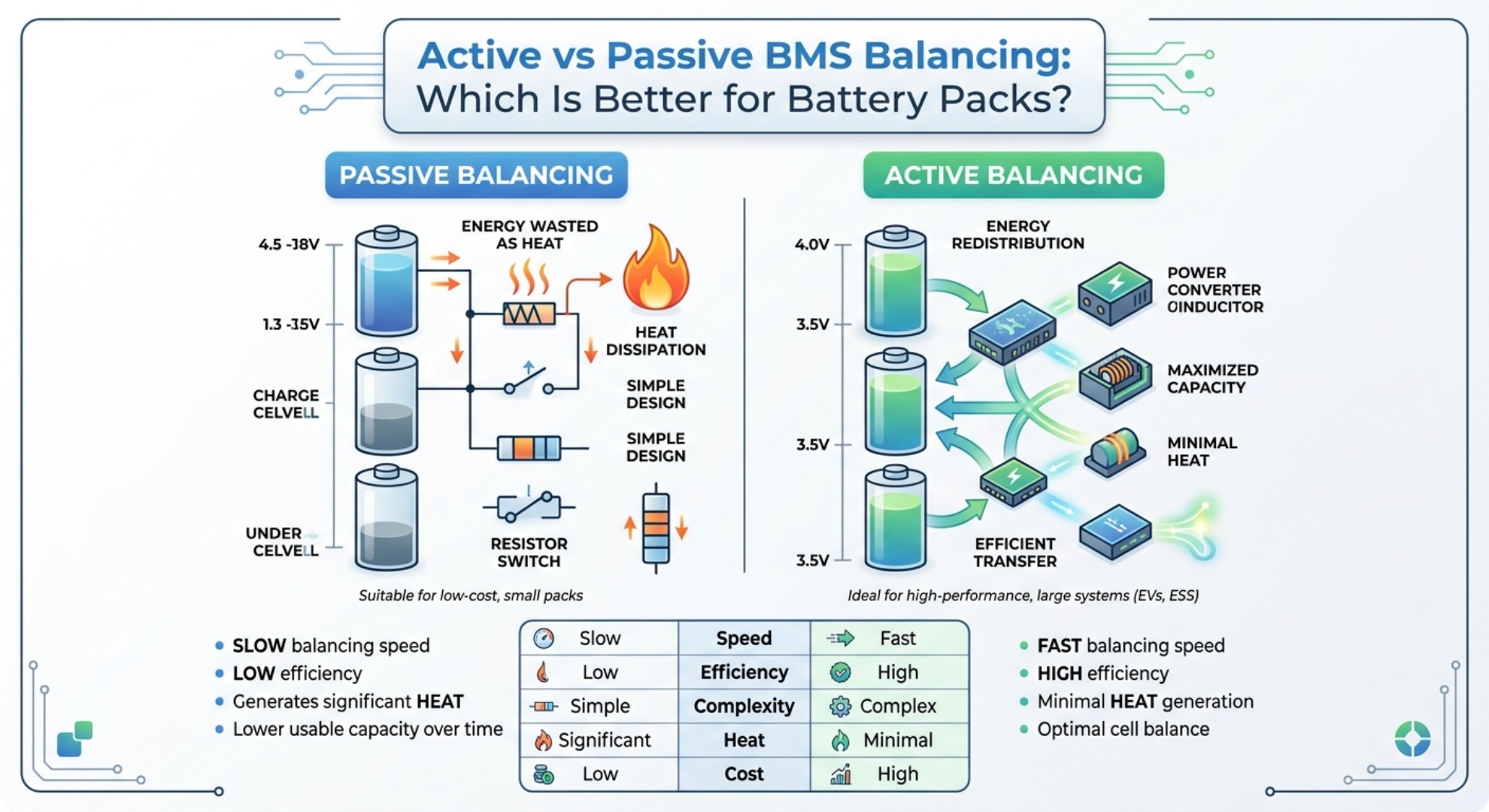
Every reliable LiFePO4 battery integrates a built-in Battery Management System (BMS), which acts as the core safety guard for lithium cells. The BMS continuously monitors single cell voltage, total pack voltage, charging current, discharge current and internal temperature to trigger protection mechanisms including overcharge cut-off, low voltage discharge cut-off, overcurrent protection and overheat shutdown.
In an unbalanced mixed battery bank, the overloaded new battery will hit its low-voltage protection threshold far earlier than the aged battery under heavy load. At this moment, the BMS will instantly disconnect the new battery to stop deep discharge damage. All the entire electrical load of your RV or off-grid system suddenly transfers to the worn, weak old battery in a split second.
The aged battery cannot handle this sudden full load spike, so its own BMS will immediately activate overload protection and cut off power output. The final result is total unexpected power loss for your whole energy system, which can shut down essential equipment like refrigerators, lighting and medical devices without advance notice.
To fully grasp how BMS hardware detects abnormal working status and executes protection logic, read our in-depth technical guide BMS Deep Dive: How It Protects Your LFP Battery.
| BMS Protection Mode | Trigger Reason In Mixed Old & New Battery Bank | Direct System Consequence |
|---|---|---|
| Low Voltage Cutoff | New battery undertakes most discharge load and hits voltage limit first | New battery disconnects; all load shifts to aging battery instantly |
| Discharge Overload Protection | Aged weak battery bears full sudden load independently | Second BMS trips, complete system power blackout |
| Overcharge Protection | New battery absorbs 70%–90% of solar charging current | New battery stops charging early, old battery remains undercharged long-term |
4. Safe Ways to Expand Your Existing Battery Bank
If complete replacement of your whole battery array exceeds your current budget, mixing old and new LiFePO4 batteries is technically achievable, but you must comply with extremely strict preconditions and daily monitoring rules. Professional energy storage technicians follow unified industry standards for temporary mixed battery expansion projects.
The core preconditions for safe temporary mixing are listed below:
- The existing old battery bank must be less than 12 months old, with recorded total charge cycles below 100 times;
- The newly purchased battery must match the old pack in nominal voltage, rated amp-hour capacity and maximum continuous discharge current;
- Both old and new batteries should adopt identical internal cell brands, cell specifications and factory BMS designs to guarantee consistent electrical characteristics;
- Daily voltage monitoring via multimeter or battery monitor is required to track voltage deviation between two packs.

For homeowners building a full residential solar energy storage setup from scratch rather than retrofitting an old battery bank, our step-by-step tutorial How to Size a Home Battery Storage System covers load calculation, capacity matching and future expansion reserve design to avoid mixed battery troubles entirely.
5. Best Practices for Parallel Battery Connection
Standardized parallel wiring rules are non-negotiable if you decide to temporarily connect old and new LiFePO4 batteries together. Any inconsistent wiring layout will introduce extra circuit resistance, further amplify voltage imbalance and accelerate uneven battery degradation. Every detail of cable configuration directly affects current distribution across the entire battery bank.
Two core wiring standards you must follow strictly:
- All interconnection cables between battery terminals need identical length and wire gauge; even a 30cm longer cable creates measurable resistance gaps;
- Main positive and main negative load output cables should connect to opposite ends of the whole battery bank layout, which balances current drawing evenly across every single battery unit.
| Wiring Specification Item | Required Standard Operation | Damage Caused By Non-Standard Wiring |
|---|---|---|
| Interconnect Cable Length | Every connecting wire between batteries uses the exact same length | Additional circuit resistance, uneven current split during charge & discharge |
| Cable Wire Gauge | Uniform wire thickness for all cross-battery links | Partial batteries carry heavier charge/discharge load and wear faster |
| Main Load Terminal Position | Positive and negative main wires mounted on two opposite sides of the battery bank | Batteries near load terminals drain far quicker than batteries at the far end |
6. State of Charge (SOC) Balancing Before Wiring
State of Charge (SOC) represents the real-time remaining power percentage of a lithium battery, and full SOC matching is the mandatory pre-step before linking any separate battery packs in parallel. If you connect two batteries with different SOC levels directly, a massive uncontrolled instantaneous cross-current will surge between terminals the moment contact is made, which poses severe safety risks.
Many amateur installers skip this balancing process out of impatience, which can melt copper terminal lugs, burn internal wiring insulation and create permanent irreversible damage to LiFePO4 cells. The full standardized balancing workflow has three mandatory steps, with strict waiting time requirements.
If you are new to energy storage terminology and confused about SOC definition, measuring methods and real-world impacts on battery matching, start with our beginner-friendly technical post What is Battery SOC.
| SOC Balancing Step | Detailed Operation Requirements | Core Safety & Performance Purpose |
|---|---|---|
| Independent Full Charging | Charge each battery separately to full 100% LiFePO4 voltage using a dedicated lithium charger, no parallel charging allowed | Eliminate initial SOC gaps between old and new battery packs |
| Voltage Stabilization Rest Period | Leave batteries standing without any load or charging input for a minimum of 12 consecutive hours | Allow floating open-circuit voltage to stabilize naturally after full charging |
| Multimeter Voltage Verification | Measure open-circuit voltage of each battery; voltage difference must be controlled within 0.1V before connection | Prevent destructive high surge cross-current when terminals connect together |
7. Long-Term Alternatives for Battery Expansion
If you want to avoid recurring voltage imbalance troubles, frequent battery monitoring and premature pack replacement costs, you should design your solar energy storage system with reserved expansion capacity from the initial planning phase. Mixing aged and new LiFePO4 batteries is only a temporary makeshift solution, not a reliable long-term storage strategy for off-grid, RV or residential solar systems.
Two far safer, more economical permanent expansion solutions are available for users with long-term power demand:
- Replace the entire old battery bank with one single higher-capacity LiFePO4 battery pack. This eliminates all imbalance risks completely, delivers consistent cycle performance and reduces long-term maintenance costs significantly;
- Run the original aged battery bank and newly purchased battery pack on two fully independent circuits, equipped with separate isolated solar charge controllers and inverter channels. The two battery sets never electrically connect, so there is no cross-current or imbalance issue at all.
These two schemes remove all hidden safety hazards caused by mismatched battery aging degrees, guarantee stable power supply year-round and extend the service life of both old and new battery equipment to their full rated lifespan.
| Battery Expansion Scheme | Overall Safety Rating | Long-Term Economic Performance | Best Applicable Usage Scenarios |
|---|---|---|---|
| Temporarily mix old + new LiFePO4 batteries | Low (only qualified under strict preconditions) | Poor; new battery suffers accelerated wear and early failure | Short-term emergency capacity upgrade with tight budget limits |
| Single high-capacity new battery full replacement | Highest safety level | Excellent; balanced full cycle life with minimal maintenance | Home residential solar storage, long-term off-grid cabins, permanent RV setups |
| Dual isolated independent battery circuits | High safety level | Good; no cross interference between old and new packs | Old battery still retains more than 70% residual usable capacity |
LiFePO4 Battery Not Charging: 7 Main Causes, Troubleshooting & Fixes
How to Size a Home Battery Storage System